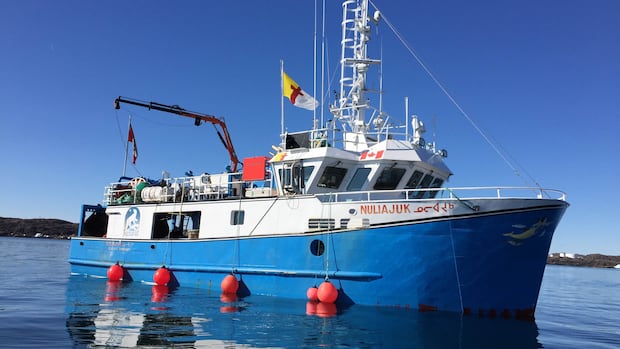
NorthThe Department of Fisheries and Oceans Canada (DFO) is looking at reissuing fishing licences off Nunavut’s coast to non-Inuit operations, despite a federal court judge saying the initial decision by Ottawa was unreasonable. Qikiqtani Inuit Organization says it’s extremely disappointed by DFO’s recommendationsSamuel Wat · CBC News · Posted: Dec 05, 2025 2:14 PM EST | Last Updated: December 5Listen to this articleEstimated 4 minutesThe audio version of this article is generated by text-to-speech, a technology based on artificial intelligence.A government of Nunavut fishery boat. Fisheries and Oceans Canada is proposing to reissue fishing licences off Nunavut’s coast to non-Inuit operations. Last year, a federal court judge said the initial decision to do so was unreasonable. (Sima Sahar Zerehi/CBC)The Qikiqtani Inuit Assocation says it’s “extremely disappointed” the Department of Fisheries and Oceans Canada (DFO) is looking to reissue fishing licences off Nunavut’s coast to non-Inuit operations.That decision from DFO was made despite a federal court judge saying the initial decision by Ottawa was unreasonable. In a news release Friday, DFO said that proposal is based on the department’s “preliminary analysis.” DFO did not state the contents of that analysis.In 2021, then DFO minister Bernadette Jordan reissued fishing licences to a coalition of seven Mi’kmaq First Nations, as part of the sale of Clearwater Foods to FNC Quota.Nunavut Tunngavik Inc. (NTI) and the Qikiqtani Inuit Association (QIA) filed a lawsuit over that decision.That’s because the sale would have given Nunavut Inuit a window to acquire those fishing licences, which predominantly involve the harvest of Greenland halibut (turbot) and shrimp. But Jordan transferred the licences to the Mi’kmaq coalition, which bought 50 per cent of Clearwater Foods, which called itself Atlantic Canada’s largest fishing company. The two Nunavut Inuit organizations argue the minister failed to consider provisions under Article 15 of the Nunavut Agreement, which states the federal government should give “special consideration” when allocating commercial fishing licences, based on the adjacency and economic dependence of communities. That means local Nunavut communities should benefit from local resources.But in an April 2024 decision, Federal Court Justice Paul Favel said Jordan’s decision in 2021 failed to meet the special considerations of Nunavut. DFO declined an interview with CBC News, but the news release stated the redetermination process is being done in a “transparent and fair process that enables the parties to put forward all relevant information and views,” while also taking into consideration the Nunavut Agreement.The Northwest Atlantic Fisheries Organization uses this map to divide fishing zones. Nunavut Inuit are fighting to have a larger share of halibut and shrimp quotas in Zones 0A and 0B, off the coast of Baffin Island. (Fisheries and Oceans Canada)Recommendations undercut Nunavut’s economyIn a statement to CBC News, Clearwater Seafoods said the transfer of the licences is widely celebrated as a model of economic reconciliation. “The report confirms the validity of the transfer of these licences and protects the significant, landmark investment of the Mi’kmaq as they take their rightful place within the Canadian fishing industry,” the statement reads.QIA said they have fought for decades alongside NTI to “address systemic Inuit exclusion from commercial fishing opportunities in Nunavut adjacent waters”. “Rather than chart a path toward equity, DFO’s latest recommendations simply maintain the status quo — allowing access to commercial fisheries to remain in non-Nunavut control and undercutting Nunavut’s economy and Inuit economic well-being for yet another generation,” QIA wrote in a statement.In a document released in 2023, QIA called the fishery in Nunavut an “underdeveloped pillar of the Nunavut economy”, however, it argued the federal government has failed to fairly distribute commercial fishing licences in Nunavut’s adjacent waters, as required by the Nunavut Agreement. As a result, QIA said Nunavut interests only hold around 52 per cent of the quota in adjacent waters, compared to other jurisdictions like British Columbia and Newfoundland which hold around 80 to 90 per cent.QIA estimated between 1993 and 2022, Nunavut Inuit have lost approximately $1 billion in economic benefits and opportunities. While the redetermination process is ongoing, DFO said the three affected fishing licenses remain valid under the name FNC Quota. They can be fished in accordance with their terms, until the minister makes her final decision on the redetermination process. The parties have until Jan. 9 to respond to DFO’s preliminary analysis, before the department puts forward its final recommendation to the minister. ABOUT THE AUTHORSamuel Wat is a senior writer for CBC North, based in Yellowknife. He has worked as a producer and reporter with CBC in Iqaluit and Ottawa, and for public and state broadcasters in New Zealand before that. You can reach him at samuel.wat@cbc.ca
Canada proposes keeping Nunavut fishing licences with non-Inuit organization