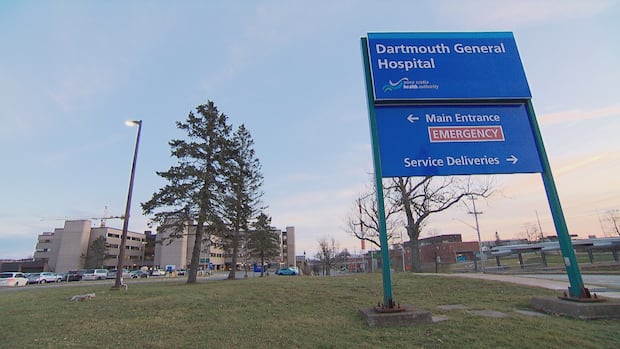
Nova Scotia·NewA senior couple from Richmond County, Cape Breton, say Nova Scotia’s public trustee office spent the wife’s funds on questionable items while she was in Dartmouth General Hospital due to dementia, but the public trustee says decisions were made in concert with a family member.Wilfred Landry says controls on funds for incidentals open to possible abuseTom Ayers · CBC News · Posted: Dec 01, 2025 5:00 AM EST | Last Updated: 43 minutes agoListen to this articleEstimated 5 minutesThe audio version of this article is generated by text-to-speech, a technology based on artificial intelligence.A Cape Breton man says his wife’s money was spent on questionable items after Nova Scotia’s public trustee took control of her finances while she was in Dartmouth General Hospital with dementia. (Steve Berry/CBC )A Cape Breton man is crying foul over the handling of his wife’s finances after Nova Scotia’s public trustee took control of her estate.He says records show a history of questionable spending amounting to thousands of dollars, but the provincial trustee, who looks after the affairs of some of the province’s most vulnerable citizens, says its office generally relies on family members to make decisions on behalf of a client.Wilfred Landry and his wife Joan were separated when she was admitted to the Dartmouth General Hospital in 2016.Joan had been diagnosed with dementia and was declared incompetent while in hospital.Landry, 74, said after the public trustee’s office took over his wife’s finances, they spent Joan’s money with little or no oversight.”It shows in the paperwork that a lot of the money was being misused,” he said.Over Joan’s nearly two-year hospital stay, receipts from her hospital account that were provided to Landry show regular cash deposits from the public trustee and numerous withdrawals with vague descriptions.Wilfred Landry says he was especially upset after discovering a social worker spent $300 of Joan’s money on pizza and party decorations near the end of her hospital stay. (Tom Ayers/CBC)The deposits began at $660 a month, but were later increased to $1,360.Receipts occasionally list “cigs” at $120 and TV at $300, but one lists “cigs and TV” combined at $500. Another just says miscellaneous $100.One month, $60 was spent on “snacks” and about two weeks later, $40 was taken for “treats” with no explanation for the difference.Pizza party ‘unreal’In one instance, $400 was spent on “rec therapy” and in another entry, “15×20 rec” amounted to $300.Near the end of the hospital stay, a social worker spent $300 of Joan’s money on pizza and party decorations.Landry was especially upset by that one, questioning the cost and the need for a pizza party at all.”It’s unreal as to the money that was spent for a couple of pizzas and a few decorations that you could have probably spent the maximum $20 on,” he said.Round numbers questionedAll of the hospital financial records are titled “Nova Scotia Health Authority patient valuables receipt” and above the amounts they say “Description – be specific.” Landry says the receipts were anything but.The dollar amounts are all round numbers, but there is no indication of the actual cost or what was done with the leftover change, if any.The amounts are initialled in the column listed “patient” by a social worker employed by the hospital and initialled by someone else from the hospital’s business office under “cashier.”Landry says receipts from Joan’s stay in the Dartmouth General Hospital show deposit and withdrawal descriptions were anything but specific, despite instructions on the hospital forms. (CBC)Nova Scotia Health spokesperson Brendan Elliott said those forms are used to account for patient funds for incidentals.In an email, he said transactions are handled in a few different ways, depending on the patient’s mental and physical condition.”In many cases, the cash is provided directly to the patient for their own use (e.g., snacks, small purchases or gifts for visitors),” Elliott said.”In other cases, the social worker makes the purchase on the patient’s behalf, provides the receipt, and is reimbursed the exact amount.”If a round figure is withdrawn and there is change leftover, it is typically returned to the patient rather than being deposited back into the account, Elliott said.The receipts occasionally show money returned to Joan’s account, but for the most part no reason is given.Nova Scotia’s public trustee manages financial and life decisions for those unable to do that for themselves, such as people with mental or other challenges, children with no family guardian, or people who die without a will or are missing.Nova Scotia public trustee Shannon Ingraham-Christie says when a clients’ money is spent in hospital, it’s done under the authority of a substitute decision maker, who is often a family member. (Robert Short/CBC)In an email, Shannon Ingraham-Christie, deputy head of the public trustee’s office, said she’s unable to comment on a client’s file.But generally, she said, when a clients’ money is spent in hospital, it’s done under the authority of a family member designated as a substitute decision maker.Landry said he does not know who that family member was, but it was not him and in any case, the hospital receipts were initialled by a social worker, not a family member.Trustee says ledgers are reviewedIngraham-Christie also said when a patient is discharged from hospital, the trustee’s office requests the ledger for the patient’s hospital account to ensure it balances.”If something does not look right on the ledger, we confer with the substitute decision maker,” she said.Public trustee to file missing annual reportsAnyone with complaints about the public trustee’s work can contact the Nova Scotia ombudsman’s office, Ingraham-Christie said.Landry has since been allowed to make health decisions for his wife, but the public trustee has said he’ll need a lawyer if he wants to regain control over Joan’s finances.Landry said he can’t afford a lawyer and was unaware he could complain to the provincial ombudsman.In an email, the ombudsman’s office said it has looked into 33 complaints about the public trustee’s office in the past 10 years, including five this year.The office does not release details of its cases, but it said all of those complaints have been resolved.MORE TOP STORIESABOUT THE AUTHORTom Ayers has been a reporter and editor for 39 years. He has spent the last 21 covering Cape Breton and Nova Scotia stories. You can reach him at tom.ayers@cbc.ca.
Cape Breton man claims public trustee misused wife’s hospital account