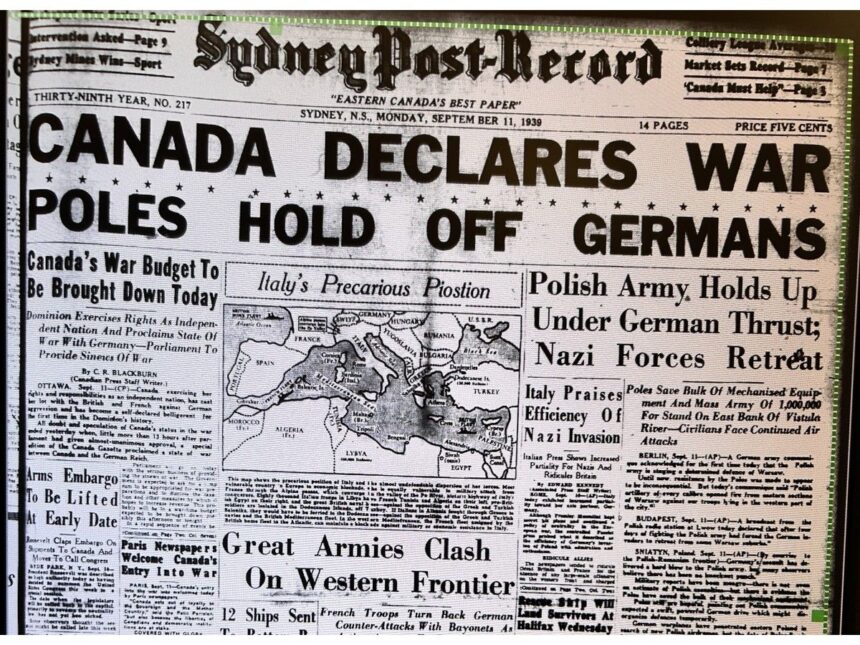
A day after Canada declared war against Germany, the news was published in the front page of the Sydney Post-Record in its Sept. 11, 1939, edition. David Johnson, president of the Old Sydney Society, will speak on several archived newspaper front pages describing the war overseas and its local impacts on Cape Breton residents during his lecture on Oct. 22. Photo by DAVID JOHNSON /SUPPLIEDArticle contentCape Breton’s involvement in the Second World War is apparent in hindsight, but what information were residents privy to when the war was on their newspaper’s front page?THIS CONTENT IS RESERVED FOR SUBSCRIBERS ONLY.Subscribe now to access this story and more:Unlimited access to the website and appExclusive access to premium content, newsletters and podcastsFull access to the e-Edition app, an electronic replica of the print edition that you can share, download and comment onEnjoy insights and behind-the-scenes analysis from our award-winning journalistsSupport local journalists and the next generation of journalistsSUBSCRIBE TO UNLOCK MORE ARTICLES.Subscribe or sign in to your account to continue your reading experience.Unlimited access to the website and appExclusive access to premium content, newsletters and podcastsFull access to the e-Edition app, an electronic replica of the print edition that you can share, download and comment onEnjoy insights and behind-the-scenes analysis from our award-winning journalistsSupport local journalists and the next generation of journalistsRegister to unlock more articles.Create an account or sign in to continue your reading experience.Access additional stories every monthShare your thoughts and join the conversation in our commenting communityGet email updates from your favourite authorsSign In or Create an AccountorArticle contentArticle contentAn upcoming lecture from David Johnson, the president of the Old Sydney Society and a political science professor at Cape Breton University, will show precisely what local front-page news headlines of the day said about the war effort. The talk is titled The Sydney Post-Record Goes to War.Article contentArticle content“I had an idea of looking at key days in the Second World War,” said Johnson. “To see how those days were reported in the front page of the Sydney Post-Record.”Article contentThe Sydney Post-Record is a predecessor of the modern Cape Breton Post, published under that name until Nov. 19, 1947. The Post-Record covered much of the news coming out of the wartime fronts, of particular interest to readers whose lives had been dramatically altered by battles overseas and in the Atlantic.Article contentThis extends from the first days of Canada’s involvement, declaring war against Nazi Germany on Sept. 10, 1939, all the way to D-Day, June 6, 1944, when the Allied Forces stormed Normandy, France. The Post-Record also covers preceding events, the end of the war in 1945, and what happened in its wake.Article content With news reports of D-Day coming through in the middle of the night on June 5 and June 6, 1944, reporters and editors at the Sydney Post-Record managed to roll out a morning edition with news of the invasion. According to David Johnson, June 6 marks the only day during the war when the Sydney Post-Record published two editions on the same day. Photo by DAVID JOHNSON /SUPPLIEDArticle contentKEY HEADLINESArticle contentMany of these newspapers are archived at the Beaton Institute at Cape Breton University. In his research for this topic, Johnson perused several years worth of digitized newspapers, investigating their front pages and flipping through to see what each edition covered.Article contentArticle content“I have about 18 or so key days during the war that have some interest to people in Cape Breton,” said Johnson. “I’m looking at, you know, what’s the headline? What’s the key headline on that day?”Article contentArticle contentJohnson will go through the wartime front-pages chronologically, but it won’t all be major events that attendees will know the dates of. Some will be specific to Sydney and the impact it had in the war as an essential port, as well as stories of some of the Cape Bretoners who went overseas.Article contentEven so, the major events are still interesting in the information they reveal — and what information is missing.Article contentSpeaking on the front-page paper for D-Day, Johnson said, “It’s the first time people see and hear that the invasion has happened, and it seems successful. News reports are saying the Americans and British, and then people come to find out the Canadians are involved in it. They don’t know exactly how, but the Canadians are mentioned.Article content“The next day, we find out that the Canadians were actually on a separate beach,” he continued. “Canadians had a beach that they had to take, so this is the first news of Juno Beach.”
CBU prof speaks on how Second World War was reported in Cape Breton