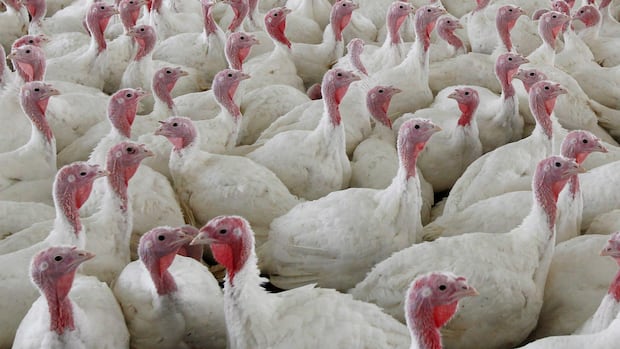
LondonAs the number of birds culled due to an avian flu outbreak on turkey farms near Strathroy, Ont., approaches 100,000, the Canadian Food Inspection Agency says they won’t provide staff for media interviews for fear they will be subject of harassment, or death threats. CFIA says staff have been subject to threats since B.C. ostrich cullAndrew Lupton · CBC News · Posted: Dec 03, 2025 4:00 AM EST | Last Updated: 11 hours agoListen to this articleEstimated 4 minutesThe audio version of this article is generated by text-to-speech, a technology based on artificial intelligence.FILE – Turkeys at a farm in Lebanon, Pa. in April 2012. (AP Photo/Matt Rourke)As the number of birds culled in an avian flu outbreak on turkey farms near Strathroy, Ont., approaches 100,000, the Canadian Food Inspection Agency (CFIA) says it won’t let its staff do media interviews for fear they will be subject to harassment or even death threats. 4 poultry farms in southwestern Ontario hit with avian flu resulting in 63k birds culled so farAbout 95,000 birds have been affected at five different turkey farms in the area where an outbreak began on Nov. 26, the CFIA says. A control zone has been set up to limit new infections. The number of birds affected at each of the five affected sites ranges from 15,200 to 33,000. The CFIA says it cannot provide information about specific farms due to privacy reasons. One expert calls it “problematic,” saying the public is missing vital information during an outbreak.Spokespeople threatened, CFIA saysThe CFIA also isn’t providing a spokesperson for media interviews. The agency said that since it culled just over 300 ostriches after an avian flu outbreak at a farm in B.C. last month, staff have been harassed and sent death threats. “In the current climate, any CFIA employee who is publicly identified in relation to our avian influenza response (regardless if they are in B.C. or Ontario) immediately becomes the target of harassment, including death threats, from individuals opposed to the CFIA’s eradication policy in British Columbia at the Universal Ostrich Farm,” the agency said in a statement to CBC News. University of Ottawa professor Daniel Stockemer says it’s unfortunate that threats would lead to the media’s access being limited during an outbreak. “It’s very problematic,” said Stockemer, who researches extremist groups. “What people want from the government is extreme transparency. And so now they get threatened and they don’t deliver this transparency? This can feed into more people distrusting the government. That’s not the way to fight disinformation.” The Feather Board Command Centre (FBCC), which co-ordinates the Ontario poultry industry’s response to avian disease outbreaks, has not responded to a request for an interview with CBC News. Avian flu a serious threat to humans, academic saysShayan Sharif, an immunology professor at the University of Guelph’s Ontario Veterinary College, has studied avian flu for more than 20 years. He says the virus represents a potential threat to humans because it’s highly infectious, can mutate quickly and has a demonstrated ability to cross species.WATCH | What’s the potential for avian flu to infect humans?:What’s the potential for avian flu to infect humans — and can we handle it?A housecat has died in the United States after eating raw pet food and contracting H5N1 bird flu. Epidemiologist Dr. Christopher Labos tells CBC News the risk of any individual pet getting avian flu is still low, but what is concerning is the easier it becomes for it to infect different types of animals, ‘the easier it will ultimately become for this virus to infect humans.’ “It has been able to hitch-hike with migratory birds,” said Sharif. “And then at the same time, it’s actually been able to infect a lot of different kinds of species … over 300 different species of birds and over 40 species of mammals.”Last year, a 13-year-old girl in B.C. contracted avian flu, the first human case of the virus recorded in Canada. She was in critical condition but was discharged after spending weeks in hospital. People infected can have symptoms similar to seasonal influenza, though it can also be life-threatening in serious cases. “These viruses undergo a lot of mutations,” said Sharif. “In one poultry barn, when the virus enters, it has a certain kind of genetic structure. By the time it’s done with that poultry barn, it might actually have a very different genetic structure.” Sharif says right now the risk for human-to-human transmission is low, but that could change.”Then we’re going to be facing a virus that I would say … certainly has a pandemic potential in it,” he said. “That’s really what we need to avoid.” Sharif says culling birds creates a considerable hardship to the poultry industry, but it’s “one of the major tools we have” in controlling outbreaks. He also pointed to progress in developing vaccines, both for people and for birds. Earlier this year, the Public Health Agency of Canada bought 500,000 doses of a human vaccine to protect against avian influenza for those most at risk.ABOUT THE AUTHORAndrew Lupton is a reporter with CBC News in London, Ont., where he covers everything from courts to City Hall. He previously was with CBC Toronto. You can read his work online or listen to his stories on London Morning.
CFIA says death threats since B.C. ostrich cull reason it wont do interviews on Ontario avian flu outbreak