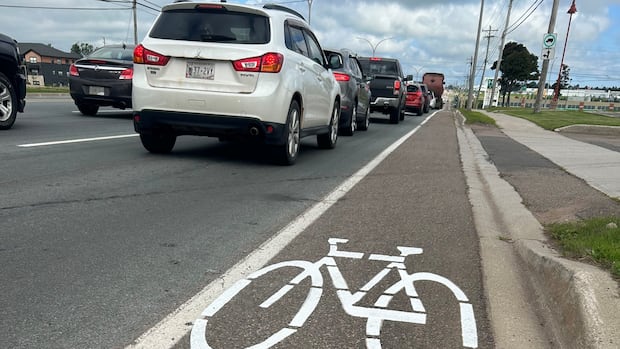
PEI·NewThe City of Charlottetown has adopted a new active transportation plan aimed at better connecting walking and cycling routes across the capital, and improving safety for everyone who uses them.City to roll out upgrades over next 10 to 15 yearsThinh Nguyen · CBC News · Posted: Dec 11, 2025 5:00 AM EST | Last Updated: 28 minutes agoListen to this articleEstimated 5 minutesThe audio version of this article is generated by text-to-speech, a technology based on artificial intelligence.New active transportation plan aims to make Charlottetown less car-dependentThe City of Charlottetown has adopted a new active transportation plan that aims to make is safer for pedestrians and cyclists to get around. Advocates and officials say building the infrastructure will make it easier for people to get around without a car, which will help residents stay healthy and ease congestion on city streets. CBC’s Connor Lamont has more. The City of Charlottetown has adopted a new active transportation plan aimed at better connecting walking and cycling routes across the capital, and improving safety for everyone who uses them.Anna Keenan, the city’s sustainable transportation officer, said the plan is a long-term project that will unfold in stages.“We’re going to have some projects that are getting going, you know, in the next few months, we’ll be starting planning for construction for next year,” Keenan told CBC’s Island Morning.“For full implementation of this plan, there’ll be construction every year for the next 10 to 15 years to really complete a network.”Strengths and gapsKeenan said the current network has some strong foundations, but also gaps that the plan aims to fix.One of the biggest strengths, she said, is the Confederation Trail, which functions as a multi-use route for both cyclists and pedestrians. Another is the active transportation path, completed in 2023 and now named the Josh Underhay Way, which was built along Charlottetown’s arterial highway. But when it comes to connections into downtown and residential neighbourhoods, Keenan said “that’s where we’ve been weak.”Keenan said the last active transportation plan for the capital region emphasized links between Charlottetown and surrounding communities, including Cornwall and Stratford. Those connections are now in place, but how they meet city streets remains an issue.The active transportation path built along Charlottetown’s arterial highway, shown in this file photo from its completion in 2023, is now named the Josh Underhay Way. (Shane Hennessey/CBC)“You’ve got these paths, but then they just sort of spit people out onto… traffic-heavy roads,” she said. “We want to make sure that cycling is a safe choice for everyone to have complete journeys, and that includes kids who are cycling to school on the bike bus, for example.”Jordan Bober, executive director of Cycling P.E.I., is in favour of the plan. He said the challenge will be to keep the momentum going over the next decade, since the city hasn’t adopted a budget to ensure the plan is implemented long term. But if all goes well, Bober said Charlottetown has the potential to be a “highly bikeable city.” “We really don’t have an interconnected network. We’ve made a lot of progress in terms of bike lanes,” he said. “But other than that, if people want to get efficiently from one part of the city to the other, it’s hard to do that… on bike-safe routes. “It should be as easy, if not easier… to hop on a bike and go somewhere as it is to take a car.” New standards, safer routesKeenan said the new plan sets updated technical standards based on national and international best practices.For example, she noted that many drivers will be familiar with the painted bike lanes on streets such as North River Road, University Avenue and St. Peters Road. Those lanes were added a number of years ago, but no longer meet modern safety standards.Current standards, such as those used for painted bike lanes on major roads, no longer meet modern safety needs because they place vulnerable cyclists next to high volumes of high-speed traffic, Keenan says. (Laura Meader/CBC)”They’re putting a very vulnerable road user, a cyclist, right next to quite high volumes of quite high-speed traffic,” she said.“If we’re building a cycling facility on a major road like that, it will have to be separated and protected, so above the curb and with some horizontal separation, and we would only consider painted bike lanes or even mixed traffic [on] slow streets in very low motor vehicle traffic volume.”One of the more complex projects ahead is University Avenue. Keenan said changes there will require discussions with the federal government and talks with Maritime Electric about the possibility of relocating utility poles.She said that work is currently planned for 2027. “It’s just going to take a little bit more planning to make it happen,” Keenan said. “That is still very much part of this complete active transportation network vision that we’re working towards.”Early projects coming soonKeenan said design work on the active transportation plan is underway this winter. Part of her job is to move from broad five-year priorities to concrete one- and two-year projects, so residents will begin seeing changes soon.One of the first projects will be Spencer Drive, which will be reconstructed next season to connect with existing active transportation paths between Charlottetown and Cornwall. It’s about providing more options for people to get around… during that beautiful part of the year when people want to be outside.- Anna Keenan, City of CharlottetownA section of land beside Capital Drive needs to be planned and completed as a multi-use path, she said. Work can also be done in areas such as Nassau Street, Belvedere Avenue and Maple Avenue.“We’re going to be consulting the community every step of the way. We know that we have to accommodate drivers, we have to accommodate transit, big freight trucks [and we] also need to accommodate pedestrians and cyclists,” Keenan said.“It’s about providing more options for people to get around, especially tourists, in our very traffic-heavy tourism season, during that beautiful part of the year when people want to be outside.”ABOUT THE AUTHORThinh Nguyen is a digital reporter with CBC P.E.I. He can be reached at thinh.duc.nguyen@cbc.caFollow Thinh Nguyen on XWith files from Island Morning and Connor Lamont
Charlottetown adopts new plan to make streets safer for cyclists and pedestrians