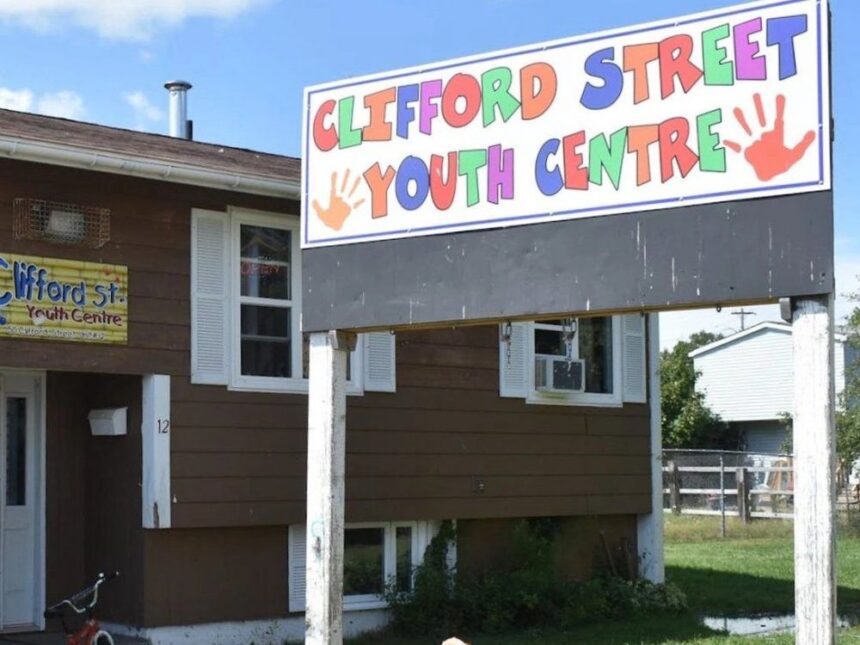
Article contentCHILD POVERTY RATESArticle contentAbout 40 per cent of the Cape Breton Regional Municipality is living with child poverty in their communities, Ratchford said. That would make that an increase from 2022’s rate of 32.4 per cent, according to statistics provided by the Canadian Centre for Policy Alternatives 2024 Report Card on Child and Family Poverty in Nova Scotia, released last year.Article content“And of that, probably 50 per cent or more of our kids (in the Northside area) are in some form of poverty,” he said.Article content“In some cases, they’re living with their grandparents because a parent may have issues with mental health, alcoholism or other chemical-related issues. Or they’re living with other family members. We also have kids who come to us who have no parents at all.”Article contentBy keeping the facility open, crime rates can drop — as much as by 90 per cent, Ratchford said.Article contentArticle content Clifford Street Youth Centre, shown in 2018 with its outdoor signage, has been in operation since 2009. Photo by CAPE BRETON POST FILEArticle contentSTUDENTS’ EXPERIENCESArticle contentAaralyn Oxner of North Sydney volunteers with the centre as part of her Nova Scotia Community College program work placement. To her, the facility offers “a safe haven” for a lot of kids.Article content“I find on the Northside, there’s a lot of poverty, there’s a lot of drug addiction, and it’s these kids, parents who sometimes go through it,” said Oxner, 19. “So they do need a safe haven. They need someone they can trust — in a place they can trust and go to when they need it. If they don’t have it, what do they have?”Article contentMiranda Hawley, 17, a Memorial High School student who has been coming to the Clifford Street Youth Centre since the age of four, said she considers the facility a second home, and a safe place amid an area filled with social housing and other unpleasantries.Article content“This area was used as a drug place. Multiple accidents happened here; there have been crimes, homicides, suicides, overdoses — a lot of traumatic experiences,” she said.Article contentArticle content“So by coming here, it stopped the kids, including me, from seeing a lot of that, which was really good.”Article contentHawley, who was just accepted into Cape Breton University, hopes to one day become a teacher. Oxner aspires to be a social worker.Article content“We need our kids who come here to aspire,” Ratchford said. “We’re trying to inspire kids younger to be all they can be and fulfil their goals.”Article content CBRM District 2 Coun. Earlene MacMullin: “We’re willing to go to the table and meet with other levels of government … to see what we can do.” Photo by IAN NATHANSON/CAPE BRETON POST FILEArticle contentEMERGENCY FUNDING ON WAYArticle contentCBRM District 2 Coun. Earlene MacMullin, who lives near the Clifford Street Youth Centre, said the thought of such a facility on the verge of closing is “unfathomable.”Article content“The need here is so great,” MacMullin said. “As far as youth services on the Northside, we’re limited. We have J-Street Community Space in Sydney Mines. We have Clifford Street Youth Centre in North Sydney. They don’t get funded by the government. It really runs on the sweat and tears of their volunteers.”Article contentRatchford said that MacMullin, District 1 Coun. Gordon MacDonald and Mayor Cecil Clarke all have visited the centre to see first-hand what the facility offers.Article contentAsked if the municipality could help in terms of funding opportunities for the centre, MacMullin said, “The CBRM is going to be providing the centre with a $10,000 emergency fund, just to kind of pull them through — and in hopes that they’d be able to use that to secure other funding partners.Article content“And we’re willing to go to the table and meet with other levels of government … to see what more we can do.”Article content
Clifford Street Youth Centre may be facing closure