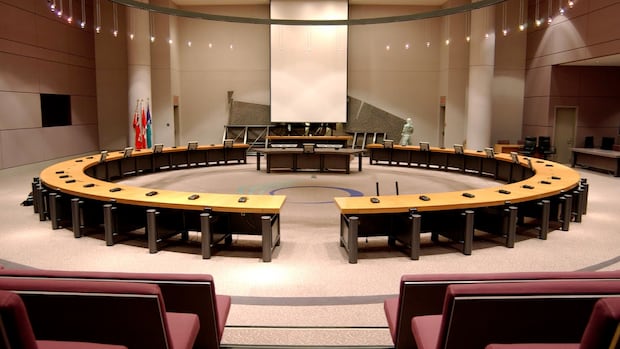
OttawaCity councillors are divided over funding for police, transit and infrastructure as they prepare to vote on Ottawa’s last budget before next year’s municipal election.’I think this myth of Team Ottawa is starting to fall apart,’ says councillor as budget reveals divisionsListen to this articleEstimated 6 minutesThe audio version of this article is generated by text-to-speech, a technology based on artificial intelligence.Ottawa city councillors will gather around this table Wednesday to pass the 2026 budget, but the document has revealed ‘fundamental differences’ among them, one councillor says. (City of Ottawa)City councillors are divided over funding for police, transit and infrastructure as they prepare to vote on Ottawa’s last budget before next year’s municipal election.The spending plan comes up for final approval on Wednesday. It commits more than $5.2 billion to city operations and more than $1.9 billion to capital projects. It would hike taxes that fund police by five per cent and transit by eight per cent, while the rate that funds most other city services would rise by only two per cent.That adds up to a 3.75 per cent property tax increase overall, or about $166 annually for the average urban homeowner.The mayor has framed the budget as a balancing act between affordability and investment in key priorities like public safety. But some councillors including Kitchissippi Coun. Jeff Leiper are already planning to vote no.”I think this is a status quo budget that fails to address head-on some of the challenges that we have with respect to austerity funding for the day-to-day services and ensuring that our infrastructure is being maintained,” Leiper said.He said the efficiencies the mayor has touted in the budget stem in part from “lucky breaks” like savings on the scuttled carbon tax.Even so, Leiper has little doubt that the majority on council will vote the other way.”I don’t think there’s any question the budget will pass virtually as drafted tomorrow,” he said Tuesday.Police spending reveals stark divisionsThe boost to the police budget will increase the city’s ongoing contribution to the Ottawa Police Service by $26.1 million, plus $5.4 million in one-time funding from reserves. It will help hire 21 more officers.”This budget is there to address what has been a very long-standing issue of under-resourcing our police units,” said Beacon Hill-Cyrville Coun. Tim Tierney.But that spending has proven controversial, with councillors exchanging barbs on social media and in newspaper opinion sections.Tierney has criticized council colleagues who “chronically oppose police budgets,” saying they tend to represent areas that have recently seen spikes in violent crime. He singled out Leiper’s Kitchissippi ward and Coun. Ariel Troster’s Somerset ward, both of which have seen double-digit increases in crime, according to the latest police data.”This will be the election issue,” Tierney told CBC. “We need police on the street to be able to deal with a lot of the violent crime issues.”Leiper said he plans to support the police budget to address “significant financial pressures on the police service,” while voting against the city budget as a whole. It seems that there is no ceiling for police funding, but everyone else has to tighten their belt.- Coun. Ariel TrosterTroster said she will vote against both. She called it “beyond the pale” for Tierney to go after urban councillors for representing their residents. She said the 2022 convoy protest frayed trust in police among residents of her ward.”He suggested that councillors who somehow vote no or disagree with a particular budget are somehow causing crime in communities, which is really absurd,” Troster said in an interview.”Crime is always higher in urban communities. We are the epicentre of the addiction, homelessness and mental health crisis.”She faulted the budget for increasing police spending by far more than funding for programs that directly target those social issues.”Why would we constantly write a blank cheque?” she asked. “It seems that there is no ceiling for police funding, but everyone else has to tighten their belt.”Orléans councillors getting ‘crumbs’Some councillors are planning to reject specific chunks of the budget while lending their support to others. River ward Coun. Riley Brockington told CBC he will vote no on the OC Transpo budget. He said he can’t support a budget with a “$46-million dream of a bailout,” referring to a placeholder in the transit budget that assumes the province will come to the rescue and upload the LRT.Alta Vista Coun. Marty Carr, who dissented on part of the transit budget at committee, said she might be prepared to support it on Wednesday “if some concessions are made.”That might be in the offing. Transit committee chair Glen Gower told CBC he’s working with the mayor and other councillors to “tie up loose ends” on fares and an improvement to LRT Line 1 service frequencies.Two Orléans councillors have targeted their ire at the public works and infrastructure budget, repeating their perennial complaint that the city is shortchanging the east end.During a committee meeting last month, Orléans South-Navan Coun. Catherine Kitts said budget season has often left her frustrated. “Now I’m verging on angry,” she said. “We cannot build a community with crumbs, and every year there seems to be a new set of excuses for why funding isn’t reaching the east end.”She said she won’t be supporting any transportation budget until it commits funding to advance projects in her area. “We have a list of long-planned projects that never seem to move forward, and every year the gap gets bigger,” Orléans East-Cumberland Coun. Matt Luloff added.’There are fundamental differences’Gower said councillors may dissent here and there, but he doesn’t think it will be enough to sink the budget as a whole.”This has been a very collaborative budget process,” he said. “I think there’s some specific departmental budgets where some councillors have concerns and may vote no. On the overall budget, I think we’ll be in good shape.”But Troster said the budget process — and the debate it has provoked — has been anything but collegial.”I think this myth of Team Ottawa is starting to fall apart,” she said. “There are fundamental differences.”ABOUT THE AUTHORArthur White-Crummey is a reporter at CBC Ottawa. He has previously worked as a reporter in Saskatchewan covering the courts, city hall and the provincial legislature. You can reach him at arthur.white-crummey@cbc.ca.
Councillors spar over spending as city budget heads to final vote