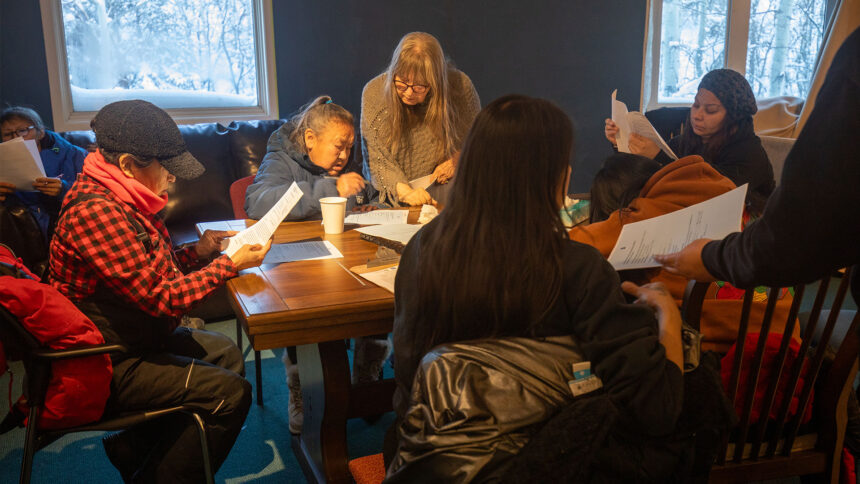
With no place to call her own and the Yellowknife emergency women’s shelter at capacity, Rhonda walked through the night in the unforgiving December cold. Her life has unfolded in cycles, with brief periods of stability swallowed by severe hardship. Five and a half years ago, she fled domestic violence and moved to Yellowknife in search of safety and employment. For a while she found both. But a relationship tangled with addictions unravelled everything. She was evicted and then left her partner, starting over again with nothing. “It’s like back to square one, starting from scratch with the applications, phone calls and emails,” she said. “Even though my name is cleared with Northview for arrears, I won’t go there for an application again because I don’t want to put myself in that situation.” APTN News sat with Rhonda and a dozen other women in a sharing circle. Many of the stories of loss, upheaval and relentless perseverance echoed her own. Their voices would inform upcoming program partnerships between the National Indigenous Women’s Housing Network and the Yellowknife Women’s Society. A common thread ran through every story: each woman had faced housing insecurity in her home community, and when she came to Yellowknife in search of opportunity, the struggle continued. Watch Part 1 of Charlotte’s story: Marie held stable housing for the first five years in the city. But after separating from her husband, the financial burden became too much. “My rent was $2,150, and I was the only one paying the bills,” she said. Her income disqualified her from acquiring housing subsidy, so she was forced to turn to the women’s shelter, debt piling behind her. “Having a spouse helps with the rent, groceries… just someone to come up with half,” she said. In a city where the average rent for a one-bedroom hovered near $1,757 and a two-bedroom went for $2109 per month affordability felt out of reach. According to Canada Mortgage and Housing, rental data from October 2025 showed that Yellowknife had a vacancy rate of just 1.9 per cent, indicating tight market conditions that pushed prices up. In remote communities, that number was even higher. Doreen, from Gjoa Haven, Nunavut, spoke about giving her apartment to her son when she left for school. She returned home and lived at her mother’s. Four families squeezed into one small house. “It was overcrowded,” she said. “We all fought over the bathroom, and things went missing.” She came and went from Gjoa Haven, but even with a job, she could not keep up with $2,600 rent in her home community. She eventually returned to Yellowknife, relying on the women’s shelter to get by. The women in the sharing circle confronted the colonial legacy and impacts on housing insecurity for Indigenous women. Homelessness: According to the city’s latest point-in-time count on homelessness, there were 327 individuals experiencing homelessness. Eighty-five per cent identified as Indigenous; 65 per cent said their parents attended residential school; and 19 per cent said they attended themselves. Elsie said that after her divorce, she was uprooted from the family home in the remote community of Łutsël K’é, N.W.T. She built a shack by the river and lived there for more than a decade before moving to Yellowknife. Returning home to care for her father reconnected her to the land, but did not provide her with a roof over her head. “I have land in Łutsël K’é. I want to stay there because it’s my hometown, but I don’t have a house. That’s what really gets to me as an Indigenous woman — by rights I should have a home.” Marie McGregor Pitawanakwat, chair of the National Indigenous Women’s Housing Network, listened to each story with a visible understanding. She spoke about the historic role Indigenous women held in the home as keepers of family knowledge, transmitters of culture and the profound impact of dispossession. “We were contained in a school system, in a residential school system, in foster care systems, basically contained, corralled, counted, controlled and captured. […] That is a severe disruption.” The city’s latest point-in-time homelessness count reflected the reality that the women here knew intimately addictions and mental health struggles. Seventy-four per cent of individuals experiencing homelessness reported substance-use issues, and 41 per cent said they struggled with mental health. Watch Part 2 of Charlotte’s story: Many of the women in the circle discussed their lives with addictions, the apprehension of their children, and the difficulty of staying sober in environments where people around them were partying. Living in survival mode, many said they never went to rental boards after receiving eviction notices. Tessa, originally from Inuvik, N.W.T., shared about the grief and trauma that had turned her life upside down, the death of her mother, the murder of her boyfriend. “I didn’t care about bills, I just started partying, and addictions took over,” she said. She missed her rental board hearing, lost her home and has been couch surfing or staying at the women’s shelter for the last four years. She said she wanted to see more Indigenous workers in frontline shelter roles: “The staff there, when you want to talk about it, they say they understand, but they don’t know what you have been through.” Yellowknife saw a rise in the number of unsheltered individuals, including those staying in tent encampments. According to the city’s 2024 point-in-time count, 32 individuals identified as unsheltered, up from 8 in 2021. Tina, originally from Łutsël K’e shared with the group that she slept in stairways and unlocked laundry rooms of apartment buildings. Her years experiencing homelessness were marked by ingenuity and a deep critique of colonial land ownership. “I have a cave up on the hill there… It is blended in. The wind and rain don’t go in there. Even when it is cold, it is still safe in there.” Her frustration was sharp as she spoke about being criminalized for sleeping outdoors, connecting the injustice to systemic dispossession. She rhetorically asked, “How can it be private property?” and argued, “We had one big land and they separated us and drew lines, targeting areas and taking away our rights.” McGregor Pitawanakwat applauded the resilience she saw in women like Tina. “Anyone who puts up a tent to provide housing for themselves is doing the very best they can with what they have in front of them. They’re exercising agency, self-sufficiency and independence, and how do I know? I’ve been there.” Her own experience with homelessness is something she shared with APTN in 2018 when she was evicted from her family home in Daawganing (Whitefish River First Nation) on Manitoulin Island in northeastern Ontario and became homeless. Her own experience with homelessness, building an off-grid tiny home, fighting eviction in court, seeking recognition of her right to live on her homeland, relocating and becoming a member of Wiikwemkoong Unceded Territory, all of this has shaped her work across Turtle Island as an advocate to create culturally safe housing. Her vision was clear: a return to agency, self-determination and pride through programming that helped Indigenous communities build and own their homes. “What brought me here [to Yellowknife] was a project called ‘Developing a Toolkit for Indigenous Women in Housing,’ and it’s for Indigenous women to learn what is required in order to enter a trade, particularly housing, and what are the tools, what are the resources that we will need to have,” she said. When asked what would help them secure permanent housing, the group was quick to answer, training. “I like what you were saying about trades. I need support so I can build something,” said Alice from Behchokǫ̀, NWT. “Maybe they can teach me how to build a small box house, and I can go from there.” Alternative homes: In recent years, McGregor Pitawanakwat led an “alternative homes” research project, applying an Indigenous lens and using local materials to create housing for Indigenous women, girls, two-spirit and gender-diverse people. The project explored natural materials such as timber, straw bale, cordwood and stone, and culturally relevant housing designs to promote self-determination, build community capacity and create local jobs. When the conversation turned to what the women wanted to support them in acquiring and maintaining permanent housing, the group unanimously suggested more training. “I need support and help so I can build something. Maybe they can teach me how to build a small box house and I can go from there,” said Alice from Behchokǫ̀. McGregor Pitawanakwat nodded. “People in the tent villages are forming community,” she said. “My dream is to see little homes popping up all over Canada that Indigenous women and Indigenous families own.” Rhonda had to leave the conversation a few minutes early, it was food hamper day, something she couldn’t afford to miss, but thanked the group for the opportunity to contribute, and she was already taking the next step. She had a mental-health first aid workshop scheduled that week. Continue Reading
Cycles of loss and survival: Voices of northern Indigenous Women experiencing homelessness



Leave a Comment