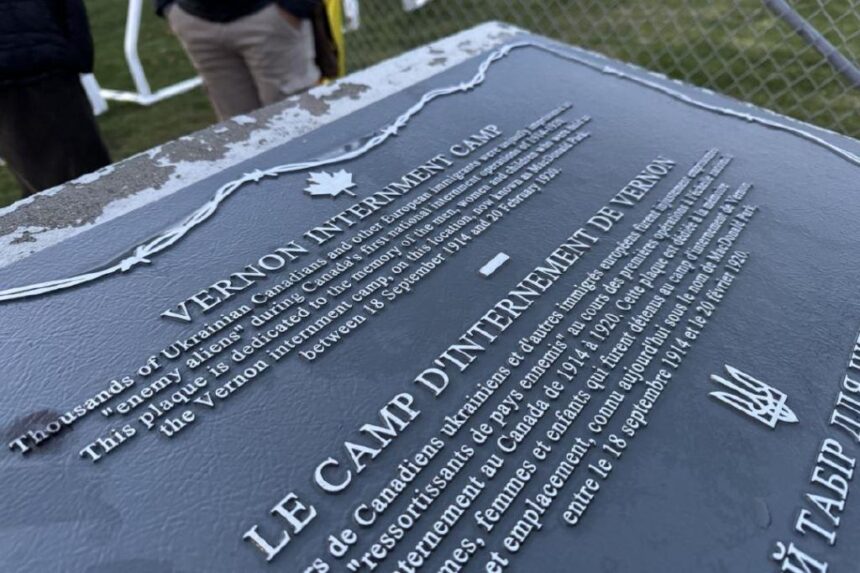
On the outskirts of MacDonald Park near Vernon, B.C.’s Seaton Secondary School, a monument has stood since 1997. It commemorates a chapter in the city’s history that needs to be remembered. So say the folks who have cared for the Vernon Internment Camp monument and had it replaced a few years ago. Those people and others gathered at the monument on National Internment Commemoration Day Wednesday, Oct. 28, to share words about a local First World War-era injustice and the lessons that can be drawn from it. The camp opened on Sept. 18, 1914 and closed on Feb. 20, 1920. In Canada, a total of 8,579 individuals were identified as enemy aliens and incarcerated in more than 24 internment camps such as the one in Vernon, and forcibly put to work on the country’s frontier, said Andrea Malysh, president of the Thompson Okanagan Branch of the Ukrainian Canadian Congress. Most of the internees were Ukrainians. Others were of Croatian, Bulgarian, German, Hungarian, Italian, Russian or other ethnicities. Many of them lost their personal wealth and were forced into heavy labour. One-third of Canada’s internment camps were in B.C., and Vernon’s was one of the largest and longest running. “As Canadians, we are entrusted to ensure that this does not happen again,” Malysh said. Lawrna Myers, of Project Roll Call — a searchable online document that includes information about many of the internees — said 11 men died while associated with the Vernon Internment Camp. “Today, a monument stands at the Pleasant Valley Cemetery in memory of these men,” she said. “For many decades, this chapter of Canadian history received little public attention.” Myers said attention must be given to this historical injustice so that lessons can be learned. This chapter of history invites people to ask important questions, such as how to balance security and freedom, or how to protect minority groups during times of crisis, she added. “How do we ensure that fear does not lead to injustice? These are not just historical questions. They remain relevant today.” Marcy Kennedy, Chief of Staff for Vernon-Lake Country-Monashee MP Scott Anderson, shared words from Anderson on his behalf at the event: “As your Member of Parliament, I share your commitment to remembering those who suffered and protecting the freedom that every Canadian should enjoy. Thank you for being here, for honouring the victims, and for making sure that this history continues to be told.” Vernon mayor-elect Kari Gares thanked the 20 or so attendees who came out to recognize “this difficult chapter in Canadian history.” She said many of the internees had come to Canada seeking better opportunity, safety and a future for their families. “It’s important that we remember these stories, not only because they are a part of our history, but because they remind us of the consequences of fear, prejudice, and division,” Gares said. “And at the same time, this day is about recognizing resilience.” Resilience defines how these internees endured their struggle. Myers said they created communities within the camp, maintained friendships and supported one another to preserve a sense of dignity. Kyndra Johnson, a youth representative, said she’s learned from a very young age about her Ukrainian-Canadian history and culture, as well as Vernon’s internment history. “It is crucial for all of us to come together in order to remember and acknowledge the trauma our people went through while keeping our culture alive,” Johnson said. At the end of the speeches, Reverend Andriy Werbowy of St. Josaphat’s Ukrainian Catholic Church performed a consecration of the monument. The Ukrainian anthem was sung, and a wreath was laid at the base of the monument.
Dark chapter in Canadas history remembered on National Internment Day