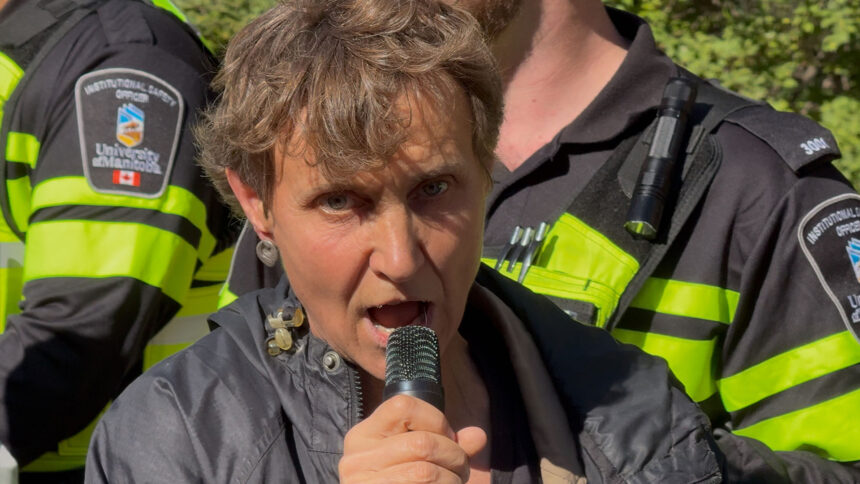
While Canada’s residential school era has become a key piece of our national identity, there has been an eruption of late of what some academics call denialism. That eruption – and efforts to counter it – is the focus of Dismantling Denialism on APTN Investigates. Frances Widdowson, a former associate professor fired from Calgary’s Mount Royal University in 2021 in the wake of comments she made asserting the benefits of residential schools, is emerging as denialism’s public face – recently making a series of provocative appearances on Canadian university campuses. On Dec. 2, Widdowson was arrested for trespassing at the University of Victoria after showing up in spite of being told by administrators ahead of her visit that she was not permitted to be on the property. “For the last decade I’ve been paying attention to people who are trying to undermine and attack truth and reconciliation,” University of Manitoba Indigenous Studies professor Sean Carleton said of denialism, “and they’re trying to cherry-pick certain elements of the story, twist it, downplay it, minimize it, as a way of hiving off support for reconciliation.” University of Manitoba Associate Professor of Indigenous Studies Sean Carleton in front the sign for the former Assiniboia Residential School in Winnipeg. Photo: Christopher Read / APTN. APTN Investigates was at the University of Manitoba with cameras rolling when Widdowson appeared there a few days ahead of the National Day for Truth and Reconciliation. Her stated purpose was to stand in front of the National Centre for Truth and Reconciliation and engage people in a question-and-answer type process she calls a “spectrum street epistemology” – supposedly aimed at determining truths about residential school history. But Widdowson’s event immediately became a public clash. Indigenous demonstrators drummed, sang and war-cried to drown out Widdowson and those there to engage in her exercise. Early on, Ben Gavel – who goes by Red Horse – laughed as he mocked Widdowson about her claim that certain stories of survivors might be false memories similar to what occurred during the so-called Satanic Panic. “The shit that was disproven in the ‘80s is what you’re saying was happening at the school?” said Gavel, cackling derisively. “With the incineration,” said Widdowson, referring to stories that have emerged of babies being incinerated in the schools. Red Horse, also known as Ben Gavel, war-crying at Widdowson’s event in front of the National Centre for Truth and Reconciliation on Sept. 25, 2025. Photo: Christopher Read / APTN. Widdowson claims the national anxiety over what happened in residential schools is similar to what happened in the 1980s when the Satanic Panic had some members of the public as well as police operations believing that widespread ritual abuse of children was happening. During Widdowson’s appearance at the University of Manitoba, people in attendance were mostly in one of two camps; those eager to express doubt about the history of residential schools and engage with Widdowson and those who were there to shut Widdowson down. And occasionally the sides would shout at each other. “I was born here” shouted a non-Indigenous woman at one point. “It doesn’t matter,” said Indigenous Elder Mary Starr back at her. “Well then it doesn’t matter that you were born here either, lady,” said the White woman. “You want money!” said another supporter of Widdowson to Starr. “We don’t need your money!” said Red Horse. When the protest against Widdowson dissipated, she told us more about her argument that residential school testimonies could be inaccurate. “You can’t just accept survivors’ testimonies about the incineration because that’s a highly improbable claim,” said Widdowson, “And the Satanic Panic, you had similar kinds of claims over here. That, you know, all sorts of Satanic abuse was happening. It turned out it was just misremembering where people had memories implanted through various stories.” In an essay by Widdowson that is published in the book Grave Error: How The Media Misled Us (and the Truth about Residential Schools) she highlights a story from Kamloops Indian Residential School survivor William Coombs – about Queen Elizabeth and Prince Philip supposedly abducting 10 children from the school in 1964. By Widdowson’s logic, Coombs’ improbable tale is good reason to question other survivors’ stories as well. “If we’re going to believe all residential school survivors, everything that they say, we’ve got to believe Billy Coombs – and Billy Coombs said that Queen Elizabeth II abducted 10 children,” she tells us in Dismantling Denialism. “So I’m just using it as an example that we can’t just believe what residential school survivors say because they could be misremembered.” But for Sean Carleton, what Widdowson is engaged in is a rhetorical tactic known as a straw man fallacy. “It’s very clear that denialists are engaged in a form of debate known as cherry picking, which draws on straw man arguments, the most extreme arguments, to make it seem that that’s what the majority of people believe,” said Carleton. Widdowson at the University of Winnipeg on Sept. 26 with men in “Crazy Indians” vests. Photo: Christopher Read / APTN. But the point that Widdowson and her followers get most excited about involves the uncertainty of ground penetrating radar [or GPR] when used to locate potential graves. “You will get boulders, you will get animal burrows,” said Widdowson, “So GPR is incredibly inaccurate and is completely inconclusive. You must excavate if you’re going to find what is beneath the soil.” However – despite the limits of ground penetrating radar readings, Carleton notes that when used in conjunction with records indicating a cemetery is there – not to mention testimonials from survivors – it is a highly useful tool. “They will say ‘only exhumation can confirm that death occurred’ – that is incorrect technically in archeological work,” said Carleton. “Much of this work is being done in graveyards that have lost their markings, and that work, the pattern work that can be done can confirm based on existing graves that these are fairly certain.” Widdowson and others like her also take note of the fact that in spite of receiving funding, the Tk̓emlúps te Secwépemc Nation has yet to exhume any human remains. “Many denialists would say zero bodies have been found at the Kamloops Residential School,” said Carleton, “Well, yeah, because the Kamloops investigation isn’t over yet.” And, one of the reasons the investigation is not done yet, is that multiple communities are making the decisions. “Getting all of those different communities to agree on what the best way forward is, is very difficult – it’s a very emotional process with sometimes consensus not being readily available or easy to achieve,” said Carleton. “So, some communities don’t want to pursue that for a variety of reasons – they don’t want to disturb the dead.” During her Winnipeg visit, Widdowson returned to the University of Winnipeg the day after her appearance at the National Centre for Truth and Reconciliation. This time the crowds were larger, with even more residential school survivors and their supporters turning out to counter Widdowson’s message – and things got more noticeably even less civil than the previous day A man attending was put in a headlock by another attendee, another man had his hand cut in a skirmish, Widdowson had liquids poured on her, and Widdowson’s videographer was forced off the property by a small group of demonstrators, a couple of whom were wearing biker-style vests. Widdowson’s videographer Daniel Page being stopped from recording the event at the University of Winnipeg. Photo: Christopher Read/APTN. The tumult of the day eventually subsided sometime after Widdowson used a de-escalation tactic and lay down in the middle of a group of Indigenous women who had encircled her with locked arms so she could not escape. At time of publication, Winnipeg Police say an investigation is still ongoing, but so far nobody has been charged with anything. Widdowson, however, was handed a letter by campus security saying she was trespassing and barring her from the property for five years. “I’m not listening to this,” said Widdowson upon getting it. Residential school survivor Geraldine Shingoose – who was at Muscowequan Indian Residential School for nine years – feels Widdowson wasn’t listening to her either. “I sincerely felt that hate, I felt that ridicule,” said Shingoose. “As a survivor, she laughed at us. She combated what we shared.” Another residential school survivor Vivian Ketchum felt similarly after encountering Widdowson at the University of Winnipeg. Vivian Ketchum, on the bank of the Red River. Ketchum turned out to the University of Winnipeg to demonstrate against alleged residential school denialist Frances Widdowson. Photo: Christopher Read/APTN. “These people that are saying our residential school didn’t happen, that there’s no unmarked graves, that hurts,” said Ketchum. “To go into that emotional well over and over again, that’s a lot.” But despite Widdowson’s impact on residential school survivors, experts and academics watching what she’s up to say she’s not going to win. One of the academics Widdowson has called out in her online videos is University of Manitoba Indigenous Studies professor Niigaan Sinclair. He is reluctant to give Widdowson any oxygen. “The biggest statement we can make is to not engage,”said Sinclair. But in spite of his reluctance to engage with the Widdowson crowd, he and his colleague Sean Carleton are working on a book aimed at debunking the arguments being made by the so-called denialists. “We have to believe that education got us in this mess, as my father once said, education will get us out of it,” said Sinclair, echoing a famous quote from his Dad – Justice Murray Sinclair. And so far, from the perspective of Carleton, the truth is winning, “There are more Canadians that are marching with their orange shirts, that are learning the truth, who want to build better relationships to create a more honorable future, and marching with them on Orange Shirt Day made me realize that denialists will lose,” Carleton said. “It will just take time.” Continue Reading
Denialism close-up: APTN Investigates captures Frances Widdowsons surge

Leave a Comment