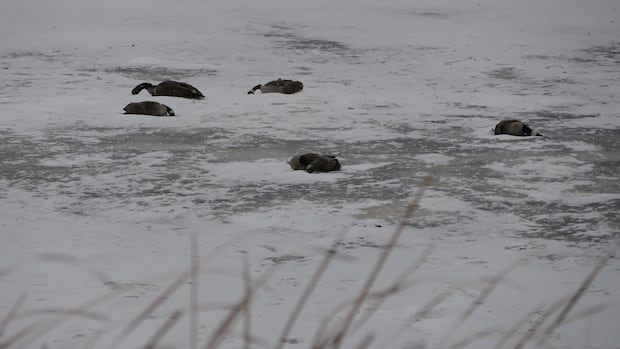
ManitobaAt least 500 carcasses of birds, the majority of them Canadian geese, have been recovered near water streams in southern Manitoba over the last month — a die-off scientists say they have not witnessed in the province before and are attributing it to avian influenza.Scientists suspect die-off is related to avian influenza after birds in Niverville test positive for virusListen to this articleEstimated 5 minutesThe audio version of this article is generated by AI-based technology. Mispronunciations can occur. We are working with our partners to continually review and improve the results.Several dead birds were found in the area around Niverville, Man., on Dec. 5. Frank Baldwin, a biologist with the Canadian Wildlife Service, says nearly 500 bird carcasses have been recovered in the town in recent weeks. (Trevor Brine/CBC) WARNING: This story contains an image of a dead goose.At least 500 bird carcasses, the majority Canadian geese, have been recovered near water streams in southern Manitoba over the last month — a die-off scientists say they haven’t witnessed in the province before and are attributing to avian influenza.”Anywhere there was open water, where birds were concentrated, now we’re seeing carcasses,” Frank Baldwin, a biologist with Canadian Wildlife Service, told CBC News on Thursday. “We haven’t experienced this in Manitoba yet at this scale.”Separate clusters of dead birds have been found near the Red River, north of Winnipeg’s Perimeter Highway, in recent weeks.Niverville, about 30 kilometres south of Winnipeg, has seen the highest concentration of bird carcasses in recent weeks.Close to 500 dead birds have been recovered in that area alone by the Canadian Wildlife Service and other authorities, most in a number of ponds near residential areas on the southeast corner of the town, Baldwin said.Frank Baldwin, a Canadian Wildlife Service biologist, says dead birds recovered from Niverville that were lab tested had avian influenza. (Jura McIlraith/CBC)Lab tests done on some of the birds in Niverville confirmed the animals had avian influenza, also known as the bird flu. Baldwin said bird carcasses have also been found in the south side of a dam in Lockport, north of Winnipeg. CBC saw around 50 dead geese there on Monday.A group of dead birds were also found near Winnipeg’s West End Water Pollution Control Centre on Wilkes Avenue, Baldwin said.While the vast majority are Canadian geese, Baldwin said some carcasses of ducks and scavenger birds like crows have also been recovered. Dead Canada geese lie in snow on the frozen Red River in Lockport on Dec. 8. (Justin Fraser/CBC)While the Canadian Wildlife Service said the Manitoba government has information on more specific locations and total numbers of dead birds recovered to date, a provincial spokesperson didn’t answer CBC’s request for that information.Instead, the spokesperson said the province is aware of recent wild bird die-offs.The spokesperson also said 726 dead birds have been tested in Manitoba this year, and 54 have been positive for H5N1, the predominant subtype of bird flu.Virus may have mutated It is still unclear how either the birds found in Winnipeg or Lockport died, but the Canadian Wildlife Service suspects avian influenza.Through initial lab testing, scientists learned dozens of birds in Niverville died from the H5 subtype of avian influenza. But Baldwin said the Canadian Food Inspection Agency will have to do more testing to determine if the birds had H5N1, a highly pathogenic variant of the virus that saw an outbreak in parts of Canada this fall.The contagious viral infection creates neurological symptoms for birds, which become disoriented and increasingly incapable of moving. Avian influenza tends to peak in the late fall. Most birds generally migrate from Manitoba before then, Baldwin said, but this year’s mild weather meant some flocks stayed until November, favoring transmission.Without food sources on the ponds during the fall, birds with influenza struggle to feed themselves, Baldwin said. In cold temperatures, they burn more energy, and can freeze to death without nutrients or fat stores.But “ultimately, what led to them dying would be this virus,” Baldwin said. Hannah Wallace, a University of Manitoba researcher, says it’s not clear yet what’s behind the number of suspected H5N1 deaths in Manitoba, but late migration could be partly to blame. (Trevor Brine/CBC)Hannah Wallace, a University of Manitoba researcher with expertise in viral immunology, said it is strange that after years of avian influenza circulating in North America there would be so many bird deaths at once. “We would think that some of the birds that had been exposed … would have some protection,” she said. The virus mostly transmits among birds that defecate in and drink the same water. Wallace said studies have shown the virus can stay in the environment for up to a year, and can be contagious at any point. While it is not clear yet what’s behind the number of suspected H5N1 deaths in Manitoba, Wallace said it is possible that with late migration, food was in short supply, making birds more susceptible to contracting different diseases at once.Scientists are also not discounting the possibility avian influenza could have mutated. Several dead birds were found in the area around Niverville, Man., on Dec. 5. Biologists confirmed the die-off was caused by avian influenza. (Trevor Brine/CBC)With changes to the virus, other species can also be more susceptible at being infected.”Every animal is a chance for that virus to mutate.… It makes it a more possible option that it could also then become better at infecting people,” Wallace said.”But that’s far off, and I want to stress that’s a distant possibility at this point.”At the moment, there’s no risk to the general public, Wallace said. Since the arrival of H5N1 into North America at the end of 2021, there have been a few human infections, but most have been similar to a mild cold.For now, Wallace stressed it is important pets don’t get close to dead birds and people avoid touching them. “It’s sad to see this many birds,” Wallace said. “But this is not a ‘ring the alarm bell’ situation.… It’s a reminder to monitor.”ABOUT THE AUTHORSantiago Arias Orozco is a journalist with CBC Manitoba currently based in Winnipeg. He previously worked for CBC Toronto and the Toronto Star. You can reach him at santiago.arias.orozco@cbc.ca.
Die-off of hundreds of birds something Manitoba hasn’t experienced ‘at this scale’: biologist