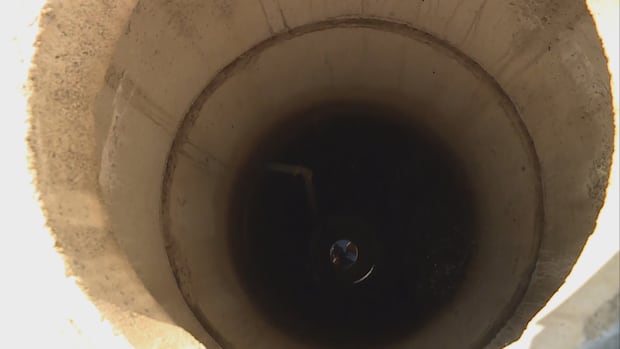
Nova ScotiaAfter about five months without water, some homeowners are grateful for plentiful November rain. But some wells may need to be disinfected, or professionally tested, if the water in them is discoloured.Sediment is disrupted as water levels rise and professional testing may be in order, professor saysPreston Mulligan · CBC News · Posted: Dec 12, 2025 5:00 AM EST | Last Updated: 4 hours agoListen to this articleEstimated 3 minutesThe audio version of this article is generated by AI-based technology. Mispronunciations can occur. We are working with our partners to continually review and improve the results.A dry well in the Halifax municipality. (Stephanie Blanchet/Radio-Canada)Gary Webb of Roundhill, N.S., says he spent the summer “shower surfing” and relying on the kindness of neighbours with deeper wells during several months of drought.His home has a dug well, which has been dry since about midsummer.During that time, he and his neighbours would routinely visit a nearby church that had a working well with a good water supply.”It was like a watering hole in the Serengeti,” he recalled. “I saw every possible contraption you could think of there to get water from that well.”After steady rain throughout November, his well is finally full. Environment Canada says precipitation was just slightly above what is considered normal for that part of the Annapolis Valley. The Valley, Halifax and Sydney received above-normal rainfall in November, while the rest of the province was in the normal or below-normal category. Tea-coloured water”We’ve gone almost five months without reliable water and it’s really nice to have it back now,” Webb said. But he’s wondering if is it safe to drink. Since the water has returned, he said it has taken on a “tea-coloured” hue. He’s tried treating it a few times with calcium chloride capsules, but said there was no change. He’s also used household bleach.Ian Spooner, a professor in the department of Earth and Environmental Science at Acadia University, said the discoloration is normal. The water that’s flowing back into his well and the adjacent aquifer has disrupted some of the sediment and microorganisms that sat dry for months.”And then as soon as you add water, it releases that into the water almost, catastrophically,” Spooner said. “And it takes a while for your water to stabilize.” He said the bacteria isn’t very harmful but it does lead to “aesthetic challenges in the water.””It’s just not fun to drink it,” he said.Guidance on disinfecting wellsThe provincial department of Environment and Labor has some guidance on its website about how to disinfect wells by chlorination in order to kill bacteria and other microorganisms. Spooner’s advice is to get your water professionally tested if there is any concern about water discoloration.Spooner said during this most recent drought, he observed that the dug wells were going dry — not the deeper drilled wells. The dug wells, he said, respond very quickly to any change in precipitation.”Dug wells react very quickly to lack of water,” he said. “But they also react very quickly to the addition of water. So they’re a vulnerable resource.” He cautioned that with climate change upon us, it’s a problem that will likely persist. The only solution, he said, is for homeowners to dig deeper wells — or for municipalities to find a way to provide a steady water supply.MORE TOP STORIESABOUT THE AUTHORPreston Mulligan has been a reporter in the Maritimes for more than 20 years. Along with his reporting gig, he also hosts CBC Radio’s Sunday phone-in show, Maritime Connection.
Dry wells across N.S. have been refilled, but ‘tea-coloured’ water raises concerns