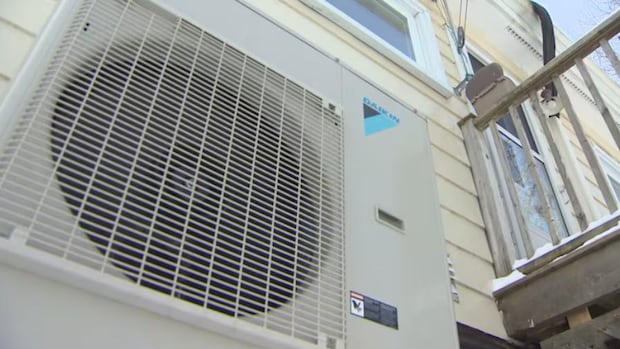
Some New Brunswick homeowners will be left with higher energy bills this winter after the federal government stopped accepting applications for a program geared to promote energy efficiency upgrades. The Canada Greener Homes Initiative loan program offered interest-free loans of up to $40,000 to Canadian homeowners to make improvements like sealing and insulating their homes, replacing doors and windows, and installing heat pumps and solar panels. But the sudden end of the loan program on Oct. 1 has led some to change their plans.”We have had customers already call and say they’re going to put their project on hold,” said Russell Hayward of Hayward Healthy Home Solutions in Riverview.He said the federal program had been “a big driving force for us, especially for solar.”Saying the $3.2-billion budgeted for the loan program this fiscal year has been nearly fully allocated, the federal government announced on Sept. 18 that applications would close in two weeks.About 120,000 households across the country, including just more than 4,300 in New Brunswick, have taken advantage of the no-interest loans since the program’s inception.Alex Lissandro of TruSun Solar says the federal no-interest loan program was a ‘game changer’ when it came to sparking interest in residential solar arrays. (Submitted by Alex Lissandro)The program was a game changer for TruSun Solar Energy in Beresford, according to vice president Alex Lissandro. Within weeks of the program starting in 2022, Lissandro said TruSun saw “a tremendous increase” in requests for quotations and information about solar projects. And indeed, the number of households registered with N.B. Power for net metering, which lets homeowners with solar send their excess power to the grid for credit, has roughly doubled every year since 2021-2022, around the time the federal government launched the Canada Greener Homes Initiative. This is money that technically is coming back to the government… so we’d like to see that reinvestment.- Cindy Gareau, Canadian Association of Consulting Energy AdvisorsBut the program was about more than solar.To qualify for the no-interest loan, homeowners first had to have their property assessed by a licensed energy advisor to determine which upgrades made the most sense.In New Brunswick, 69 per cent of loans awarded were used to have heat pumps installed, 25 per cent went to solar panel purchase, and 18 per cent covered the cost of new windows, according to figures from the Canada Mortgage and Housing Corporation. Agency says 11 million homes still need energy retrofitsUnder the initiative, only about two per cent of Canadian homes were being retrofitted each year to reduce energy costs and greenhouse gas emissions, says Efficiency Canada’s Brendan Haley.”But to deal with climate change, to help people with affordability, we’re actually going to have to retrofit almost all,” he said. That’s more than 11 million homes, according to Green Communities Canada’s 2025 progress report Retrofitting Canada’s Homes. Brendan Haley of Efficiency Canada says that in order to deal with climate change and affordability, all of Canada’s homes will need energy retrofits. (Erica Butler/CBC)”A significant number of the homes we live in were built before there were any energy efficiency standards in the building code,” said Haley. “So there’s some homes that definitely could use a very deep retrofit.”While cutting energy costs is a significant incentive in itself, he pointed out that the savings from energy-smart renos accrue incrementally, while the costs come all at once. “It’s a big capital investment — actually, the biggest capital investment that a lot of people who own a home could make,” Haley said. The entrance cost is so big. Not many people have that kind of money just waiting around.- Alex Lissandro, TruSun SolarLissandro agreed, saying: “The entrance cost is so big. Not many people have that kind of money just waiting around.”For major retrofits and solar installations, Hayward too said it was the interest-free loan that “really made the math work.” Both Hayward and Lissandro are hoping to see the federal government reinvest in the loan program, as it did in the spring of 2024, when it topped up the then-depleted program by an additional $600 million to meet heavy demand.That call is echoed by Efficiency Canada and industry groups like Canadian Renewable Energy Association and the Canadian Association of Consulting Energy Advisors (CACEA).”It’s not as if this money is going out the door and never coming back,” says CACEA director Cindy Gareau. “This is money that technically is coming back to the government… so we’d like to see that reinvestment.” CMHC said that to date, about $301 million has been repaid by homeowners who have taken advantage of the loans in the past.Energy advisors worried about their futureThe number of energy advisors working in New Brunswick has doubled since the Canada Greener Homes Initiative launched, with its requirement for an energy assessment in order to trigger the payment of any funds. Gareau said those jobs are now at risk, along with the positions of solar panel and heat pump installers. “I think the shock waves are going to be felt pretty far and wide,” said Phil McKay of the Canadian Renewable Energy Association. It was that abrupt stop that really has rattled some folks.- Phil McKay, Canadian Renewable Energy AssociationMcKay said that with just nine business days between the announcement and the closure of program applications, companies with a focus on residential solar are facing the need to pivot.”They know they can keep going, but it was that abrupt stop that really has rattled some folks.” The “start-stop, boom-bust” nature of federal incentive programs is a real problem, said Haley. “It’s not conducive with the government’s own objectives to create jobs, to build the capacity in the sector.”An energy advisor carries out a blower door test to determine a home’s airtightness during an EnerGuide energy efficiency home evaluation. (CBC/Radio-Canada)Inconsistency can also lead to consumers rushing retrofits or waiting too long for government incentives, Haley said.”We want them timing those retrofits in terms of when it makes the most sense in the life cycle of their home, when they can achieve the most amount of energy savings at the lowest cost,” he said. “And that doesn’t happen unless we have consistent services.”Pressing pause for nowIn Riverview, Heath Johnson and his family are pausing their plans to install solar panels on their home after hearing the loan program has been closed.Johnson said his family built their home seven years ago with energy efficiency in mind. With power rates climbing, they started considering generating their own power to cut costs. Once they discovered the Canada Greener Homes loan program, they got quotes from three different companies, but missed the October 1 deadline. We believe in the environmental benefits. We believe in the financial benefits.- Riverview homeowner Heath Johnson”What we’re going to do now is wait for the federal budget to come out this fall and see if there is a new program that is there to incentivize homeowners,” Johnson said.The 10-year interest-free promise of the Greener Homes loan had been “exactly what we needed to be able to go forward with the project,” he said. “The economy is up and down. You never know what interest rates are going to do.”Solar panels arranged on the roof of a home can supply more energy than the house needs in the spring and summer months, when days are longer. That excess energy gets directed to a region’s power grid, with the homeowner getting credits that can be used at night and during in the darker months. (Justin Pennell/CBC)Johnson said the family may eventually go ahead with the project, even without a new federal program, by seeking out a bank loan or other financing. “We’re still committed to having solar,” he added. “We believe in the environmental benefits. We believe in the financial benefits. We think it is the right thing for our family.”Incentives for some changes still availableThere are still programs in New Brunswick to help homeowners with upfront costs for some energy efficiency renovations. N.B. Power administers the federally and provincially funded Oil to Heat Pump Affordability program under two streams:The Enhanced Energy Savings Program can cover the full cost of insulation, ventilation and mini-split heat pumps for households with income below $70,000. The Total Home Energy Savings Program offers rebates for efficiency upgrades to households with income over $70,000, and also offers up to $15,000 for households switching from oil systems to heat pumps.So far, nearly 2,400 grants have been approved for New Brunswickers, with another roughly 1,400 applications still being processed. The federal government has also started to roll out the Canada Greener Homes Affordability Program, which promises no-cost home retrofits — such as installing insulation and heat pumps — to “low-to-median-income homeowners and tenants.” That program is available only in Manitoba at the moment.
End of interest-free loan program puts a pause on energy upgrades for some N.B. homeowners