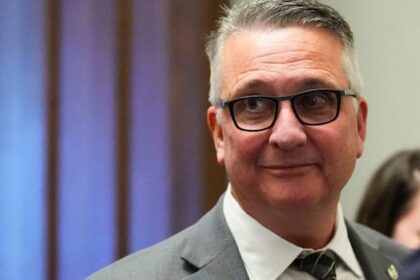
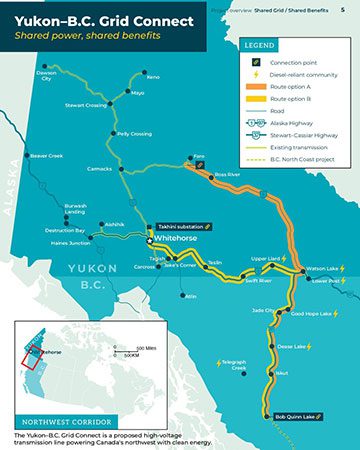
Recent comments made by the head of the Yukon Development Corporation about support for a proposed grid connection project are catching flak from one First Nation who’s now calling on the Crown corporation to “correct the record.” The CBC reported last month that Yukon Development Corporation (YDC) President Gary Gazankas told attendees at the Geoscience Forum in Whitehorse that the Yukon-B.C. grid connection project, which would connect the territory’s isolated electrical grid to the Canadian grid through British Columbia, had universal support from First Nations. The corporation has hailed the estimated $4 billion-dollar project as a notable benefit for the Yukon and the North: it would deliver clean, low-cost energy; lower up to nine million tonnes of greenhouse gas emissions annually and create thousands of jobs – not to mention help expand the territory’s energy capacity to meet peak winter demand. “The great news is there are still conversations happening and no one is opposed to this project,” Gazankas is reported to have said at the event. But Chief Dylan Loblaw of the Ross River Dena Council, whose Kaska community of Ross River in eastern Yukon is located along a potential transmission line route, disputes the claim. “I was a little bit disappointed and shocked,” he said. “We never supported their project or their proposal at all.” According to Loblaw, the First Nation met with government officials to learn about the project months back, but never took an official stance. He said Gazankas’ claims aren’t true, at least for his First Nation. “We’d like to see that statement corrected for the record,” Loblaw said. “We’re not in support of the proposed route going through Kaska (territory), at least through the Ross River area.” Loblaw said his First Nation isn’t willing to back the project due to concerns surrounding its high cost and environmental impact. The project could also help boost power to a number of proposed mines, such as the massive Casino mine and the Kudz Ze Kayah mine, the latter, which, if approved, would be located on the First Nation’s asserted territory and is at the centre of a years-long legal battle with the territorial and federal governments. Loblaw believes the project will pave the way for other resource extraction projects to the territory – something he isn’t willing to get behind. On top of that, Loblaw said his First Nation is already struggling with many outstanding issues and challenges, and trust with the government is shaky due to what he said is a history of broken promises. He said those concerns need to be addressed first before it can consider the project. “The mitigations that are being rolled out now aren’t enough,” he said. “We’d like to see some meaningful engagement and a partnership, rather than just being pushed aside like we always have.” Chief Dylan Loblaw of the Ross River Dena Council says his First Nation never lent its support to the grid-connect project. Photo: Jordan Haslbeck/APTN News Grid project a “good idea” says energy expert But energy experts say the project has the capacity to kick the Yukon’s clean-energy future into high gear. Paul Parker, a professor emeritus with the University of Waterloo’s faculty of environment, said there are big advantages. “When we connect many users – because everybody’s not using it at exactly the same time – it makes our whole system more efficient. And so, by having many users, many suppliers, it generally makes it an easier system,” he said. He also noted the territory’s hydro power dips during the winter, and southern grid connectivity would allow it to tap into B.C.’s hydro energy supply. “Basically, it should give the Yukon a lower cost supply of energy in the winter when you need more energy,” he said. “So, big picture, it sounds like a good idea.” While Parker said the impact of transmission lines would be relatively minimal, he noted there are some caveats, such as their high cost and the disturbance caused by access-road construction. He also said there’ve been findings of transmission line clearings becoming wildlife corridors, allowing predators to better access prey, and that transmission lines are susceptible to increasing wildfire activity and extreme weather. “Transmission lines are relatively low impact. That’s not to say it’s zero, but that it is low,” he said. He also said small, rural communities should be presented with options when considering the power needs of their community, rather than a one-size-fits-all proposal. “It might be that connection to the grid is the best option, but they should also consider other options to decide, ‘What are the resources we have?’ Just to recognize the voice of the communities,” he said. “The transmission line is a huge project for the relatively small amount of energy that they may need,” he added. “Individual communities should be examining what is best for them.” Energy expert Paul Parker says there’s big benefits with the project. Photo: Screen grab Project in early days, says YDC While Gazankas was not available for an interview, Cynthia James, the director of First Nations Relations with YDC, said the project is still in early days. She said as work moves ahead, the First Nations will have more opportunities to have their voice heard – though she stopped short of clarifying earlier comments about Ross River’s support. “We have recently sent a letter out, and so we’re hoping for a response and to set up more of an engagement plan with Ross River,” she said. Despite starting off on the wrong foot, Loblaw said his First Nation could be open to the grid project – but only if its concerns are addressed. “It can be great if the counterparts actually meaningfully engaged with our Nation, and not say things like all the nations are in support of the project, which we obviously aren’t. That would be the first step,” he said. Pre-feasibility work for the project is now underway. Continue Reading
First Nation in Yukon pushes back after development corporation says no First Nations oppose grid-tie project



Leave a Comment