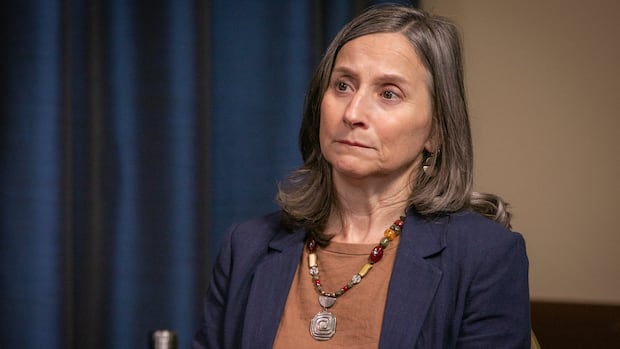
British ColumbiaB.C.’s former chief coroner says the provincial government didn’t seem influenced by evidence or expert advice on how to prevent overdoses, saying it ignored multiple recommendations from experts to create a safer drug supply that did not require a prescription.Lisa Lapointe was testifying during court challenge filed by co-founders of an illicit drug ‘compassion club’Ashley Joannou · The Canadian Press · Posted: Dec 11, 2025 4:37 PM EST | Last Updated: 4 hours agoListen to this articleEstimated 4 minutesThe audio version of this article is generated by AI-based technology. Mispronunciations can occur. We are working with our partners to continually review and improve the results.B.C. Chief Coroner Lisa Lapointe on Aug. 16, 2022. (Mike McArthur/CBC)B.C.’s former chief coroner says the provincial government didn’t seem influenced by evidence or expert advice on how to prevent overdoses, saying it ignored multiple recommendations from experts to create a safer drug supply that did not require a prescription.Lisa Lapointe was testifying in court as part of a constitutional challenge filed by Jeremy Kalicum and Eris Nyx, the founders of Drug Users Liberation Front (DULF), who ran a Vancouver-based “compassion club” that sold tested illicit drugs to members.Lawyers for Nyx and Kalicum are arguing that shutting down the club that sold tested heroin, cocaine and methamphetamine violated the Charter rights of those wanting to use the safer drugs instead of those purchased on the streets.On Wednesday, Lapointe told a judge that she set up three expert panels into the overdose crisis since 2017.WATCH | Lapointe told CBC News she was terrified at backlash to safe supply:Safe supply backlash ‘terrifies’ B.C.’s chief coronerAs she heads into retirement, B.C.’s chief coroner Lisa Lapointe says she worries that the political winds have turned against drug decriminalization, and that people who oppose it don’t understand how safe supply saves lives.The former chief coroner said the last two panel reports in 2022 and 2023 recommended the government oversee a “non-medical” model of providing drugs without the need for a prescription, similar to what DULF was doing. She told the court that recommendations from the 2017 received a detailed response from the government, though not everything was implemented, but the later two did not get the same reaction.”By that point it seemed that government was not being influenced by evidence or expert advice, and I’m not sure what they would need,” she said.WATCH | Drug policy analyst praised Lapointe as she retired:Retiring B.C. chief coroner was ‘steadfast and unwavering’ advocate for drug users, analyst saysKaren Ward, a drug policy analyst and Downtown Eastside resident, talked about Lisa Lapointe’s legacy as the coroner looks set to retire in the new year.She said that, in 2022, the government responded to the recommendations with a list of projects that were underway to expand a prescribed safer supply of drugs — but were “silent” about a model not requiring a prescription.Lapointe, who retired last year after 13 years in the position, said she found out at the news conference while releasing the third report that the government had already said that a non-medical model was not being considered.She told the court that the 2022 report in particular was written with a sense of urgency as deaths climbed and there was “a great deal of fear” among those on the front line trying to help.Jeremy Kalicum, left, and Eris Nyx, founders of the Drug User Liberation Front speak to media in Vancouver in October 2024. The two were found guilty of drug possession for the purpose of trafficking, but the convictions are suspended pending the constitutional challenge. (Ben Nelms/CBC)The B.C. government declared a public health emergency in 2016 as deaths started to climb and since then, at least 15,000 people have died. Lapointe said she feels frustration with the provincial funding of in-patient recovery facilities without keeping data on how the beds are used and whether they are “successful,” while also not regulating recovery facilities in the province.Safer supply programs, on the other hand, are very well monitored, she said. Lapointe testified that “political winds have shifted” both on the federal and provincial level from a health focus to one more interested in law enforcement.People are pictured during a rally in support of the Drug User Liberation Front (DULF) after the arrest of Kalicum and Nyx in November 2023. (Ben Nelms/CBC)DULF originally applied to Health Canada for an exemption to Canada’s drug laws that would allow them to run a compassion club that tests and sells drugs at cost to a small group of users to track its effectiveness.When that request was denied, the group went ahead anyway, buying drugs off the dark web and testing them for safety.While Nyx and Kalicum have been found guilty of possession for the purpose of trafficking, those convictions have been temporarily suspended until the constitutional challenge has been resolved — which won’t happen until next year.Their lawyers have said that the Health Canada exemption was not “practically available” to the club because of a series of bureaucratic and legislative barriers.WATCH | Kalicum speaks about positive impact DULF had on its members:A positive impact for membersCompassion club co-founder Jeremy Kalicum says members of the group benefited from having access to a predictable and uncontaminated supply of drugs such as heroin, cocaine and methamphetamine.The court has heard that no group is currently licensed to provide the type of legal drugs Health Canada would require be used if it were to grant an exemption for a program like DULF.Federal Crown lawyer Oren Bick flagged for the judge that the provincial government was not a part of the case and did not have a lawyer present to take a position.The court heard that the provincial attorney general’s office is aware of the case but chose not to participate.
Former B.C. chief coroner says province unmoved by expert advice on toxic drugs