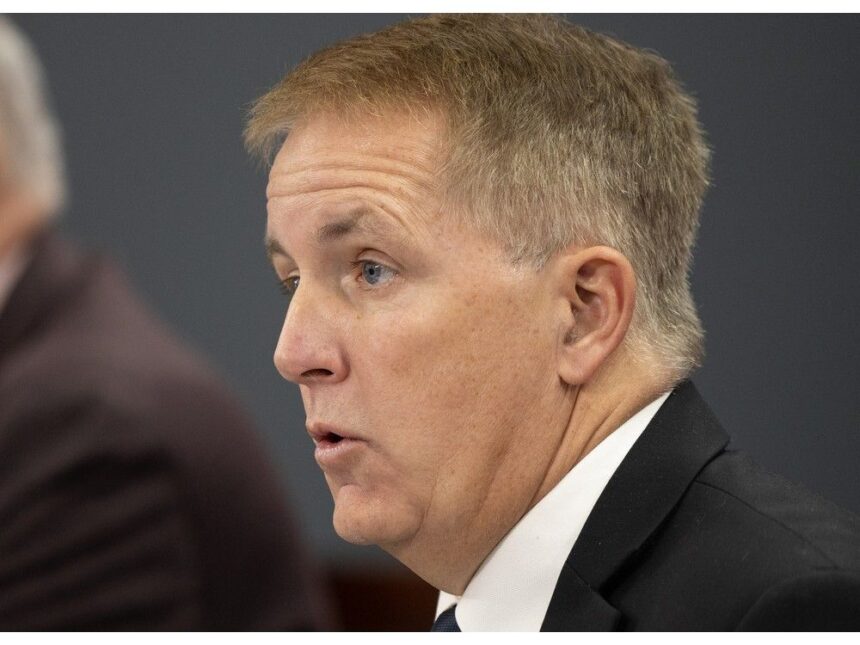
Article contentHe rejected the suggestion that he is positioning himself as a representative voice for Mi’kmaq people over chiefs and council. He said, “No, I think, as premier and as government, we have an obligation to Nova Scotians to protect public safety.” Article contentArmstrong: “This is not a First Nations issue” Article contentArmstrong, whose directive triggered the dispute, said the order was not targeted toward Mi’kmaq communities. Article content“This isn’t a First Nations issue. This is a public safety issue. We have illegal cannabis shops on reserve and off reserve across the province,” he said. “My concern is the public safety of Nova Scotians.” Article content Justice Minister Scott Armstrong answers questions from reporters at One Government Place on Thursday, Dec. 4, 2025. Photo by Ryan Taplin /The Chronicle HeraldArticle contentArmstrong acknowledged that the initial reference in the directive to 118 illegal dispensaries on reserves is inaccurate. However, he said, it was representative of a broader issue.Article content“There’s well over a hundred illegal dispensaries across the province,” he said. “Some are on reserve, some are off the reserve, some are small, some are big, but I just wanted to show everyone the challenge that we’re facing here in trying to control legal substances being sold to Nova Scotians.” Article contentArticle contentMartin will not resignArticle contentMartin was referred to as “a disrespectful person who has no right to speak on our behalf” by Chief Michelle Glasgow in the resolution statement and has faced calls from Sipekne’katik First Nation to resign. Article content“I’m disappointed that we don’t have a more positive message coming from my colleague . . . but she’s entitled to her own opinion,” Martin said when asked about Regional Chief for Nova Scotia Andrea Paul, who recently shared similar disapproval of the minister.Article contentMartin said she would not be resigning. Article content“I don’t have to hold this position, and I’m not in this position because I am Mi’kmaq. . . . I think it’s a limited scope to say that I should resign because we don’t agree on all things.” Article contentMartin said she’s “remaining committed to open dialogue and positivity” and keeping “an open door” despite protests from Mik’maq leadership and the ban. Article contentArticle content“Whether or not we disagree, it’s a reality of governance. . . . There’s decisions that happen all the time where people agree and disagree,” she said. Article contentHow the opposition sees itArticle contentMembers of the opposition said the ban signals an erosion of trust between the Houston government and Mi’kmaq leadership. Article content“We have seen the complete deterioration of the relationship between our Indigenous leadership in our communities and the government,” said Liberal MLA Derek Mombourquette. “There’s only one way that this is going to be fixed at this point. . . . The premier has to pick up the phone.” Article contentNDP Leader Claudia Chender said that beyond health and safety concerns, this is a revenue issue for Houston’s government.“This government wants the tax revenue from the unregulated cannabis that’s being sold,” she said.Article contentChender added that beyond revenue, she wasn’t “sure what it is that this government is trying to accomplish, other than to, you know, set up another enemy for themselves.” Article contentArticle content
Houston says Nova Scotia cannabis crackdown about fentanyl-lacing, public safety in response to Sipeknekatik ban