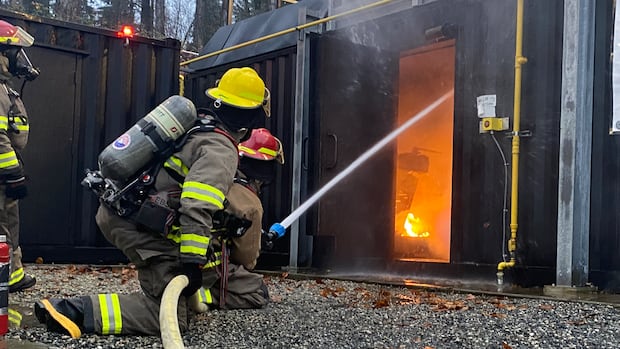
British ColumbiaThe faux tugboat sits on land at the District of North Vancouver’s Maplewood Fire Centre. There, municipal fire crews and Seaspan workers are getting a taste of what a boat fire in the harbour’s waters could throw at them.Seaspan’s $800K mock tugboat fire simulator trains crews to fight flames in dangerous conditionsLiam Britten · CBC News · Posted: Dec 03, 2025 10:00 AM EST | Last Updated: 5 hours agoListen to this articleEstimated 5 minutesThe audio version of this article is generated by text-to-speech, a technology based on artificial intelligence.Trainee fire crew members, left, and an instructor stand outside the mock galley on the tugboat fire simulator in North Vancouver. Built by shipbuilder Seaspan at the cost of $800,000, CBC News was granted an exclusive look at training efforts on Monday, as officials say there needs to be more preparations along the busy Burrard Inlet. (Liam Britten/CBC)Donning respirators and heavy, protective jackets and pants, crews are preparing to extinguish a blaze on a boat docked in Burrard Inlet.It’s a task that comes with a long manifest of dangers.“It’s not just fire, it’s confined spaces we have to deal with,” said Dwayne Higgins, rescue safety lead for shipbuilder Seaspan. “How do we get to those fires? How do we get to our people? How do we extinguish those fires? How do we get our hose lines down there?”Fortunately, today is only a dry run of a disaster on the water, using what Seaspan says is training coming to the West Coast for the first time.It’s a modular tugboat, on dry land, helping train crews to fight a fire on a boat.Crews prepare to open the galley door and douse gas-powered flames with hoses as part of a drill. (Liam Britten/CBC)The vessel looks a bit like a stack of containers on top of a small boat hull. Gas fixtures blast flames and billow smoke. Steep staircases and narrow halls, along with jutting-out pipes, make movement a challenge. Rough metal furniture resembles a ship’s diesel engine — and even a galley or kitchen — prime places for flames to erupt.The faux tugboat sits on land at the District of North Vancouver’s Maplewood Fire Centre. Dwayne Higgins is a former Vancouver Fire Rescue Service firefighter and now leads Seaspan’s fire training at the tugboat. (Liam Britten/CBC)There, municipal fire crews and Seaspan workers are getting a taste of what a boat fire in the harbour waters could throw at them.“It’s not just about training,” said Higgins. “It’s about understanding how a vessel operates, what’s in a vessel, what obstacles we’re faced with and how are we going to deal with them.”North Vancouver firefighters are welcoming the simulator as a valuable tool to help improve safety on the Burrard Inlet’s busy waterfront — a waterfront likely to only get busier in the future.WATCH | Tugboat gives crews marine disaster experience:This tugboat is giving B.C. crews hands-on experience fighting marine firesA North Vancouver shipyard has teamed up with the local fire department for a novel approach to safety in the busy waters of Burrard Inlet. Liam Britten got an exclusive look at the training session — which included Seaspan tradespeople who are volunteering to be a first line of defence should a fire break out on a ship still under construction. ‘Let’s do what we do’The mock tugboat — christened Seaspan Responder — has been in the works for four years, Higgins said, and the company paid $800,000 to build it.Recent months have seen responders come aboard to gain their sea legs on it. CBC News was granted an exclusive look at that training Monday.Monday saw volunteer shipbuilders, not career firefighters, taking a turn. Higgins described these tradespeople as a first line of defense should a fire erupt.Instructors, in red helmets, brief trainees on the drill. (Liam Britten/CBC)As they gathered in their gear outside the boat, Higgins explained the scenario to them: a fire in the ship’s kitchen has been burning for some time. Fire extinguishers didn’t snuff it out, but the flames are contained.“Are we clear with that?” Higgins asks the assembled crew, drawing nods and affirmatives.“Okay guys, let’s do what we do.”Trainees put on self-contained breathing apparatuses before opening the door to the “galley” on the tugboat. (Liam Britten/CBC)A pair of volunteer firefighters approach the heavy metal door with smoke escaping from it. They lay down a line of hoses and then spray down the door. The water’s reaction, Higgins explains, helps them tell how close the flames are.“I see some smoke! Let’s open it all the way!” one yells after putting his mask on, and then they beat back bright orange flames with a concentrated spray.“Advancing!” the lead yells, and they run closer to the inferno. Both kneel, spray more water, and turn the fire to smoke.A second drill saw the trainees extinguish a fire in the tugboat’s “engine room.” Higgins explained engine rooms can be dangerous because of the chemicals often them, and the smoke billowing up can create a chimney-like effect. (Liam Britten/CBC)Higgins says it wasn’t a perfect drill, but it let these less-experienced crews learn from their mistakes safely.“It’s not just about problem-solving. It’s about doing it safely and taking care of each other,” Higgins said.Firefighters say more marine resources neededDistrict of North Vancouver firefighters have also been making use of the prop for their training.Gunter Kramer, assistant chief of training and professional development, says it’s been a useful tool for improving readiness for a land-based response to boat fires. He explained that, as it stands, Vancouver Fire and Rescue and their three firefighting boats would be called on to fight a boat fire from the water.And while Kramer expressed gratitude for Seaspan’s tool, he argues there is more needed to fight fires on the busy Burrard Inlet waterfront that separates Vancouver from the North Shore.“This is a huge challenge … and we are just in the beginning of getting prepared for that,” Kramer said. “It’s obviously, financially, it’s a big impact on fire departments.”Kramer said part of the problem in the Burrard Inlet is the lack of cohesion between so many agencies and governments claiming jurisdiction along the shoreline.Pointing to Monday’s training, Kramer said having shipbuilders trained to fight fires is valuable as they have the knowledge of what’s going on inside a ship under construction, and shipbuilding is work that could lead to a fire.Higgins agreed.“We need to be able to respond quickly, do the best we can with what we have,” he said.ABOUT THE AUTHORLiam Britten is an award-winning journalist for CBC Vancouver. You can contact him at liam.britten@cbc.ca or follow him on Twitter: @liam_britten.
How a tugboat on land is helping prepare for nautical disaster on Burrard Inlet