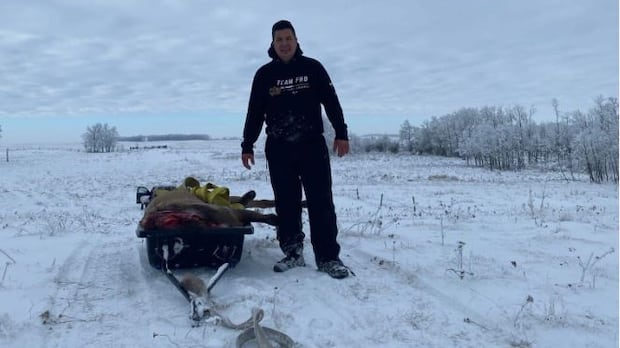
Indigenous·NewRiel Thomson hunts elk, deer and moose on farmland to harvest meat for his community while helping control the big game that can wreak havoc on crops, bales and fencing.’We all love the land and want the best for it,’ says rancher who relies on huntersLouise BigEagle · CBC News · Posted: Dec 04, 2025 5:00 AM EST | Last Updated: 30 minutes agoListen to this articleEstimated 4 minutesThe audio version of this article is generated by text-to-speech, a technology based on artificial intelligence.Riel Thomson beside a sled with a elk carcass on top. Thomson has been hunting on farmland for over 10 years, building a long-lasting relationship with one family in particular. (Submitted by Riel Thomson)Riel Thomson, a hunter from Cega’kin Nakoda Nation (Carry the Kettle), helps farmers and ranchers with their elk, deer and moose issues in southeast Saskatchewan.Thomson said he has been doing this for 10 years and feeds about 30 families with the meat he gets from these animals.It started when he heard about a farm family asking for help because wildlife were eating haybales meant for their cattle.”I didn’t just show up and start dropping all the elk,” said Thomson.”It was something we built together and it’s nice to have that trust both ways.”Thomson said that relationship started to build as the family would invite him inside for breakfast and the older man would share stories of the Indigenous people he knew.Thomson, a principal for the adult high school program in his community, learned his hunting skills from his father and grandfather and was taught to use all parts of the animal. Riel Thomson (right) with his dad and a cousin. Thomson was taught to hunt and fish by his dad and grandpa. (Submitted by Riel Thomson)Thomson said they not only use the animals for food but the boys from his school made drums from the hides and they use the bones for tools.”That’s healthy food and we want to make sure that we’re still consuming it,” said Thomson. Thomson said he gets calls from other farmers asking for his help with their elk or moose to harvest them in a good way.He said he makes sure to get to know the area before shooting, like where the houses are located, and he even offers help around the farm with chores they may need.”We have about six or seven good guys that are down to hunt to share with the community and be there just as our warriors once were,” said Thomson.The Saskatchewan Crop Insurance Corporation’s 2024-25 annual report stated there were 267 waterfowl claims resulting in $1.7 million in compensation paid, 2,976 big game claims with $24.2 million in compensation and 3,548 predation claims with $6.7 million in compensation. The Saskatchewan Wildlife Federation stated it encourages relationship building between farmers and First Nations hunters for opportunities for subsistence hunting.’A really good fit’Mark and Laura Hoimyr in Gladmar, Sask., about 160 kilometres south of Regina, have been raising beef cattle for 30 years on a large area of native prairie. Mark Hoimyr said there have been times when mule and whitetail deer populations have caused issues with their electrical and temporary fencing. “There are years when the winters are hard and the deer are really hard on haystacks or especially hard on things like corn grazing and swath grazing,” he said. Mark and Laura Hoimyr are hoping to connect with more First Nations hunters and medicine pickers to come harvest on their lands. (Submitted by Laura Hoimyr)They were looking for options for help and Mark said that can be a challenge.”We don’t know the people to offer the hunting to and people don’t always know whose yards are safe to approach or go in or who to call,” he said.Three years ago they attended a conference where they learned about the Treaty Land Sharing Network.”We thought that’s a really good fit — a way to to be able to share our land and have people be able to access land for hunting or gathering plants, medicines,” said Laura Hoimyr. She said this relationship building is a good way to challenge those stereotypes people may have about First Nations people. “Just being able to talk to people one-on-one and realize we all have the same goal. We all love the land and want the best for it,” she said.Thomson said he sees it as a way to move forward collectively within the treaty relationship. He said he will be continuing to help farmers out and get some meat into the freezers of families and elders for the holidays. ABOUT THE AUTHORLouise has been a journalist with CBC since September 2022. She is Nakota/Cree from Ocean Man First Nation. She holds a bachelor of fine arts from the University of Regina. Louise can be reached at louise.bigeagle@cbc.ca.
How this First Nations hunter builds treaty relationship with farmers