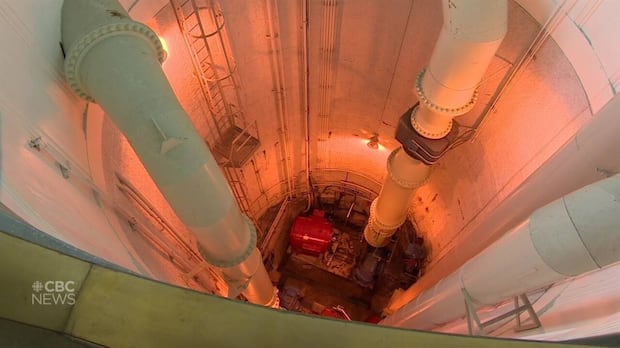
Manitoba·AnalysisWinnipeg now has a potential end date for its multi-year sewage-upgrade saga — three decades after the initial sewage spill that triggered it in the first place.There’s an end date to the city’s multi-billion-dollar sewage-upgrade saga: 3 decades after it startedBartley Kives · CBC News · Posted: Dec 02, 2025 6:00 AM EST | Last Updated: 4 hours agoListen to this articleEstimated 6 minutesThe audio version of this article is generated by text-to-speech, a technology based on artificial intelligence.Upgrades to the North End Water Pollution Control Centre, the largest of Winnipeg’s three sewage-treatment plants, are part of a multi-decade environmental improvement program. (Cameron MacLean/CBC News)By every measure except one, Winnipeg was a pleasant place to be on Sept. 16, 2002.It was a mostly cloudy but unseasonably warm Monday, with temperatures peaking at 25 C. Manitoba Public Insurance announced a steep decline in car theft. The Winnipeg Goldeyes beat the New Jersey Jackals 3-0 in the first game of the Northern League Championship Series final.And starting at about 1:30 p.m., raw sewage began spilling out of the North End Water Pollution Control Centre, the largest of the city’s three sewage-treatment plants.About 2½ days later, during the wee hours of Sept. 19, this spill into the Red River was contained. In the meantime, 427 million litres of raw sewage ended up in the Lake Winnipeg watershed.This was the largest raw-sewage spill in the city’s history. Although the total volume of the spill was small compared to the vast waters of Lake Winnipeg — it would have taken about 667,000 similar accidents to fill the lake — the fact this was actual raw sewage, as opposed to partly treated effluent or stormwater-diluted crud, led to a series of engineering and environmental investigations.The following year, the province ordered the city to upgrade all three of its sewage-treatment plants. The city was given a deadline of Dec. 31, 2014, to improve the processes at its North End, South End and West End plants.The cost was initially estimated at less than $1 billion.This did not go as planned, as the city lacked the financial, engineering and construction resources to do this on its own, despite the provincial Clean Environment Commission envisioning this massive project as a shared responsibility between the city, province and federal governments.Now, there is a proposed end date to the project — three decades after the initial sewage spill that triggered it in the first place.On Monday, Winnipeg water and waste director Tim Shanks told city council’s water and waste committee that upgrades to the North End Water Pollution Control Centre could be finished by 2032.“We’re essentially building a brand new plant within the footprint of a 100-year-old facility. So it’s a huge upgrade,” Shanks said following the meeting.The North End Water Pollution Control Centre, built in 1937, is the largest and oldest sewage treatment plant in Winnipeg. Upgrades totalling $3 billion include new headworks, biosolids processing for all three city sewage-treatment plants and a nutrient-removal facility. (City of Winnipeg)The city completed the upgrades to the small West End plant 16 years ago for $47 million. Upgrades to the larger South End plant required another decade and $336 million.The cost of the North End upgrades, meanwhile, now stands at $3 billion. That includes almost $300 million for new headworks that can remove more oil and grease before it enters the plant, roughly $1 billion for a facility to process sewage sludge into non-toxic biosolids that can be used as fertilizer, and another $1.5 billion to remove nutrients from the sewage effluent before it’s returned to the Red River.The most important nutrient slated for removal is phosphorus, which contributes to blooms of algae that change the chemistry of Lake Winnipeg when they die off and deprive the lake of oxygen as they decompose.All of this work, together, will reduce the total nutrient loading into Lake Winnipeg by only one or two percentage points. Prior to the upgrades, the city was responsible for only five per cent of the phosphorus flowing into Lake Winnipeg, according to the landmark report by the Lake Winnipeg Stewardship Board.Nonetheless, the province ordered up the work and the city is completing it. The issue is now a question of economics as well as an environmental imperative: Residential and commercial developers are concerned they won’t be able to conduct business in Winnipeg if the city does not expand its sewage-treatment capacity.An existing well at the North End Water Pollution Control Centre. (CBC)In a matter of months, the city will complete the new headworks at the North End plant. The biosolids facility is not expected to be completed until 2030.The city is expected to run out of capacity to dispose of its biosolids one year earlier without completing digesters at this new biosolids facility. But that’s a temporary problem.The more concerning issue is the prospect of running out of liquid-stream sewage-treatment capacity prior if the nutrient-removal facility doesn’t get built.The city can meet the new 2032 deadline, if all goes well, Shanks said. A design for this third phase is slated to drawn up in 2026, he said.“The issue with the completion of the actual construction is the complexity and size of the project and how it interfaces with the other projects on the same site, at the same time,” said the water and waste director, referring to all three phases of the project.The main thing standing in the way is another $1 billion for this phase. The city set aside $547 million in this year’s capital budget for the $1.5-billion job and it’s counting on Mark Carney’s federal Liberal government and Wab Kinew’s provincial NDP government to kick in another $500 million each.“The variable is the billion dollars we’re going to need from the province and the federal government. So I’ll be pretty confident we can get this done if we can get that,” said St. Vital Coun. Brian Mayes, a former water and waste chair who still sits on the committee.Without that money, the city would be forced to hike water and sewer rates to the point where Winnipeggers who have not been paying attention to this decades-long sewage-upgrade saga may be tempted to believe something else in the city doesn’t smell very well.It’s a classic question of pay-me-now or pay-me-later, with the latter option always costing more in the long run.ABOUT THE AUTHORBartley Kives joined CBC Manitoba in 2016. Prior to that, he spent three years at the Winnipeg Sun and then 18 at the Winnipeg Free Press, writing about politics, music, food and outdoor recreation. He’s the author of three books – two of them Canadian bestsellers – and the winner of a Canadian Screen Award for reporting.
In Winnipeg, a distant light flickers at the end of a sewage-treatment tunnel