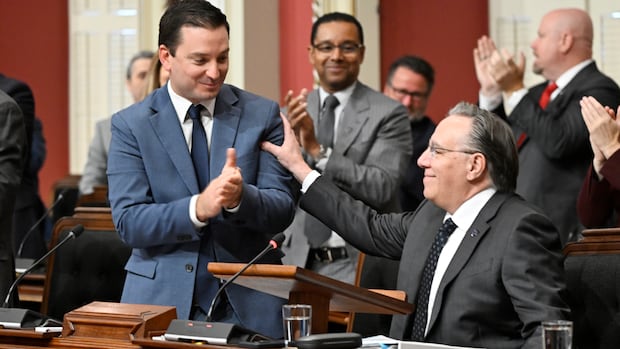
MontrealA group of legal experts has requested United Nations special rapporteurs examine Bill 1 to determine if it infringes on human rights.United Nations special rapporteurs called on to examine Bill 1Benjamin Shingler · CBC News · Posted: Dec 03, 2025 12:56 PM EST | Last Updated: 2 hours agoListen to this articleEstimated 3 minutesThe audio version of this article is generated by text-to-speech, a technology based on artificial intelligence.Quebec Premier François Legault, right, congratulates Quebec Justice Minister Simon Jolin-Barrette in October after he tabled legislation to create a Quebec constitution. The bill has faced criticism in the months since. (Jacques Boissinot/The Canadian Press)A group of legal experts is taking its fight against Quebec’s proposed constitution to the international stage, arguing the legislation fails to respect the rights of minorities, Indigenous people and the rule of law.The Canadian branch of the International Commission of Jurists (ICJ) has requested United Nations special rapporteurs examine Bill 1 to determine if it infringes on human rights.Stéphane Beaulac, a professor of constitutional law at the Université de Montréal and a member of the ICJ, held a news conference Tuesday alongside other law professors and Indigenous leaders to announce the move.While Beaulac said he favours Quebec having its own constitution, he said “the bill in question is not that.”“This is not a constitution,” Beaulac told CBC News. “It’s a political, ideological program that runs contrary to international standards with regard to access to justice.”The draft constitution was tabled in October by Premier François Legault’s Coalition Avenir Québec government without prior consultation. It sets out to protect what the government deems to be the common values of the province, including the French language, secularism, the right to abortion and equality between men and women.However, many First Nations leaders, civil liberties groups and legal experts have come out against the draft.Critics contend that, under Bill 1, the collective values defined by the state — such as secularism and the French language — could trump individual liberties.There is a provision that would effectively ban publicly funded bodies, including school boards, from using their funds to challenge provincial laws in court — a move experts say attacks the rule of law by insulating the government from judicial review.First Nations leaders have also raised concern the constitution fails to recognize their status as sovereign nations with rights to self-determination.Consultations set to beginThe ICJ sent a letter on Tuesday to 10 UN special rapporteurs, including those responsible for minority rights, racism and the independence of judges and lawyers.Special rapporteurs are appointed by the UN Human Rights Council to monitor, report on and advise on specific human rights issues or country situations. While they do not conduct formal investigations, Beaulac is hopeful that criticism on the international stage will force the CAQ government to make changes.“Our initiative is really to bring the case of Bill 1 outside of the jurisdiction of Quebec and of Canada and to bring it to the attention of the world,” Beaulac said.WATCH | Quebec bar raises concern over 3 bills:Quebec bar association condemns recent CAQ government laws in rare political moveThe Barreau du Québec rarely gets involved in politics, but it’s publicly calling elements of three recent provincial government bills “concerning.”Legault, for his part, has said the constitution aims to assert Quebec’s “distinct national character.””When we look at our history, our survival as a nation was improbable, but we are still here,” he said after Justice Minister Simon Jolin-Barrette tabled the bill.Consultations on Bill 1 are set to begin Thursday at Quebec’s National Assembly.Miriam Cohen, also a law professor at Université de Montréal, said those consultations should have been held before the constitution was tabled.”We should know better,” she said. “If we are calling a law a constitution, according to international standards, you need to have [those prior] to drafting a text — consultations that are inclusive and transparent.”ABOUT THE AUTHORBenjamin Shingler is a reporter based in Montreal covering social issues and Quebec politics. He previously worked at The Canadian Press and the New Brunswick Telegraph-Journal, and is an alumnus of the Oxford Climate Journalism Network. He can be reached at benjamin.shingler@cbc.ca.
Legal experts ask UN to scrutinize Quebecs proposed constitution over rights concerns