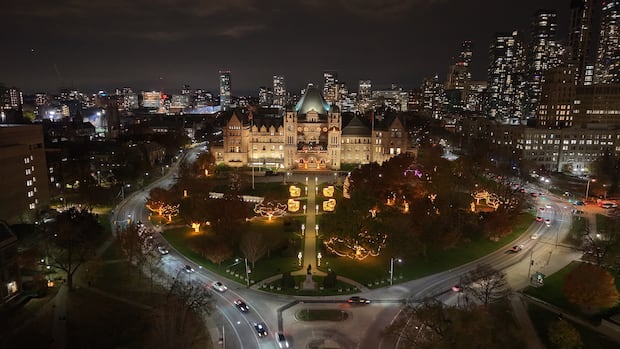
Toronto·NewLess than half of the province’s “strong mayors” were using their controversial powers in the months ahead of a sweeping expansion of the system to 170 additional communities, according to estimates by Ontario’s civil service.Ontario expanded powers to 170 more mayors in the spring with little oversight, experts sayShawn Jeffords · CBC News · Posted: Dec 09, 2025 4:00 AM EST | Last Updated: 30 minutes agoListen to this articleEstimated 6 minutesThe audio version of this article is generated by text-to-speech, a technology based on artificial intelligence.Less than half of Ontario’s ‘strong mayors’ were using their powers before a sweeping expansion of the system to 170 new communities, according to documents obtained by CBC News. (Patrick Morrell/CBC)Less than half of the province’s “strong mayors” appeared to be using their controversial powers in the months ahead of a sweeping expansion of the system to 170 additional communities, according to estimates by Ontario’s civil service.Those findings are detailed in internal Ontario Public Service reports that tracked the use of so-called strong mayor powers until March 31. CBC News obtained the reports through a freedom of information request.According to the reports, 48 per cent of the 46 mayors had used the powers at least once by that point. The province extended the powers to nearly half of Ontario’s municipalities just months later. The report, intended for senior government officials, also finds that a quarter of the strong mayors delegated all of their powers to city council or their chief administrative officers. “Ministry staff are not commenting on whether the purported use of strong mayor powers was done so in accordance with the legislation and regulations,” the civil servants cautioned. “Implementation of the strong mayor framework is a local responsibility.”Premier Doug Ford’s government created the strong mayor system in 2022, saying it did so to help build housing after promising to build 1.5 million homes by 2031. (Evan Mitsui/CBC)Ford created strong mayor system to build housingPremier Doug Ford’s government created the strong mayor system in 2022, saying it did so to help build housing after promising to build 1.5 million homes by 2031. But Ontario’s housing market has ground to a halt in recent years.The powers give mayors control over appointments, the ability to hire and fire most city staff, vetoes over some council votes and the ability to pass some bylaws with support of only a third of council.Ontario first granted strong mayor powers to Toronto and Ottawa, then to 26 more communities the next year. On May 1, the province expanded the system to 170 more municipalities, bringing the total to 216 strong mayors across Ontario.But the internal reports show strong mayors were using their powers to reorganize their municipal structures more than for vetoes and votes.The tracking shows 15 mayors reorganizing committees 37 times. Three mayors either fired their top administrator or a division head. The civil servants also found three mayors used their powers for vetoes or passing bylaws with a third support a combined 12 times by three mayors.The report is careful to acknowledge the limits of the tracking, which doesn’t count the budget process as a use of the strong mayor powers, even though the legislation fundamentally changes how communities draft and pass their annual spending packages.Nor does it include directives the mayor can issue to staff under the powers — directives that don’t have to be publicly posted and can’t be tracked.Ajax Mayor Shaun Collier believes he’s one of the most active users of the system since it was introduced. He says he’s delegated most of the powers to hire and fire to city staff, but is using the powers to speed up approvals for dense, high-rise development.“I think once they got comfortable with it, everybody realized it is a very good tool,” he said of his council and staff.Ajax Mayor Shaun Collier believes he’s one of the most active users of the system since it was introduced. (CBC)He acknowledges that his use of the powers has, at times, been controversial. He’s not running for another term in office, while some mayors could be concerned about facing political consequences and are taking a wait and see approach, he said.“I was able to remove that kind of political side of things, and it allowed me to get this done,” he said.Concerns over ‘chill’ among municipal workersDave Arbuckle, executive director of the Association of Municipal Managers, Clerks and Treasurers of Ontario, said use of the strong mayor system has created a “chill” among municipal workers. “(They) do not want to challenge a mayor or provide advice that’s contrary to the mayor’s perspective,” he said.Arbuckle said the province to must remove the power to hire and fire civil servants from the strong mayor system to ensure staff are able to provide independent advice.“There’s no evidence at all to support that the changing of staff in any position … is doing a thing to be able to build housing in the province of Ontario,” he said.NDP municipal affairs critic Catherine McKenney says the powers are undemocratic and that’s why only half the mayors have used them.“They do understand that no one person knows what’s best for their entire municipality. It’s a dangerous precedent,” McKenney said.Liberal municipal affairs critic Stephen Blais worries extending the powers to smaller municipalities where oversight is low could make the powers prone to abuse.“It’s a recipe for corruption,” he said. “It’s a recipe for really kind of bad decision-making that then becomes very hard to track.”NDP municipal affairs critic Catherine McKenney says the strong mayor powers are undemocratic and that’s why many mayors in the province aren’t using them. (Robyn Miller/CBC)A spokesperson for Municipal Affairs Minister Rob Flack defended the expansion of the strong mayor powers. Michael Minzak points to Ajax, Brampton and St. Catharines, which have utilized the system to help get housing built.“Across the province, we are seeing municipalities using the strong mayor framework to deliver results,” he said in a statement.Few guardrails on strong mayor powers, experts warnExperts who study municipal government say the civil service findings line up with their own studies. University of Toronto political science professor Gabriel Eidelman and his colleagues survey politicians in 1,000 communities annually for their Canadian Municipal Barometer. Strong mayors appear to be more comfortable using the powers to reorganize and hire or fire, as opposed to the more contentious vetoes, he said.But he worries there are very few guardrails on how far into city hall a mayor can reach when it comes to staffing changes, he adds.“What is to stop a mayor from firing the zamboni driver at the local rink if they don’t do a good job of cleaning up the ice there?” Eidelman said.York University political science professor Zac Spicer said the shift to accountability to a single individual, rather than a full city council, is a significant change. “We really want our city staff giving fearless, evidence-based advice,” Spicer said. “And if the hiring around them becomes political, that becomes much harder.”Eidelman said firm protections for civil servants, whistleblower policies, and more general guidance from the province is needed.“It really is leaving it to chance in some way, for some particularly for the smaller municipalities, to see how this plays out,” Eidelman said.ABOUT THE AUTHORShawn Jeffords is CBC Toronto’s Municipal Affairs Reporter, but is currently covering the Ontario Legislature. He has previously covered Queen’s Park for The Canadian Press. You can reach him by emailing shawn.jeffords@cbc.ca.
Less than half used strong mayor powers before Ontario expanded system