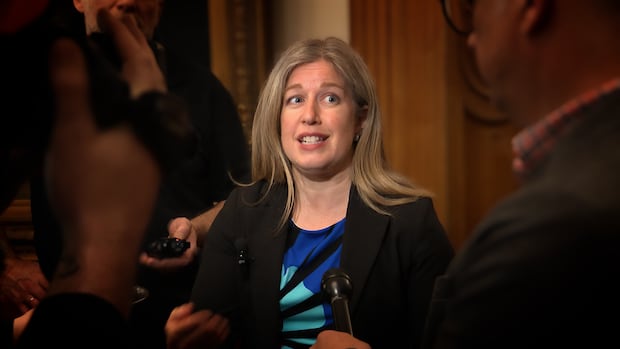
New BrunswickThe province’s Energy and Utilities Board blocked Susan Holt’s move to get rid of the cost-of-carbon adjuster. Holt may be frustrated with the board’s decision but it could’ve been avoided with proper legislation.Holt government opted against explicitly forcing oil producers to absorb cost of federal regulationsJacques Poitras · CBC News · Posted: Dec 04, 2025 3:06 PM EST | Last Updated: 1 hour agoListen to this articleEstimated 5 minutesThe audio version of this article is generated by text-to-speech, a technology based on artificial intelligence.Premier Susan Holt said she is ‘frustrated’ with the Energy and Utilities Board decision to wipe out her eight-cent gas price cut. (Mikael Mayer/CBC)Premier Susan Holt may say she’s “frustrated” by the Energy and Utilities Board wiping out her eight-cent gas price cut, but comments at last week’s hearing on the plan make it clear the Liberals had an option to avoid that and chose not to use it.An oil sector lawyer and a member of the board itself both said the government could have simply forbid consumers from being charged for the cost of federal clean fuel regulations.“The legislature could have said, ‘Board, here’s a definition of these costs. They are not to be included in your consideration’” of what consumers pay, Irving Oil lawyer James MacDuff told the EUB.“That is something the legislature clearly could have done. They did not do so.”EUB chair Christopher Stewart called it “a void” left in place by the Liberal legislation, which repealed the previous government’s 2022 cost-of-carbon-adjuster law.That void opened the door for gas retailers to argue that the board should use other mechanisms in existing laws and regulations to replace the eight-cent surcharge with a new charge in the same amount.WATCH | ‘They did not do so’: Liberals failed to force carbon cost onto producers:Why Susan Holt’s carbon adjuster bill failed to eliminate gas surchargeNew Brunswick’s energy regulatory board says Liberal legislation left a ‘void’ that led it to adopt a new, eight-cent charge on the price of gas. In its ruling, the board said it still had the discretion to do that because the Liberals did not take it away.“The 2022 amendments [creating the adjuster] did not change this. The 2025 repealing statute does not change this either,” Stewart said.The Liberal law adopted in June “does not remove the board’s discretion to determine what other factors” are relevant in its price setting, he added. Natural Resources Minister John Herron said this week the government didn’t force the cost onto oil producers because “standard regulatory practice is that regardless of what that sector is … you’re entitled to recover your cost of operation.”Most of New Brunswick’s gasoline is supplied by the Irving Oil refinery in Saint John and the Valero refinery outside Quebec City.The previous Progressive Conservative government created the adjuster in 2022, requiring the EUB to calculate the cost of federal clean fuel regulations — aimed at oil producers — and insert it into its formula that sets the maximum price of gas each week.That forced the cost down the supply chain from the producers — through wholesalers, distributors and retailers, such as gas stations — onto consumers.The cost has fluctuated since then but hovered around the eight-cent-per-litre mark before the Dec. 1 repeal.Energy and Utilities board chair Christopher Stewart said new Liberal legislation left “a void” which allowed the board to replace the old charge with a similar one. (Pat Richard/CBC)Holt promised in the 2024 election to repeal the adjuster bill to save consumers money.Gas retailers argued that would leave them absorbing the cost passed down from producers, potentially driving some of them out of business.The EUB agreed last week that was a risk and, with the adjuster gone, opted to use other mechanisms in its price-setting formula to continue passing the same cost onto consumers.Herron, a former EUB member, said the board could have picked a different method of calculating the cost that might have at least reduced the surcharge by a few cents.“They chose to use the most costly mechanism that was before the board by maintaining the existing formula. They could have done something different,” he said.Opposition Progressive Conservative Leader Glen Savoie, who opposed the repeal of the adjuster, said the Liberals couldn’t even execute a bad decision properly.“It failed to draft legislation that was written clearly enough to protect consumers,” he said in Question Period this week.Natural Resources Minister John Herron said the government didn’t put the federal clean fuel regulation on producers since they are ‘entitled’ to recover their cost of operation. (Silas Brown/CBC)Holt promised as recently as Oct. 30, in a social media video, that prices would go down this month.“We’re delivering on that promise effective December 1,” she said. “This will save you money at the pump.” The premier said Monday the board “had the choice to deliver on the intent and spirit of what we were trying to do in the legislature, and they didn’t.”Herron also suggested the board should have relied on what elected officials wanted.“The legislative intent is part of their consideration. So those words may not be found in text, in legislation, but they have the responsibility to take judicial notice of that language,” he said.The EUB’s replacement surcharge is temporary, pending a more in-depth look at the costing formula in the new year.Holt said this week the government was “looking at other options” and “there’s lots of different interpretations about what the EUB can and can’t do.”Asked why her government didn’t have a Plan B ready in case the board put a replacement surcharge in place, the premier said there was a range of scenarios for the EUB’s ruling.“That’s what’s begging us to dig a little deeper into which of those plans … C, D, E, F – we can apply under these conditions,” she said.ABOUT THE AUTHORJacques Poitras has been CBC’s provincial affairs reporter in New Brunswick since 2000. He grew up in Moncton and covered Parliament in Ottawa for the New Brunswick Telegraph-Journal. He has reported on every New Brunswick election since 1995 and won awards from the Radio Television Digital News Association, the National Newspaper Awards and Amnesty International. He is also the author of five non-fiction books about New Brunswick politics and history.
Liberal bill repealing N.B. carbon adjuster left void for new gas surcharge