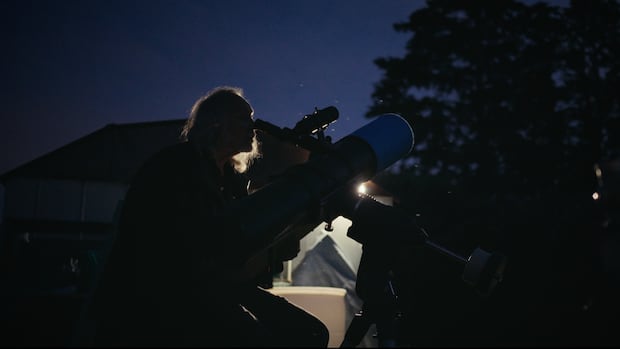
Manitoba·VideoThe new documentary Dark Skies follows scientists, researchers, and amateur astronomers fighting to create a rural preserve free of light pollution to save a slice of the night sky south of Winnipeg.There are easy ways to reduce light pollution, astronomers say in new documentary Dark SkiesListen to this articleEstimated 5 minutesThe audio version of this article is generated by text-to-speech, a technology based on artificial intelligence. New film ‘a love letter’ to the dark skyDark Skies, a new documentary by Winnipeg filmmaker Tyler Funk, warns of the dangers of light pollution and looks at efforts to create a new dark sky preserve in Manitoba.While many ecological problems seem overwhelming, a group of Manitoba astronomers say one is easily solvable: light pollution.”This is the one form of pollution we can just do something about by just not doing anything — by just refusing to participate in something that’s detrimental,” said Gerry Smerchanski. It’s as simple as turning off the lights, says Smerchanski, who is one of several amateur astronomers making the case for a second dark sky preserve in Manitoba.The proposed second preserve would be located north of Highway 201, between Stuartburn and Vita, around 100 kilometres southeast of Winnipeg. The exact boundaries are yet to be determined, but it would be about 190 square kilometres.Gerry Smerchanski is working to create a second dark sky preserve in Manitoba. Light pollution can easily be controlled by just turning off the lights, he says. (Tyler Funk)The pursuit to create a second preserve is at the heart of Dark Skies, a new 44-minute documentary directed by Winnipeg filmmaker Tyler Funk for CBC’s Absolutely Canadian series. (The film can be screened for free on CBC Gem.) In it, Smerchanski is joined by scientists and park staff in the quest. The documentary also provides awe-inspiring views of night skies, courtesy of Winnipeg filmmaker Tyler Funk.Dark Skies is “a love letter to the sky, to the dark sky,” said Funk.During filming, he learned that Spruce Woods Provincial Park became a dark sky preserve in 2022 — an international designation from the Royal Astronomical Society of Canada. So far, it’s the only such preserve in Manitoba. In urban and rural centres, bright, unshielded lights and strong LEDs whose glare bounces back up off the ground have diminished — and even erased — our view of the stars.”Once I started learning about this, the stats that we are literally losing our ability to see the night sky, that kind of affected me,” Funk said. “It’s weird to think that there might be a day when we don’t see the stars.”Filmmaker Tyler Funk, seen here with scientist Natasha Donahue, spent many nights outside in darkness to capture the magic of the night sky. His new documentary delves into the science and mysticism of preserving the darkness. (Tyler Funk)Funk connected with some of the astronomers who were part of Spruce Woods’ journey to become a dark sky preserve, which, due to floods and funding issues, took 13 years.Tim Kennedy was one of those astronomers. Part of that battle was sharing how dark skies have value to others beyond astronomers like himself, said Kennedy.”This was really an ecological preserve that had much greater implications for everybody — not just a special interest group but the whole entire land, animals, creatures, night, everything,” he said.The disappearing darkWith relatively cheap electricity in Manitoba, as well as technology like solar lights, the local astronomers noticed the sky being bleached out even in small rural communities.To that end, the astronomers’ work involved finding ways to ensure the park’s lights were shining more where they’re meant to, and less toward the sky. They visited Spruce Woods with dark sky meters, a process repeated in Dark Skies within the second potential preserve.The Nature Conservancy of Canada, in collaboration with the astronomers and Shared Legacy — a habitat protection group in Stuartburn — are currently working on the application for the second preserve, which will eventually be sent to a committee within the Royal Astronomical Society of Canada to evaluate.Smerchanski’s love of astronomy and science started as a child. Today, he has a backyard observatory where he spends a lot of time looking to the skies. (Tyler Funk)In addition to taking light meter readings and other measurements of the night sky, organizers met with community members in the area to talk about light pollution and the ecological and economic benefits of creating a dark sky preserve. The process to establish the new preserve was not finished by the time the documentary wrapped filming. That approval could still take months, organizers say. Meanwhile, the light bleed into the night sky has the astronomers concerned for other reasons.As homes and businesses keep lighting up, they worry about the life experiences their children and grandchildren might lose. I feel like humanity is missing out. If you have that connection to the universe, all of your problems really seem so much more smaller.- Silvia Graca”When your eyes are adapted to the darkness, you’re able to see so much further, so much more. Even the moon itself will cause shadows,” Kennedy said. “But most people will miss that.”This loss of darkness can affect natural migration patterns, which ripples outward, even putting at risk the survival of some species — like a rare orchid pollinated only by moths at night.Astronomers like Silvia Graca, who also appears in the film, care for life on the ground as much as for the awe of night skies. They want future generations to see the stars and also feel the sense of wonder they provoke.”I feel like humanity is missing out. If you have that connection to the universe, all of your problems really seem so much more smaller,” Graca says.”You look at it in such a different light.”ABOUT THE AUTHORAnastasia Chipelski is a copy editor with CBC Manitoba. She joined the CBC in 2019 after managing a community newspaper.
‘Love letter’ to dark skies shares wonder of the stars, warns of dangers of light pollution