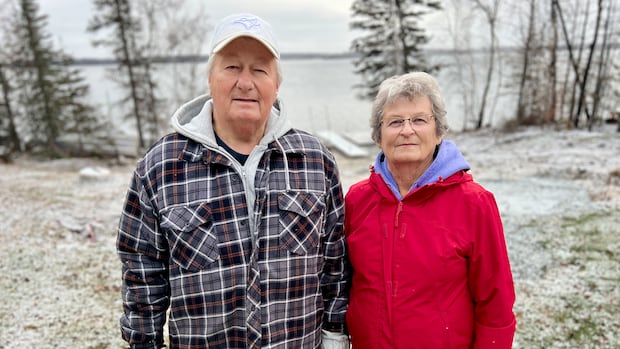
ManitobaPeople in the Flin Flon area who lost cabins and homes, or had theirs threatened, are still dealing with the aftermath of the wildfires more than six months later. They face decisions around fire protection, insurance and whether to rebuild.Cottage association says owners cutting brush and trees, setting up sprinklers around cabins, homesRosanna Hempel · CBC News · Posted: Dec 11, 2025 6:00 AM EST | Last Updated: 10 hours agoListen to this articleEstimated 5 minutesThe audio version of this article is generated by AI-based technology. Mispronunciations can occur. We are working with our partners to continually review and improve the results.Debbie and Greg Ellingson regularly visit the land where their home once stood. (Travis Golby/CBC)People in the Flin Flon area who lost cabins and homes, or had theirs threatened, are still dealing with the aftermath of the wildfires more than six months after the region was evacuated.They face decisions around fire protection, insurance and whether to rebuild.Debbie and Greg Ellingson lived in their garage for two months after this season’s wildfires. Their home along Sally’s Beach Road on Lake Athapapuskow, southeast of Flin Flon, Man., didn’t survive, even though they laboured to water the property for days before the evacuation.The couple, who are in their 70s, left the afternoon of May 30. By the next day, their house was a pile of charred debris and metal — news they received the morning of their grandson’s wedding.”It was emotional. It was overwhelming,” Debbie said last month.In just over a week at the end of May and early June, Flin Flon, a city of about 5,000 people more than 600 kilometres northwest of Winnipeg, was nearly encircled by wildfires. During that time, about 230 families lost cabins and homes in the nearby community of Denare Beach, Sask., as did others in the cross-border region. Debbie and Greg Ellingson’s home on Sally’s Beach Road, southeast of Flin Flon, Man., burned down at the end of May. (Submitted by Debbie and Greg Ellingson)The evacuation of the area displaced thousands of residents and lasted nearly a month.Early on, the Ellingsons agreed to stay positive as they figured out insurance through what felt like endless calls, emails and lists of what they lost, including antique furniture and family heirlooms — “a house full of treasures that are worth nothing to anybody else, but they’re priceless to us,” Debbie said.”We can go down that rabbit hole of despair, but we might never come out of it,” Greg recalled telling his wife of 54 years.After cooking on a hot plate and sleeping on a fold-out couch throughout July and August, the Ellingsons gratefully moved into a neighbour’s cabin for the winter.They reminisce and walk over often.”This is where the house was,” Greg said, motioning to a bulldozed lot he said is filled with three generations of memories.Debbie and Greg Ellingson lived in their garage for two months after they lost their house to wildfires in May. (Submitted by Debbie and Greg Ellingson)The couple must now decide whether to move away or rebuild, which would be their first choice, depending on how their home insurance pays out.The process has been arduous and slow, given the details needed and “the magnitude across Canada” of the wildfires, they said.Their premium has jumped more than 50 per cent since last year.The cost of John Clark’s property insurance has nearly doubled to more than $4,000 a year. “It was a big jump,” said Clark, who is president of his cottage association.He and his wife live on a different lake southeast of Flin Flon. A wildfire came within a few kilometres of their longtime residence this spring.Debbie and Greg Ellingson are deciding whether to move away or rebuild their home, depending on how insurance pays out. (Travis Golby/CBC)They’re among many owners preparing for a future threatened by wildfires.A Schist Lake/Big Island Cottage Owners Association committee has been improving its emergency response plans for the region, especially since the 2025 season, Clark said.The group ironed out the organization’s communications system, so that people get a door knock and multiple calls and texts to cellphones and landlines during an evacuation, and they organized shared fire equipment that residents can access at caches during emergencies, Clark said.Cabin owners and homeowners like him have also been busy cutting down nearby brush and beloved trees to create a buffer against future wildfires, in accordance with the FireSmart program, he said.But not everyone has been able to make changes, whether due to age, financial or time limitations.”There’s some cost involved if you can’t do it yourself,” Clark said.John Clark, president of Schist Lake/Big Island Cottage Owners Association, says the organization has been improving emergency response plans for the region. (Travis Golby/CBC)Over the last few years, Clark and his neighbour have invested in a shared sprinkler system. Their fuel-powered pump draws water from Schist Lake and feeds it to roof sprinklers through a network of hoses, he said. Other residents are setting up their own systems, too.”If we’re not dealing with it every year, it will be something frequent, unfortunately,” Clark said of the wildfires.Meanwhile, the Ellingsons also recommend being as prepared as possible, as they navigate insurance and an uncertain retirement.Debbie and Greg Ellingson have put up a Christmas tree with lights where their house once stood. (Submitted by Greg Ellingson)”I guess we were living the dream, and now the dream burned. You’re sort of feeling like you’re in no man’s land. You’re not sure where you’re going to be, where you’re going to live or what you can do,” Debbie said. “Every now and again, I tell my poor husband, ‘I don’t want to do this anymore. I just want to stop,’ but you can’t. You have to go forward.”They’re finding comfort in familiar places, including their garage, which is filled with family photographs, Greg’s motorcycle and other mementos.”We’re going to put a Christmas tree out here,” Debbie said.”I’m going to put it right smack in the middle, with some lights on,” she said, pointing to the empty lot where the house they built once stood.”Just to say, ‘We’re still here,'” Greg said.”We’re not gone yet.”WATCH | Manitobans affected by wildfires weigh decisions on fire protection, rebuilding:Manitobans affected by wildfires weigh decisions on fire protection, rebuildingPeople in the Flin Flon area who lost cabins and homes, or had theirs threatened, are still dealing with the aftermath of the wildfires more than six months after the region evacuated. They face decisions around fire protection, insurance and whether to rebuild.ABOUT THE AUTHORRosanna Hempel is a journalist with CBC Manitoba. She previously worked at Global Winnipeg, where she covered the arrival of Ukrainian refugees in Manitoba, along with health, homelessness and housing. Rosanna obtained her bachelor’s of science in New Brunswick, where she grew up, and studied journalism in Manitoba. She speaks French and German. You can send story ideas and tips to rosanna.hempel@cbc.ca.Follow Rosanna Hempel on X
Manitobans hit by wildfires near Flin Flon weigh decisions on fire protection, rebuilding