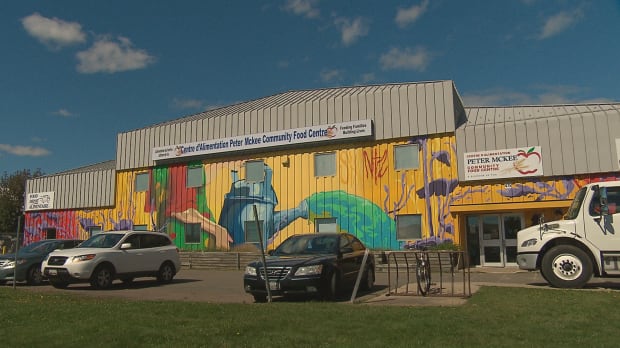
New BrunswickFood banks are feeling the pressure of rising food costs, while also serving a growing number of New Brunswickers.National report shows small uptick in food bank use in N.B. since last yearCBC News · Posted: Dec 06, 2025 5:00 AM EST | Last Updated: 3 hours agoListen to this articleEstimated 3 minutesThe audio version of this article is generated by text-to-speech, a technology based on artificial intelligence.The Peter McKee Community Food Centre, which houses Moncton’s largest food bank, sees three to four new registrations each day. (CBC)A growing number of New Brunswickers are struggling to put food on the table, according to food banks across the province.That front-line experience is reflected in Food Bank Canada’s annual hunger report, which says New Brunswickers made 32,343 visits to food banks this year — an increase of 0.5 per cent over last year, but 45.3 per cent since 2019.In Woodstock, Monica Grant, with Volunteer Family Services, is seeing that trend first-hand.Grant said last year the food bank helped 470 households, representing 905 individuals. This year, that number increased to 495 and 997, respectively.“They can’t do the whole grocery plus power bill,” said Grant. Food banks say rising prices mean their dollars don’t go as far either — what once bought a month’s worth of food now lasts only about two weeks. (Evan Mitsui/CBC)“We’re also seeing a fair amount of folks that have just been recently laid off still trying to get their EI or just trying to figure out what they’re going to do next.”Bonnie Veno, with Central N.B. Self Help in Doaktown, said her food bank numbers have also gone up.Having worked with the food bank for 25 years, she is worried about the situation — and fears it will continue to get worse.“Even working poor people coming is different than what it used to be … You didn’t have that years ago,” said Veno. The Peter McKee Community Food Centre, which houses Moncton’s largest food bank, sees three to four new registrations each day. Christine Taylor is the executive director of the Peter McKee Community Food Centre in Moncton. (Maeve McFadden/CBC)“At the end of our last fiscal year, the Peter McKee Food Bank served over 2,900 unique families,” said executive director Christine Taylor.She estimates the food bank also serves about 800 children — a number she said grows each month.Sherri Chase, the director of the Minto Community Resource Centre, said her food bank numbers have remained mostly static, but that number doesn’t tell the whole story.She said their numbers have dropped, in part, because some of their clients have died.“However, on a positive note, we’ve had families who have moved and left the community, which I think is great that they, you know, are going someplace else because there’s more opportunities than what there is in a smaller community, not just for themselves, but for their kids, too.”Food banks are also feeling the crunch with rising food costs. (Paula Duhatschek/CBC)In addition to more clients, food banks have also been impacted by rising food prices.“I know last year around this time we would probably be spending maybe $1,000 on food,” said Veno. “Last month I spent $1,500 on food.”The effects are similar in Moncton, Taylor said.“Last year, for instance, if I spent $20,000, I might be able to get enough food to last, let’s say a month,” Taylor said. “Now that might last me two weeks. That same amount of money.”Grant said people should seek help if they need it and not “let your pride let you go hungry.”“We never, ever want anybody to feel that they can’t walk through the doors,” she said.With files from Information Morning
More people in N.B. struggling to put meals on the table, food banks say