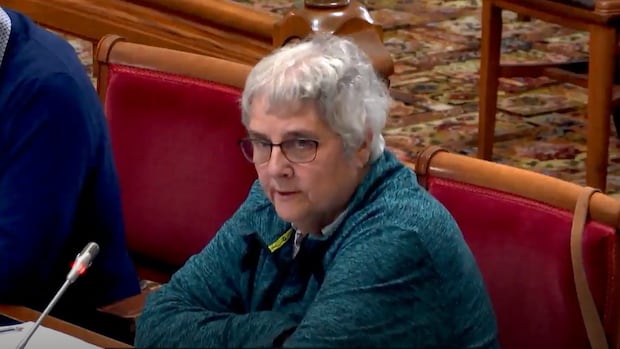
New Brunswick·NewNew Brunswick has begun a year-long review of legislation meant to guarantee government services are available in both official languages.Co-author of last review says MLAs must balance challenges in health, long-term care with linguistic rightsSavannah Awde · CBC News · Posted: Dec 10, 2025 6:00 PM EST | Last Updated: 29 minutes agoListen to this articleEstimated 4 minutesThe audio version of this article is generated by text-to-speech, a technology based on artificial intelligence.Provincial court Judge Yvette Finn said the recommendations she and retired deputy minister John McLaughlin made in 2021 are still relevant. (Legislative Assembly of New Brunswick)New Brunswick has begun a year-long review of legislation meant to guarantee government services are available in both official languages.A legislative committee on official languages, tasked with reviewing the province’s Official Languages Act, met Wednesday to begin that work.The law aims to uphold the availability of government services in both English and French in New Brunswick, Canada’s only officially bilingual province.But that’s become increasingly difficult to achieve in the province’s overburdened health and long-term care systems, according to John McLaughlin, a retired deputy minister of the Department of Education.He conducted the last review of the act in 2021, along with provincial court Judge Yvette Finn, and they both appeared at the standing committee meeting in Fredericton Wednesday.WATCH | Official Languages Act review kicks off with ‘frank conversation’ on previous report:Official Languages Act review begins with study of 2021 report The new standing committee on official languages heard from the authors of the most recent report on the act. “The nursing home situation is very precarious right now. We just look at the number of people who are waiting for nursing home placements, who are in beds in hospitals because there aren’t enough,” McLaughlin said. “This is a significant challenge for the province, and for you folks to consider, is how can we try to balance those things — to give to our seniors the dignity of being able to live and breathe in their mother tongue, while also having a place where they can be well cared for?”In their 2021 report, McLaughlin and Finn issued a series of recommendations, which dealt with strengthening governance and certain linguistic obligations in areas such as health and long-term care.But those have yet to be implemented in full.Finn said that the 2021 recommendations are still relevant, and noted some still require a lot of work. Premier Susan Holt said last month that her government would implement the Finn-McLaughlin recommendations from 2021. (CBC News)“Municipalities, nursing care homes … we’re really just skimming the surface, we have to go more in depth, especially figuring out how to implement it,” she said. Last month, Premier Susan Holt said in a statement that her government would act on the recommendations, but that they would first be reviewed by the committee. The province said last month that the Department of Social Development would consult with the long-term care sector on a path forward.“The government will establish a working group … to draft a progressive and sustainable implementation plan to improve the capacity of nursing homes to provide equal quality of service in both official languages,” a news release said.The act has a mandatory review period of 10 years, but Holt noted Finn and McLaughlin recommended that be changed to five years.Progressive Conservative MLA Glen Savoie sits on the committee, and believes communicating with the public will be important during the review. (Chad Ingraham/CBC)Committee chair Benoît Bourque said the group might ask Finn and McLaughlin to appear again later in the review period.Interim Progressive Conservative Leader and committee member Glen Savoie believes the review will help improve communication to the public about linguistic rights.”Constitutional language law always tips it towards the favour of the minority language group, and that’s the way it’s supposed to be,” Savoie said. “But we always need to make sure that the decisions that we take as a group, as a legislature, are in the interests of all New Brunswickers. “So, making sure that both linguistic communities are engaged and involved and aware of what’s going on, and the reality on the ground.”The legislative standing committee on official languages was struck last December. It was expected to work on official languages policy and programs, and to address reports from the commissioner of official languages, according to a government news release issued at the time.ABOUT THE AUTHORSavannah Awde is a reporter with CBC New Brunswick. You can contact her with story ideas at savannah.awde@cbc.ca.
N.B. begins year-long review of official languages law