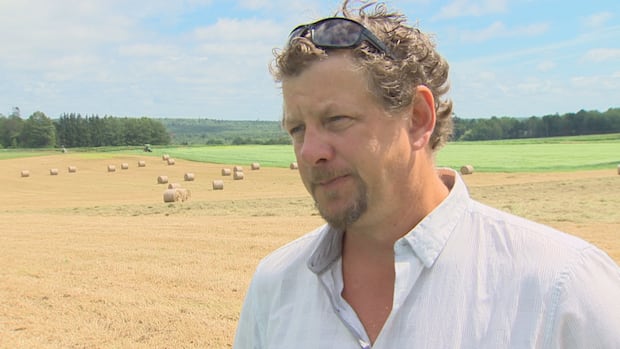
New Brunswick·NewA New Brunswick cattle farmer says his customers have stayed loyal despite an increase in beef prices. A new report from Dalhousie University’s Agri-Food Analytics Lab shows beef prices increased by 9.2 per cent between September 2023 and 2024, with another increase expected for 2025. Report from Dalhousie University predicts 4-6% meat price increase for 2025Hannah Rudderham · CBC News · Posted: Dec 09, 2025 9:18 AM EST | Last Updated: 10 minutes agoListen to this articleEstimated 3 minutesThe audio version of this article is generated by text-to-speech, a technology based on artificial intelligence.Cedric MacLeod, owner of Local Valley Beef in Long Settlement near Centreville, said a 25-pound premium package cost $185 during COVID, but now, that same package costs $275. (Joe MacDonald/CBC)A recent report from Dalhousie University’s Agri-Food Analytics Lab shows beef prices increased by 9.2 per cent between September 2023 and 2024.But that doesn’t come as a surprise to cattle farmer Cedric MacLeod, who is seeing the rise at a retail level and is trying to keep up.“With all the inputs rising, it’s tough for us all to maintain profitability,” said MacLeod, who owns Local Valley Beef in Long Settlement near Centreville.MacLeod recalls the year that he started cattle farming — mad cow disease had just hit Canada and he was selling steers for 60 cents per pound.The Dalhousie food report is forecasting an overall food price increase of three to five per cent, with a four to six per cent forecast increase on meat. (Colin Butler/CBC News)Now, that has more than quadrupled at upwards of $4 per pound.During COVID-19, MacLeod said a 25-pound premium package cost $185, but now, that same package costs $275. “I’ve got to maintain a level of profitability on my operation so that I can feed my own family, because I buy groceries, too,” he said. The Dalhousie food report is forecasting an overall food price increase of three to five per cent, with a four to six per cent increase predicted for meat. Stacey Taylor, a business professor at Cape Breton University, was one of the report’s authors. She said her biggest concerns, looking at the report, centre around food and nutrition security.“As prices continue to rise, people are in really tough positions in terms of having to make really tough choices, whether it’s, you know, buying less of a product, buying a different product altogether or not buying the product at all,” she said.And Taylor said that even if people decide to pivot to a product, such as chicken, if they can no longer afford beef, these prices are also on the rise so a switch will only stave off the increases.Taylor said couponing and using food rescue apps are going through the roof. Food bank demand is also skyrocketing. The price of beef rose 9.2 per cent between September 2023 and 2024, according to a Dalhousie University report. (Ross Gordon Henry / Shutterstock)She said this is concerning because the question isn’t only if people can afford food, it’s whether they can afford to maintain a healthy diet.“Traditionally, the middle of the grocery store has been the cheaper area to be in … the staples, the canned foods and things like that,” she said.“But we’re not necessarily seeing that that is remaining the cheap area of the grocery store, which means that there is no area in the grocery store anymore that really feels cheaper.”Luckily for MacLeod, he said his market has remained steady. During COVID-19, he said a lot of customers showed up to support the business, and those customers have remained loyal.As a grass-fed beef operation, he said his farm has always maintained a bit of a premium in the market, but they try to follow retail prices as much as possible without overwhelming customers.But at the end of the day, he said it will be up to the consumer whether they want that beef on their plate.“So far, our customers are keen to support us, they’re glad to have our products on the plate and they’re willing to pay that price,” said MacLeod. “We’ll continue to work with them and be loyal to them and make that as affordable as possible.”ABOUT THE AUTHORHannah Rudderham is a reporter with CBC New Brunswick. She grew up in Cape Breton, N.S., and moved to Fredericton in 2018. You can send story tips to hannah.rudderham@cbc.ca.With files from Information Morning Fredericton
N.B. cattle farmer struggling to maintain profit margin as beef prices soar