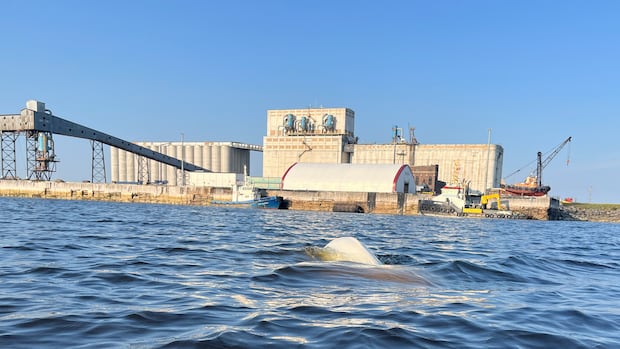
Manitoba·NewIndigenous leaders say they’re hopeful Manitoba is finally taking its duty to consult seriously, after the government revealed more details Tuesday about its planned office to approve significant economic development projects.Premier says he wants obstacles, lawsuits to be a thing of the past with new Crown-Indigenous corporationIan Froese · CBC News · Posted: Dec 09, 2025 9:00 PM EST | Last Updated: 30 minutes agoListen to this articleEstimated 3 minutesThe audio version of this article is generated by text-to-speech, a technology based on artificial intelligence.A beluga whale surfaces for air near the Port of Churchill, in Churchill, Man., in September 2025. The province hopes it can push forward a major expansion project by ensuring Indigenous people are involved in the planning process. (Darren Bernhardt/CBC)Indigenous leaders say they’re hopeful Manitoba is finally taking its duty to consult seriously, after the government revealed more details Tuesday about its planned office to approve significant economic development projects.Premier Wab Kinew said too many government consultations with Indigenous people result in a bitter fight.”By the time you end up in a courtroom on a big project, you’ve already lost,” Kinew said Tuesday, after his state of the province address at a Winnipeg Chamber of Commerce luncheon.His proposal is a new office, a Crown-Indigenous corporation, that will be responsible for guiding major economic development and trade corridor projects through the regulatory hurdles.The big difference is that Indigenous communities will be involved in the approval process from the beginning, he said.His government is trying to “change the conversation away from being one of barriers and risks and lawsuits, [and] more towards, ‘How do we make money for everybody? How do we create jobs for everybody?'” Kinew told reporters.The premier said the new office will be a true partnership, with a board evenly split between government appointees and Indigenous representatives.The NDP government is planning to introduce legislation this spring to create the new corporation.Hope for ‘new beginning’: AMCAfter the premier’s speech, Assembly of Manitoba Chiefs Grand Chief Kyra Wilson said she’s optimistic the government’s new approach to consultation will prove to be meaningful. “We always hear [about] the government-to-government discussion and relationship that needs to happen,” she said.”My hope going forward is that this will be a new beginning of how the province of Manitoba will work with First Nations leadership.”Manitoba Métis Federation president David Chartrand said the province could become a national leader in proactively soliciting Indigenous support.He believes now is the time for Manitoba to capitalize on the momentum for “nation-building” projects, and he doesn’t want the province to pass up the opportunity to advance the Port of Churchill expansion.”If we miss this … and it sails by us, we have made this province a continued have-not province.”Last month, the province put up $51 million to upgrade the Hudson Bay Railway line and build new storage and loading systems.The federal government has expressed its commitment to the Churchill project, but it isn’t listed yet on Ottawa’s official list of major projects of “national importance.”According to Kinew’s office, the project will involve a port expansion of some sort, an upgraded Hudson Bay Railway, and an all-weather road to Churchill and perhaps other northern Manitoba destinations.It will also involve the presence of icebreakers in Hudson Bay, and an “energy corridor” that could involve the transport or transmission of liquefied natural gas, crude oil, natural gas, electricity or hydrogen, according to the premier’s office. WATCH | Manitoba’s new approach to approving major economic projects:Manitoba plans new corporation to approve major projectsManitoba’s government is planning to create a new Crown-Indigenous corporation to push through major economic projects. The province is hoping that it will have success approving projects by involving Indigenous stakeholders in the discussion from the beginning.
New Crown corporation will ensure Indigenous involvement from start of major projects: Kinew