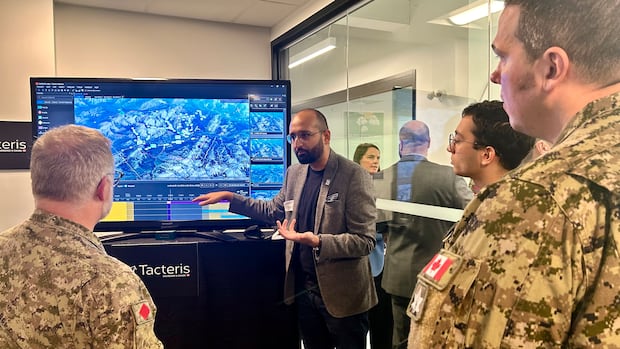
New BrunswickOne month after Ottawa announced what it called “generational” spending on Canada’s military and defence, including an extra $8.7 billion to be spent by the end of March to meet NATO’s two per cent of gross domestic product spending this year, New Brunswick stakeholders are eagerly awaiting news of what’s to come. ‘Generational’ $81 billion to be spent rearming Canadian military, including cyber defence capabilities Allyson McCormack · CBC News · Posted: Dec 05, 2025 5:00 AM EST | Last Updated: 3 hours agoListen to this articleEstimated 6 minutesThe audio version of this article is generated by text-to-speech, a technology based on artificial intelligence.Sundeep Kharey, co-founder at Tacteris, a Canadian company that develops planning software for military operations, was one of many companies demonstrating their defence technologies at a recent event in Fredericton. (Allyson McCormack/CBC)One month after Prime Minister Mark Carney announced what he called “generational” military spending, New Brunswick’s defence ecosystem is on high alert.Carney pledged $81.8 billion over five years to rearm and rebuild the Canadian military, which includes an extra $8.7 billion to reach NATO’s defence spending target of two per cent of gross domestic product this fiscal year.With less than four months for Ottawa to get that funding out the door, everyone in the defence sector is eager to flaunt what’s for sale.A number of Canadian companies gathered at the Thales National Digital Excellence Centre in Fredericton last week to demonstrate their latest technology and capabilities.Cara Salci is vice-president of growth, industry and corporate affairs at Thales Canada, a large prime contractor with the Canadian Armed Forces and leader in cybersecurity. She said industry players are getting prepared for what’s to come.Cara Salci, vice-president of growth, industry and corporate affairs at Thales Canada, said the defence spending has sparked conversations about increasing capacity. (Allyson McCormack/CBC)“We’re seeing our stakeholders and our customers ask questions about how we can scale up faster, what type of people or talent we might need to deliver on a program or a capability and by when can we do that,” she said.Those questions come on the heels of what Ottawa is calling the largest defence spending in decades. And there’s even more to come, with the Liberal government pledging to meet NATO’s defence spending target of five per cent over the next decade. It’s important for our allies to be able to trust that Canada will do what it says it will do on the world stage.- Cara Salci, vice-president of growth, industry and corporate affairs at Thales CanadaWith everyone getting in line for a piece of the investment, Salci said it’s also important to recognize the seriousness and rationale behind the spending, along with the “changing geopolitical climate.“We know that meeting our minimum two per cent NATO commitments is important for Canada,” she said. “It’s important for our allies to be able to trust that Canada will do what it says it will do on the world stage.“So as important as these investments are, it’s really about delivering value, capability and resilience to Canadians to both secure and ensure our own sovereignty and also be able to support those who serve our forces around the world.”Recent focus on Canadian market Sundeep Kharey is co-founder of Tacteris, a Calgary company that develops planning software for military operations. He calls it a small company, but said they punch above their weight with “world class” technology.In June, that technology was used during the Group of Seven, or G7, summit in Kananaskis to ensure security during high-level meetings with some of the world’s most powerful leaders.Sundeep Kharey, co-founder of Tacteris, said they built the business for the Canadian market. (Allyson McCormack/CBC)“We’re very lucky with the feedback we got from the boots on the ground, right from the commanders that were using it, from headquarters right down to the snipers that took our technology into the mountains, that they wanted to see more of this,” Kharey said.The company had trouble breaking into the Canadian market when it started out in 2012, he said, but recently there’s been more traction at home.“And certainly over the last few months, there’s a lot of focus on the Canadian market and that’s where we’re putting all our efforts right now,” he said.“We built this software for the Canadian end user. This is designed for the Canadian Armed Forces and although we’ve sold it around the world, to have it used by our soldiers, our boots on the ground, is really what we set out to build this business for.” It’s a very exciting time to be in the military.- Col. Paul Williams, commander of 5th Canadian Division Support Base Gagetown That includes people like Col. Paul Williams, commander of 5th Canadian Division Support Base Gagetown, who could see a wave of funding for Canada’s second largest military base. Col. Paul Williams, commander of 5th Canadian Division Support Base Gagetown, said he’s never seen this kind of defence spending in his military career. (Allyson McCormack/CBC)In more than three decades with the Canadian Armed Forces, he said he’s “never seen anything quite like this.”“I think that at every level within the Canadian Armed Forces, we’re excited about new technologies, we’re excited about new equipment,” he said. “But also there’s universal recognition that our buildings, our maintenance facilities are starting to show their age.”“So I certainly look forward to both aspects — the exciting new equipment, the exciting new capabilities, but also those investments in infrastructure, buildings, accommodations, which will make us more effective.”Gagetown an ‘anchor asset’New Brunswick Premier Susan Holt said there have been lots of conversations happening with the federal government and partners in the defence sector, and calls it a “good time for New Brunswick to grow this part of the economy.”“Clearly with CFB Gagetown here in New Brunswick, it is an anchor asset and plays a major role in projects of national interest,” she said.New Brunswick Premier Susan Holt said the increased spending from Ottawa makes it a ‘good time for New Brunswick to grow this part of the economy.’ (Allyson McCormack/CBC)“And then when you add on our expertise in cybersecurity, the infrastructure we have here with our companies in advanced manufacturing and AI technology, the infrastructure we have here in the cyber centre, we have a lot of capacity and a lot of people already working in the defence sector.”Base Gagetown is the second largest public sector employer after the province itself, and third largest overall employer after Irving, with approximately 6,500 military members and 1,000 civilians.Holt said there are reliable, proven partners in New Brunswick that should make it an attractive place for federal spending. And in turn, that signals to other stakeholders that projects requiring a lot of research and development, security testing, and deployment in the field, are no longer a risky investment.“Those programs aren’t cheap, but then once you build them, the kind of employment and the kind of competitiveness they give Canada around the world — that’s a game changer,” she said.ABOUT THE AUTHORAllyson McCormack is a producer with CBC New Brunswick, based in Fredericton. She has been with CBC News since 2008.
New military spending triggers anticipation among N.B. defence community