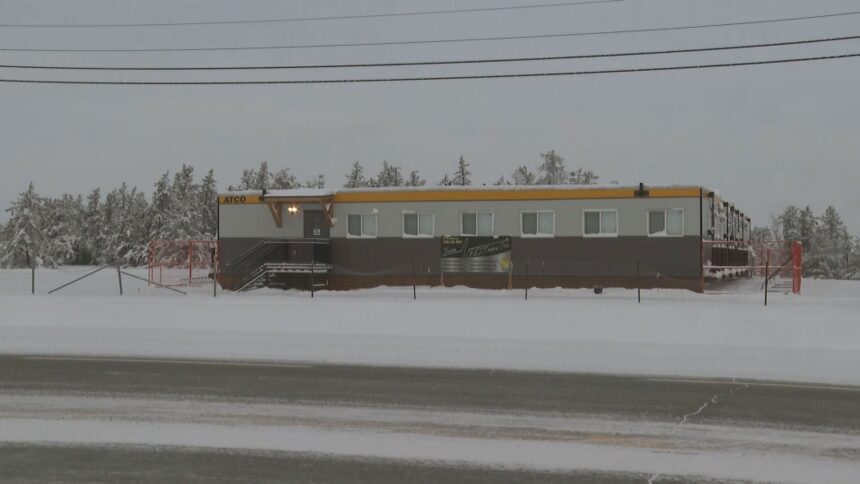
Twenty-four northerners will soon have access to a new transitional housing facility outside Yellowknife designed to offer a path to something more permanent. “This facility will offer residents privacy, stability, and a safe environment to focus on life skills, case management, and long-term planning,” said Lucy Kuptana, minister of Housing in the N.W.T.. The N.W.T. is contracting the Yellowknife Women’s Society to operate the space, which will serve people caught between emergency shelters and permanent, independent housing. The facility aims to provide stable and secure housing alongside job-specific training. Mental health and wellness support will be offered through a partnership with its sister society’s venture at the Spruce Bough Wellness Centre. Ahead of its opening, the facility was toured by Kuptana, along with a handful of city and territorial officials. Arlene Hache, interim executive director of the Yellowknife Women’s Society, said the housing will be run with respect and representation, born from lived experience. “As a person with lived experience of homelessness, nothing was more frustrating than to have everybody else talk about what it was like to be unhoused,” Hache said. “Our goal is to make sure people who are unhoused, especially Northern people and Indigenous people, have an opportunity to tell their own story in their own way about their own experience and their journey forward.” Hache said clients will have an individualized plan that complements their strengths, honors the challenges they face, and outlines steps toward their exit plan. Scheduled transportation will be available between the site and various areas of Yellowknife. The facility includes a kitchen with a walk-in fridge and freezer, a dining room, a gathering space, offices, training space, a laundry room, private bedrooms and six bathrooms. During the tour, Hache pointed out a room with a double bed and explained the need for such space, with Kuptana adding, “People often forget about couples who don’t go to male or female only shelters for that reason.” The facility is also rethinking how gender is understood within emergency and transitional spaces. “We serve all genders,” Hache said. “Having said that, we need to work with [the community] to really figure out how to support diverse genders in a good way. I don’t think we always do that, and I think we have a lot to learn.” Arlene Hache stands inside one of the rooms. Photo: APTN. According to the 2024 point-in-time count there were 327 people experiencing homelessness in Yellowknife, although advocates said that number is likely higher due to individuals who identify as couch surfing. More than 90 per cent of those experiencing homelessness in Yellowknife identify as Indigenous. Through partnerships, residents will have access to mental health and cultural supports, as well as training in digital and literacy skills and job readiness. But a central question remains, where will clients move to next? “Transitional housing only works if there are viable, sustainable options beyond its doors,” Hache said. “We have to do a lot of work, in my opinion, with landlords. We are looking at different other housing options for permanent housing and affordable rent, and those matter.” The Yellowknife Women’s Society has received $5 million from the N.W.T. to operate the facility from December 2025 through April 2028. “Housing is a right. This is an essential service, and it’s money well spent, however much it was,” Hache stated. The move-in date is anticipated for Dec. 15. “We want to really increase residents’ voice and role in the services that are provided to them,” Hache added. Partnerships with the territory are evolving alongside cultural programming. For decades, Hache says, paperwork and procedure slowed solutions, but something is changing. That collaboration shows up in practice, not just policy. Staff say residents won’t be slotted into predetermined programs but will instead be supported as whole people. “We don’t silo people into this program or that program. Our job is to say, ‘What does this person need, and how are we going to make sure they get it?’” Hache explained. It’s an approach that is changing the way services listen to, work with, and are shaped by the people who need them, Hache said. Donations of food, bedding, clothing, programming supplies, and cultural materials are already being collected, not as charity, but as relationship-building. “We will take donations from the community because we want them to also contribute to that reciprocity,” Hache said. Continue Reading
New transitional housing facility opens outside Yellowknife offers job training, life planning



Leave a Comment