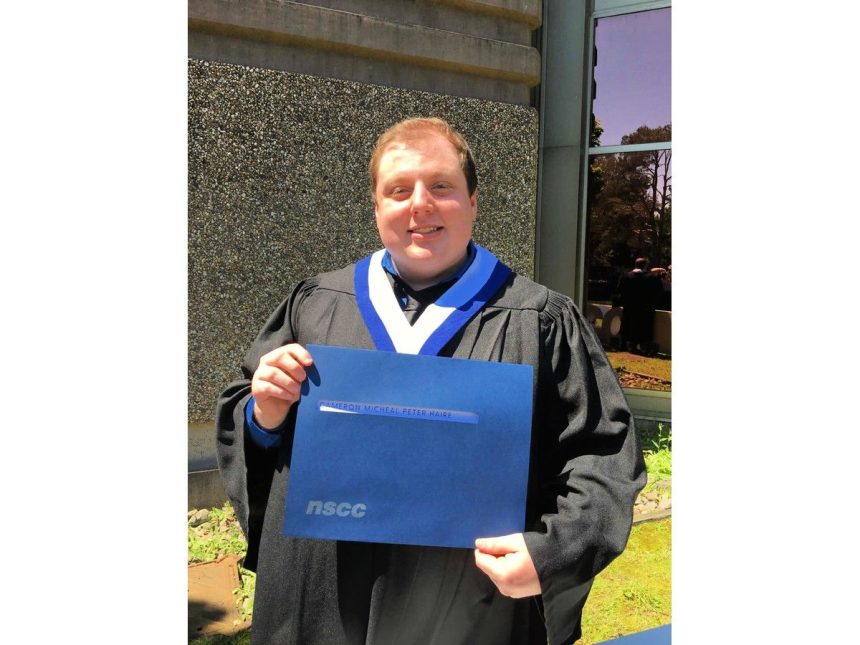
One Halifax student lost struggle with mental health after graduation while another sent out over 600 applications and couldn’t find workPublished Jul 24, 2026Last updated 6 hours ago8 minute readCameron Haire was excited for his new chapter as a pharmacy technician. ContributedArticle contentThe last time Michele Haire saw her son, Cameron, he left a short video on his phone saying he couldn’t take this world anymore.THIS CONTENT IS RESERVED FOR SUBSCRIBERS ONLY.Subscribe now to access this story and more:Unlimited access to the website and appExclusive access to premium content, newsletters and podcastsFull access to the e-Edition app, an electronic replica of the print edition that you can share, download and comment onEnjoy insights and behind-the-scenes analysis from our award-winning journalistsSupport local journalists and the next generation of journalistsSUBSCRIBE TO UNLOCK MORE ARTICLES.Subscribe or sign in to your account to continue your reading experience.Unlimited access to the website and appExclusive access to premium content, newsletters and podcastsFull access to the e-Edition app, an electronic replica of the print edition that you can share, download and comment onEnjoy insights and behind-the-scenes analysis from our award-winning journalistsSupport local journalists and the next generation of journalistsRegister to unlock more articles.Create an account or sign in to continue your reading experience.Access additional stories every monthShare your thoughts and join the conversation in our commenting communityGet email updates from your favourite authorsSign In or Create an AccountorArticle content“I love you guys. I’ll see you on the other side,” he said as he ended the message.Article contentArticle contentCameron Haire was 26 when he walked out of his parents’ home at midnight and died by suicide on Aug. 11, 2023.Article content“We were such a close family that, you know, people were just shocked when it happened, as were we, of course. I never thought he would do it. I thought we had gotten help, and uh yeah, we’re every family’s worst nightmare,” says Michele.Article contentArticle contentShe hopes that by sharing Cameron’s story, it will help raise awareness of mental health problems, bring appropriate care at an early age and support to their families, and the need to intervene and recognize that mental illness can become life-threatening.Article contentStruggles started in schoolArticle content“He was very kind, very generous, and quite sensitive in school,” Michele says of her son.Article content“In Grade 6, a teacher told me that he needed to get better control of his emotions because they said he would be bullied. We listened to this advice, and we tried to teach Cameron, ‘You know, it’s OK to cry when somebody hurts you or your feelings, but you shouldn’t cry over losing a game.’ You know, things like that.”Article contentIt’s advice Michele, a Halifax resident and registered nurse, now regrets following.Article content“He then learned to close off so that he wouldn’t be overly emotional. In high school, he found his niche of friends, settled in, did well and graduated with no problems. He then decided that he was going to work two jobs rather than go to college immediately,” she says.Article contentArticle contentCameron earned his own apartment and was full of dreams for a bright future.Article contentArticle contentOver time, long hours and living pay cheque to pay cheque began to take their toll, says Michele.Article contentCameron had no extra money to enjoy the little things in life, let alone the time, so he began saving for college to better his life with skilled work.Article content“He still didn’t have a whole lot of money leftover, so he asked his father and me if he could move home while he went back to school. Of course, we were thrilled and said ‘yes.’ So, he did three years of school at the Nova Scotia Community College (NSCC), and he upgraded his marks to take the pharmacy technician course.”Article contentMichele recalls Cameron being “excited to be in school, learning, and forging a new path.”Article content The day Cameron Haire proudly got his apartment, it was nothing fancy, but to live independently meant everything to him, says his mom. ContributedArticle contentWorking in health care can be hardArticle content“It was just so good to see,” Michele says.Article content“Once he graduated, he got a job right away in our local hospital. He had a full-time position as a pharmacy technician. Dad and I were so excited for him because both of us work in the same health-care field.”Article contentIt can be a steady job with a good income and a paid retirement plan, notes Michele, but there are major drawbacks to working in health care.Article content“It wasn’t too long after he started isolating again,” she says.Article content“He was having a difficult time with his mental health and was working full-time with no downtime. He would often sit alone at work, and I think that really took a toll on him as well.”Article content‘A cry for help’Article contentCameron made a first attempt, “a cry for help,” says Michele.Article contentMedications were laid out that would end his life, but Michele intervened just in time.Article content“We talked, and I said to him, ‘Help me understand what’s going on.’ He came from a middle-income family. Two parents, an older brother. A loving home situation. I couldn’t understand why he felt so defeated. He had gone to school; there was a new chapter opening for him.”Article contentAfter three years of study — sacrificing finances, time, and mental health — Cameron explained he had unmet career expectations with the upfront costs of student loans. He could not live independently and pay for an apartment and a car with his salary as a pharmacy technician.Article contentArticle content“It was really discouraging for him…We were happy to have him home; we told him that. But he wanted his independence. He had worked hard for it.”Article contentOn top of that, the barrage of cataclysmic news events 24/7 through the juggernaut of social media, television, and radio, following the pandemic and political upheaval, reinforced his fears.Article content“The state of the world was something he was extremely worried about, and the doomsday clock was ticking closer,” she explains.Article content“All of that was frightening for him. We could see how the weather was changing. We were getting unusual forest fires and floods.Article content“He was also extremely sensitive about the homeless encampment near our home, which he would pass on his way daily to work. He saw people suffering in the pouring rain to extreme cold, and he could not understand how society could allow that to happen.”Article contentCameron struggled with mental anguish, becoming more isolated while wrapped in all the burdens of the world.Article content“He was thinking about homeless people, thinking about homophobic slander and slurs of people trying to take away the rights of the LGBTQIA2S+… You know, he was just a very sensitive young man,” says Michele, through heartbroken sobs.Article contentArticle contentSeeking help a struggleArticle contentShe tried various available outlets to help her son.Article content“We did not have a family doctor, and that was part of the problem because I told Cameron, ‘let’s go into the emergency department.’ He had heard all the horror stories about people with mental health concerns going into the emergency department and then being released and nothing done,” she says.Article content“Plus, he worked in the local hospital emergency department, so he was worried that people would see him. And so, his privacy and confidentiality would be at risk. He agreed to see somebody to look at medication changes… But Maple (virtual care) said they couldn’t help us. I even paid to get a hold of a doctor…”Article contentEventually, Cameron began talking with a psychologist. For a while, it worked.Article contentUntil one night, he quietly left the home for the last time.Article contentMichele believes it was to “save them from the pain” of finding him in that state.Article contentA month or so before, Michele remembers Cameron saying, “Mum, there’s nothing left for us. We’re not going to be able to buy homes. There’s nothing left for us.”Article contentA comment that over the years has really hit her hard.Article content“They (youth) feel quite hopeless. That even though they work, they don’t necessarily feel that they have a future because of all the doomsday stuff.”Article contentMichele and her family are still trying to pick up the pieces since his death.Article content“It should start at school. Kids need to have access to mental health because that’s where a lot of things begin with social media; they see what they’re not included in, and that plays a real role. They see their friends out having fun, and they’ve not been invited. Plus, online bullying, all of that,” she says.Article content“And we definitely need better access to family doctors.”Article contentAccording to government statistics, suicide is the second leading cause of death among youth and young adults in Canada aged 15 to 34 years, with rates approximately three times higher among males.Article contentArticle contentThe dream no longer worksArticle contentGo to school. Get a job. You’ll live the dream, was the traditional path that, for a growing number, no longer applies in today’s modern world.Article contentJustin Lemire spent his late teens and twenties figuring out what he wanted to do for a career.Article content“I was incredibly lucky to have very supportive parents,” he comments.Article contentLemire studied automotive mechanics at NSCC, worked in that field for a while, then returned to study business administration, where he worked minimum-wage jobs before finding work at an auto salvage yard.Article content“I decided that wasn’t what I wanted to do, and I was always good with computers, so I decided to become a software engineer,” he says. “I was accepted to Saint Mary’s University (Halifax) for their Bachelor of Science to major in computer science.”Article contentHe started his four-year degree in September 2018, while working part-time at the salvage yard. Then, in 2019, Lemire’s father was diagnosed with cancer, and COVID-19 hit the following year with lockdowns.Article contentArticle contentLemire says he struggled and failed a semester, which pushed him back.Article content“I had to take a year off after my father had passed away in August 2021,” he adds.Article contentIn May 2024, Lemire graduated, but instead of a bright and lucrative future in his chosen field of study, he says he owes “$50,000 in student loans and lost earnings,” which he could have made during that time.Article content“The debt I incurred and not being able to find any jobs in my field, I wouldn’t do it again if I could go back. It was just such a large waste of time and resources for a degree that was supposedly in such great demand.”Article contentStruggling to find a jobArticle contentAfter the auto salvage closed in August 2024, Lemire spent eight months writing resumes for a career in computer science, applying for positions and getting rejections or worse, silence.Article contentIn one year, he applied to around a whopping 600 positions, with one interview for a job, he says, that was only vaguely related to his degree.Article content“In May of 2025, I ran out of severance and started looking for any job. Thankfully, one of my acquaintances knew of an automotive shop hiring a service advisor and recommended me, so I have been there since,” he says.Article contentHe claims that a bachelor’s degree no longer guarantees professional employment because employers seek portfolio-driven capabilities rather than just formal credentials.Article content“I hoped to secure a remote position and move out of the city to somewhere quieter, but unfortunately that’s been put on hold. I’m still working as a service advisor, and while it’s not my dream job, I was incredibly lucky to end up where I am. The owners are amazing, and all my coworkers are great,” he says.Article content“While I could technically afford to live independently, I’d be completely broke to do so, especially with a student loan payment of almost $400 a month due to what I make. I’m still in the family home in North End Dartmouth, but I made out a lot better than some people, unfortunately.”Article content
‘Nothing left for us’: Graduates face mental anguish with unmet job expectations and student loans