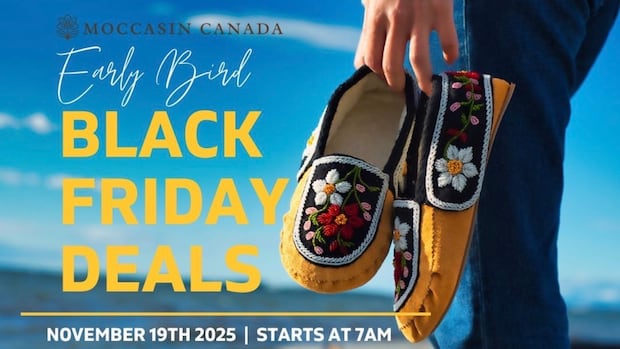
Indigenous·NewA website selling moccasins with what looks like Haudenosaunee-style beadwork but with no attribution to an artist or community has sparked conversation online about how to identify authentic Indigenous crafts. ‘It looks really distinguishable, like a Haudenosaunee pattern,’ says Christi BelcourtCandace Maracle · CBC News · Posted: Dec 09, 2025 6:00 AM EST | Last Updated: 30 minutes agoListen to this articleEstimated 6 minutesThe audio version of this article is generated by text-to-speech, a technology based on artificial intelligence.An image from Moccasin Canada with moccasins featuring designs similar to Haudenosaunee beadwork. (Moccasin Canada)A website selling moccasins with what looks like Haudenosaunee-style beadwork but with no attribution to an artist or community has sparked conversation online about how to identify authentic Indigenous crafts.Métis visual artist Christi Belcourt made a social media post in November flagging the website, Moccasin Canada. Its name is similar to another business, Moccasins Canada, but the Moccasin Canada Facebook page appears to have been created in November. Commenters on Belcourt’s post said they tried to reach out to the company for clarity but have not received any response. Belcourt said she is leery of websites that lack transparency. “It looks really distinguishable, like a Haudenosaunee pattern,” Belcourt said.”I’ve had some experience with my own work being lifted and produced in overseas storefronts.”Michif artist and activist Christi Belcourt in front of one her large scale but intricate ‘beadwork’ paintings. (Christi Belcourt/Facebook)Indigenous artists, designers and business owners say they have to be vigilant to ensure their work is not appropriated. Although protecting Indigenous intellectual property in Canada is complicated, experts say there are ways to safeguard both the artist and ensure consumers are buying authentic.One of the people who commented on Belcourt’s post was Kawisaienhne Albany, a Kanien’kehá:ka (Mohawk) beadwork artist from Kanehsatà:ke and Kahnawà:ke whose work has been copied online.Two years ago, when she noticed one of her designs was copied by a seller on Etsy, she asked them to remove the photo and they agreed. Kawisaienhne Albany, a Kanien’kehá:ka beadwork artist who has had her work copied in the past. (Submitted by Kawisaienhne Albany)”I think they were selling it for like $83 but they had sold so many. So it’s like they’re profiting off of my designs, my colours and something I made special for my cousin,” she said.Albany said her moccasins sell for $650 to $1,000 because they take 40 to 50 hours to complete and are made with quality materials, like smoked moose hide or buckskin. She uses tiny beads for more detail, each individually sewn onto the moccasin and intended to last a lifetime. Only the leather needs to be replaced after significant wear. She said it’s disrespectful to Indigenous artists who’ve been honing their craft for generations “to try to undermine us and undercut us with our prices and to copy everything just to make a buck.”A photo of Kawisaienhne Albany’s moccasin design that was used without her permission by online retailers. (Submitted by Kawisaienhne Albany)Creating is a spiritual practice for her, she said.”I really think about who the individual is I’m making it for and how it can connect to them,” Albany said.”Some of my designs I’ve dreamt of for family members. So those ones I really hold close to my heart.”‘Indigenous-inspired’ Moccasin Canada responded to CBC Indigenous regarding its website via email.”The designs are not sourced from external Indigenous artists, nor are they copies of existing pieces by specific artists. These are original patterns created internally by our in-house creative team, led by my mother,” spokesperson Fahed Sayed said in the email.”We have never claimed these specific designs were made by Haudenosaunee artists, and if there is a specific stylistic conflict, we are open to learning about it.”The email said to ensure transparency, they market their products as “Indigenous-inspired.” Screenshots taken from Moccasin Canada’s website featuring raised beadwork. (Moccasin Canada)The email also said Moccasin Canada uses a third party to donate two per cent of sales to the Centre for Indigenous Environmental Research (CIER). CBC Indigenous contacted CIER to confirm this but was told it’s not their “policy to disclose the source of any of our personal donations.” Moccasin Canada’s website says it is based in Vancouver but does not have an address listed.Intellectual property protectionAngela Mark, director of research for the Canadian Council for Indigenous Business (CCIB), said the value of creative expression for Indigenous artists goes beyond income, it’s healing through reclamation of cultural knowledge and empowerment for the artist and client.Mark, who is Anishinaabe and a member of Garden River First Nation in Ontario, owned a clothing business for 30 years. As a designer, she said having your designs appropriated is “horrifying.”The CCIB has compiled feedback from entrepreneurs on how to protect intellectual property. Mark said there’s interest in developing Indigenous geographic indications, expanding current intellectual property framework to capture an Indigenous businesses’ unique relationship with the land.But Mark said a blanket solution would not work for the over 630 First Nations across the country. Mark said this would infringe on their sovereignty and that protections are best determined by that community.Protections within CanadaShoshanna Paul, a Dene lawyer from English River First Nation in Patuanak, Sask., specializes in Indigenous intellectual property.She said as an Indigenous lawyer she is navigating two worlds and using the tools that exist within both. Indigenous nations have their own laws, rules, protocols governing the use of their knowledge and tangible expressions like designs and motifs, Paul said, “that give expression to our knowledge.”Lawyer Shoshanna Paul says she uses the tools that exist within both the Canadian legal system and traditional Indigenous protocols to safeguard Indigenous intellectual property. (Cory Aronec Photography)There are also protections within Canada under the Copyright Act, Trademarks Act and patents with minimal fees to obtain, she said.”That at least gives you something you can point to; paperwork to say ‘this is mine,'” Paul said.There are still ways that Canadian consumers can ensure they’re buying authentic work from Indigenous artisans and supporting Indigenous businesses:4 tips when buying Indigenous creations Price point: If the price looks too good to be true, it probably is. Artists like Kawisaienhne Albany will sell authentic moccasins for $650 to $1,000. Knock-offs can sell for as low as $83.Certification: Does the artist’s work come with a trademark? There are many examples like CCIB Certified Indigenous Businesses, Cowichan designs and clothing, and the Igloo tag for Inuit art, to name a few.Language: Paul says, as a consumer, phrases like “Indigenous inspired,” should trigger a desire to investigate further to ensure you’re purchasing work made ethically and contributing to the Indigenous economy. She says if you see phrases like “Indigenous traditions,” “authentic craftsmanship” or “Indigenous community partnership” with no Indigenous communities listed, it’s likely not created by an Indigenous artist.Community: Many artists will share where their community connection is. If it’s not clear, beware. That said, Albany says artists should also be wary of sharing too much of themselves and their culture. As soon as you put it out into the world, it can be copied.ABOUT THE AUTHORCandace Maracle is Kanien’kehá:ka, Wolf Clan from Tyendinaga Mohawk Territory. She has a master’s degree in journalism from Toronto Metropolitan University. Her latest short film, “Tsi ní:yoht yonkwayentá:’on ne óhses” (How We Got Maple Syrup) is completely in the Kanien’kéha language.
Online moccasin store sparks debate with ‘Indigenous inspired’ designs