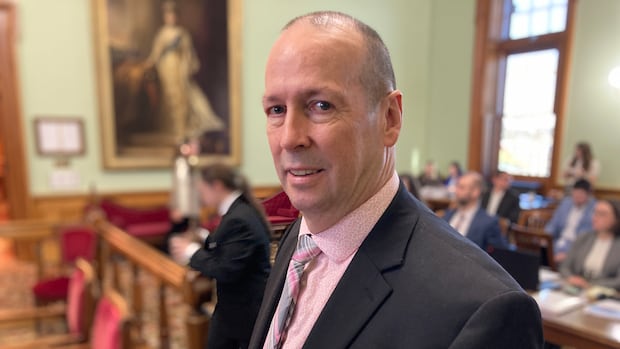
New BrunswickA new report from the province’s auditor general shows that only one-third of patients in New Brunswick hospital emergency departments are seen by a doctor within the appropriate amount of time.Audit finds outdated budgets, lack of oversight, data on hospital emergency wait timesJacques Poitras · CBC News · Posted: Dec 09, 2025 10:10 AM EST | Last Updated: 2 hours agoListen to this articleEstimated 4 minutesThe audio version of this article is generated by text-to-speech, a technology based on artificial intelligence.New Brunswick’s Auditor General, Paul Martin, released three new reports on Tuesday. The reports addresses emergency health services, highway safety and the implementation of a plan to reduce violence against Indigenous women, girls and 2SLGBTQQIA+ people. (Jacques Poitras/CBC)Only one-third of patients in New Brunswick hospital emergency departments are seen by a doctor within the appropriate amount of time, according to a new report by the province’s auditor general.Even patients with the most urgent need to see a doctor immediately were only assessed quickly enough in 56 per cent of cases, the audit found.The Department of Health’s performance indicators are incomplete and its budget doesn’t match its service delivery needs, Paul Martin added in the report presented to a legislative committee Tuesday.“Our audit work concluded that the Department of Health does not have effective oversight mechanisms in place to ensure timely access to, and adequate reporting on, emergency health services,” the report said.The audit analyzed more than 1.7 million emergency department visits per year between April 1, 2020 and Dec. 31, 2024.Another 470,000 visits weren’t analyzed because of incomplete records.The auditor general’s new report on emergency health services analyzed more than 1.7 million emergency department visits per year between April 1, 2020 and Dec. 31, 2024. (CBC)During that period, the department failed to establish an accountability framework, as required by law, for the province’s two regional health authorities, Martin found.That was despite sweeping changes to health care governance by then-premier Blaine Higgs after a patient died while waiting for care in a hospital emergency department in July 2022. “The time for changing our system and getting it on a road to improvement is now,” Higgs said at the time.A provincial health plan adopted by the Progressive Conservative government a year earlier, in 2021, had no specific objectives to address gaps in emergency care access, Martin found. The accountability framework was only put in place in April 2025, six months after Premier Susan Holt’s Liberals took power. In a point-by-point response to Martin’s audit included in the report, the department said it agreed with all of his recommendations and was implementing them, with some due by the end of April 2026 and others likely to take as long as 2029-30.The department will establish key indicators, work with the health authorities on collecting and reporting data and address risks to timely service, it said.Patients going to hospital emergency departments are triaged to assess how urgent their condition is on a scale of one to five.A level-one patient requires resuscitation and should be seen by a doctor immediately, while those in the other categories – emergent, urgent, less urgent and non-urgent – have wait-time standards ranging from 15 to 120 minutes.Triaging should happen within 10 minutes of a patient’s arrival but “this target has not been adopted” by the department or the two health authorities, the audit said.Auditor General Paul Martin’s new report on emergency health services was released on Tuesday. Martin has made recommendations to the department of health and they’ve committed to implementing all of them. (Victoria Walton/CBC)No Vitalité Health hospitals record a patient’s arrival time and only six out of 13 Horizon hospitals did so.“Arrival to triage is a critical time because patients have not yet been assessed, and their priority level is not yet known. Any delay in treatment could pose health risks and impact patient outcomes,” Martin wrote.Only one-quarter of the patients triaged at level two or level three urgency were seen by doctors within the target wait times, and almost 250,000 patients left emergency departments without seeing doctors during the audit period.When patients die, the department doesn’t look at what their wait times were, the audit noted.“It is a missed opportunity for the department to understand contributing factors into these cases and how strategies and resources may contribute to improved outcomes.”Martin also found a decline in the available treatment spaces in emergency departments over the more than four years of the audit.That can often mean patients aren’t seen even when a doctor is available, he told MLAs. He also said the department’s base budget formula for emergency care hasn’t changed since 2008 and is based on outdated assumptions.The department was “unable to clearly demonstrate how the base budget amounts were calculated,” he said, though he noted the Liberal government launched a review of the formula that it is expected to finish next spring.ABOUT THE AUTHORJacques Poitras has been CBC’s provincial affairs reporter in New Brunswick since 2000. He grew up in Moncton and covered Parliament in Ottawa for the New Brunswick Telegraph-Journal. He has reported on every New Brunswick election since 1995 and won awards from the Radio Television Digital News Association, the National Newspaper Awards and Amnesty International. He is also the author of five non-fiction books about New Brunswick politics and history.
Only one-third of ER patients are seen on time, auditor general says