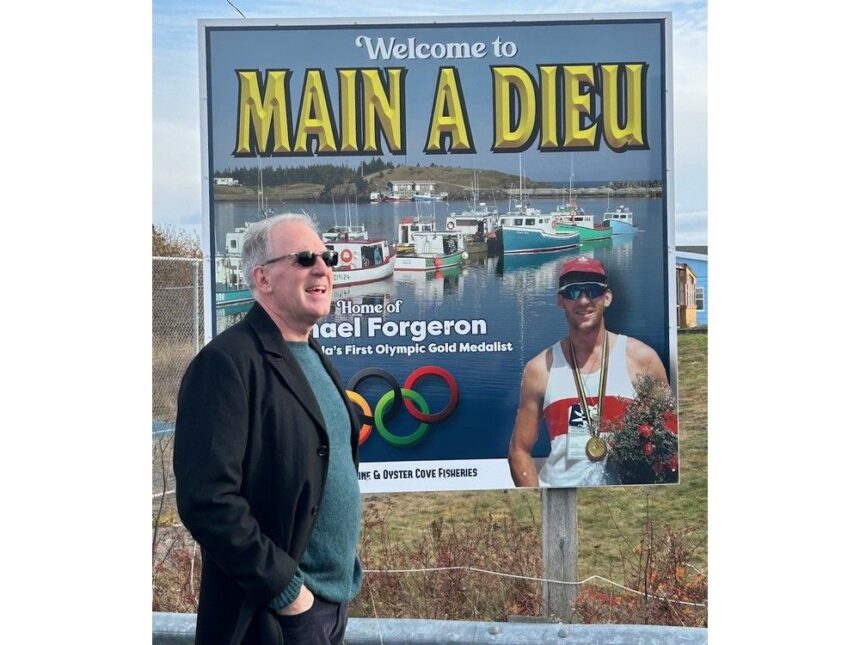
Olympic gold medalist Michael Forgeron unveils the new sign bearing his name for the first time in Main-a-Dieu on Nov 30. Photo by Paul MacDougall /ContributedArticle contentIn 1992, Michael Forgeron became the first person from Atlantic Canada to win an Olympic gold medal.THIS CONTENT IS RESERVED FOR SUBSCRIBERS ONLY.Subscribe now to access this story and more:Unlimited access to the website and appExclusive access to premium content, newsletters and podcastsFull access to the e-Edition app, an electronic replica of the print edition that you can share, download and comment onEnjoy insights and behind-the-scenes analysis from our award-winning journalistsSupport local journalists and the next generation of journalistsSUBSCRIBE TO UNLOCK MORE ARTICLES.Subscribe or sign in to your account to continue your reading experience.Unlimited access to the website and appExclusive access to premium content, newsletters and podcastsFull access to the e-Edition app, an electronic replica of the print edition that you can share, download and comment onEnjoy insights and behind-the-scenes analysis from our award-winning journalistsSupport local journalists and the next generation of journalistsRegister to unlock more articles.Create an account or sign in to continue your reading experience.Access additional stories every monthShare your thoughts and join the conversation in our commenting communityGet email updates from your favourite authorsSign In or Create an AccountorArticle contentArticle contentHe hailed from the small fishing village of Main-a-Dieu, the most easterly community in Nova Scotia, and grew up rowing dories in the harbour with his relatives and friends. His father was a lobster fisherman.Article contentArticle contentForgeron recently said he always had a competitive spirit and one of the things about growing up in a small place was age in sports and games didn’t matter. Little kids got to play street and ice hockey and baseball with those a number of years older; otherwise there’d be no teams. Many places in the Maritimes foster a strong sense of community, and this spills right over to the youngsters on ball fields, soccer pitches and ice surfaces.Article contentForgeron took this sense of community and competitiveness with him when he went to the University of Western Ontario in London, Ont., in the late 1980s. He soon discovered the university had a rowing club and felt if there was a right fit for anybody for a competitive sport this was it for him.Article content Michael Forgeron, left, and Todd Hallett at the 1996 Summer Olympics in Atlanta, Ga. Photo by Nova Scotia Sport Hall of Fame /ContributedArticle contentNATIONAL TEAM SPOTArticle contentHis excellence in rowing lead him to the Canadian national team and the 1991 Pan-American Games. He won silver in the coxless pairs with Steve Frisch and bronze in the mens’s eights. On the basis of his rowing prowess, he was selected to row with seven other accomplished rowers, who had won silver at the past two world championships, for the 1992 Olympics.Article contentArticle contentThe team trained at a rowing facility at Elk Lake, B.C. Forgeron equates the thing to him most like training is actually fishing for a living. “If you lose a day fishing you can’t get it back, it’s the same as training.”Article contentArticle contentAnother thing was eating. “We’d have to eat 9,000 calories of food per day. You’d get tired just eating.” His brother Ian remembers going to a local restaurant owned by the mother of NHL star, Ron Hextall, where she served the “rowers special.” “It was six slices of french toast stacked together and the rowers would eat it no trouble.Article content“We’d train for weeks on end, two or more hours at a time, twice a day,” recalled Forgeron.Article contentBrother Ian remembers going to B.C. in search of work and helping Michael out by finishing a carpentry job for him. “You couldn’t do both, work and train.”Article content Michael Forgeron of Main-a-Dieu at the 1992 Summer Olympics in Barcelona, Spain. Photo by Nova Scotia Sport Hall of Fame /ContributedArticle contentGOLD MEDAL IN SPAINArticle contentIn 1992, the team went to the Summer Olympics in Spain. The race wasn’t televised, so people back home got news of the win via local radio sports broadcaster Dave LeBlanc. The Canadian team edged out Romania by 0.14 of a second. Their time stood as an Olympic record until 2004.
PAUL MACDOUGALL: Olympian Michael Forgeron grew up rowing dories in Main-a-Dieu