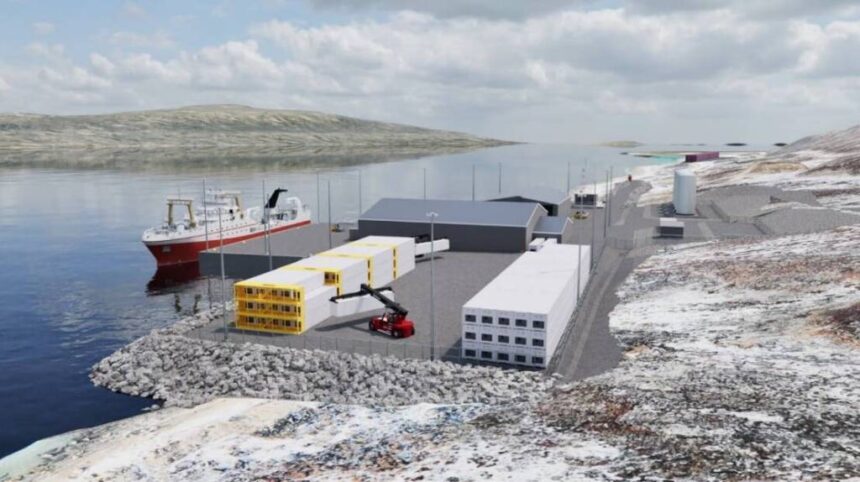
A proposed Qikiqtarjuaq deep-sea port will cost $350 million for its first phase, proponents of the project told a press conference on Dec. 2. The port was initially estimated at $200 million, but an expedited construction schedule has increased the price tag, according to Sean Leet, director of the Arctic Economic Development Corporation. Phase two does not have a projected cost yet, as requirements from the Department of Defence for a naval and fighter jet base are currently unknown. The first phase of the port is set to include a 75-metre-long dock into 10 metres of water while a second phase would extend 14 metres into the ocean. Arctic Economic Development Corporation, a private firm, and the Qikiqtani Inuit Association’s for-profit arm, Qikiqtaaluk Corporation, are behind the port’s development. Construction, hoped to begin next June, is planned to take two years instead of the previously expected four years, Leet said. Development will begin using materials brought in with assistance from an icebreaker rather than the sealift, moving up the construction start date. The Qikiqtarjuaq deep-sea port is now expected to be operational by 2028, according to Leet. The port could make back the money by attracting fishing boats in the Davis Strait, where 56,000 tonnes of seafood are currently being landed in Nuuk, Greenland, Risley said. Flaherty said Nunavut’s fishing vessels lose about $1 million per trip to offload in other jurisdictions. Fishing in the Davis Strait represents $100 million to Nunavut’s gross domestic product, according to Leet. Boats fishing in the strait can’t dock at Iqaluit’s deep-sea port because of how much the tides change in Frobisher Bay, and therefore the vessels need to anchor farther out, something that doesn’t impact the Qikiqtarjuaq project, according to Leet. At the associated Dec. 2 press conference, Harry Flaherty, president of Qikiqtaaluk Corporation, said the federal government has to start focusing on the North to address economic opportunities and sovereignty vulnerabilities. “The North is a corridor for economic opportunities and benefits that will enhance Canada, like other countries are doing, for example, in Siberia, what they have done is they built 11 deep-water ports,” Flaherty said. Out of the $350-million price tag, the port has received $40 million from the federal government and $10 million from the GN, according to Leet. He hopes the remainder of the funding will come from the $1-billion Arctic Infrastructure Fund. Representatives of Qikiqtaaluk Corporation and the Arctic Economic Development Corporation were recently in Ottawa to meet with Minister of Transport Steven MacKinnon and Department of Defence officials. “They see the value in the in the project and the opportunity for the country. And I believe they’re seriously considering the dual use aspect of it as well,” Leet said. A business plan for the port includes a submarine base, a Canadian Coast Guard base and a transport base, John Risley, chairman of the Arctic Economic Development Corporation, told the press conference. A 3,800-foot airstrip beside the proposed Qikiqtarjuaq port could serve as a tactical fighter jet base, Leet suggested. The project is one of four major infrastructure initiatives that the territorial government and Nunavut Tunngavik Incorporated pitched to the federal government to get fast-tracked under the Building Canada Act. So far, the Qikiqtarjuaq port hasn’t been mentioned by Prime Minister Mark Carney in his two announcements of fast-tracked developments around the country, one of which included the Iqaluit-Nukkiksautiit Hydroelectric Project.
Qikiqtarjuaq deep-sea ports first phase estimated at $350 million