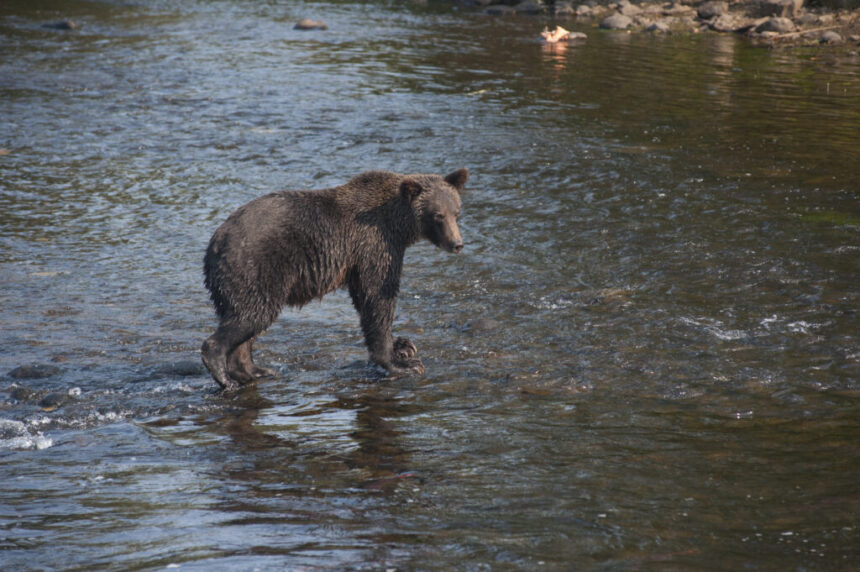
On Nov. 20, the small Central Coast community of Bella Coola, B.C. was rocked by a grizzly bear attack that sent four people, including three children, to the hospital with serious injuries. A few weeks earlier, a hunter was mauled by a grizzly bear near Cochrane, Alta., a town west of Calgary. And a few weeks before that, another hunter near Cranbrook, B.C., survived a grizzly attack, only to later die as a result of his injuries. These incidents have raised concerns about the risks posed by grizzly bears when they cross paths with humans. So far, the loudest voices have been those connecting these recent attacks to the decision to end grizzly bear hunting in Alberta in 2006 and B.C. in 2017. “When hunting pressure is removed, the number of problem grizzlies increases,” the B.C. Wildlife Federation said in a press release following the Bella Coola attack. That argument has gotten some traction. Todd Loewen, Alberta’s Minister of Forestry and Parks, announced in early November that “all options are on the table,” including re-opening the Alberta grizzly bear hunt. But there isn’t much scientific evidence to support the idea that grizzly bear hunting reduces conflicts, and some experts worry that the focus on hunting ignores more reliable, proven strategies. Research finds hunting doesn’t curtail conflict — but threats to species survival might In 2016, Kyle Artelle, a biologist who splits his time between field work on B.C.’s Central Coast and teaching at the State University of New York, published a study exploring human-grizzly bear conflict. When he examined the impact of hunting on conflict, the results spoke for themselves. “Years where more bears were hunted: there was no change in conflict in subsequent years related to that,” Artelle explains. “In years when there was less hunting, there was no change in conflict related to that. Another more recent study, this one led by researchers at the University of Victoria and posted for pre-publication review in 2024, reached a similar conclusion about black bears. “We find little evidence that lethal control interventions lead to significant long-run reductions in future human-black bear conflict,” reads the report. Jesse Zeman, executive director of the B.C. Wildlife Federation, argues that the studies that haven’t found a link between hunting and conflict reduction are looking in the wrong place. “We don’t actually study individual bears,” he explains. “Some of it is learned behaviour. We know in some cases where we have conflict bears, there’s a lineage there. So if you have a bold bear, a sow, she teaches her offspring, and you kind of end up in this cycle where you know you have problem bears because they’re taught bad behaviour.” The way that Zeman sees it, hunting would kill off these problem bears and break the chain of learned conflict behaviour. But Michelle McLellan, a grizzly bear researcher based in the Kootenays, isn’t convinced. “I don’t know that anyone knows that it’s hunting that reduces bold bears,” she says. “Nobody’s ever really tested that, as far as I can tell, so that’s a bit of a stretch.” McLellan points out that before 2017, the B.C. grizzly bear hunt wasn’t managed to reduce conflicts, but to keep the number of bears hunted below “a threshold that a population could sustain.” A 2014 study on black bears found that hunting did not reduce conflict, but the same study suggested that “reducing [bear] populations to very low densities” might be effective. Photo: Kari Medig / The Narwhal She explains that the hunt restricted which bears could be targeted, excluding mothers and cubs, and populations that couldn’t sustain hunting pressure. The places where the hunt that ended in 2017 took place, she adds, don’t necessarily align with areas reporting more recent increases in grizzly bear activity. Something that makes sense when you learn that grizzly bears are among the slowest-reproducing species in North America. McLellan also points to Alaska, where “they’re deliberately trying to reduce the number of bears via hunting and other methods.” So far, that program hasn’t been associated with any change in bear behaviour or conflict rates. Even hunting advocates have struggled to connect those dots fully. In 2019, Steven Rinella, an American writer, hunting advocate and host of the TV show MeatEater, wrote a long piece exploring the question. He determined that the idea was in the “limbo of untested hypotheses.” The only way he saw to change that was to allow large-scale grizzly hunting and study the impacts. Alberta Forestry and Parks Minister Todd Loewen said in early November that all options, including re-opening the grizzly hunt, were on the table following an attack in the town of Cochrane. Alberta banned grizzly hunting in 2006. Photo: Chris Schwarz / Government of Alberta Flickr Montana’s Grizzly Bear Advisory Council, a group of hunters, ranchers, agriculture industry professionals and conservationists, pulled together in 2019 to advise the governor on grizzly bear management strategies, came to a similar conclusion. They couldn’t align on a recommendation, so they listed considerations for both supporting and opposing a grizzly bear hunt in the state. They explain that while grizzly hunting could play a role in population management, “it will not replace the need for conflict prevention.” They also concluded that, for a grizzly bear hunt to reduce human-bear conflict, the harvest numbers would have to be high enough to pose a risk to the species’ survival. “Put it this way: if you make them go extinct, there’s a zero per cent chance of an attack,” Artelle says. Zeman says this isn’t what the B.C.Wildlife Federation is advocating for, but when asked about research supporting his claim that grizzly hunting reduces conflict, he cited a 2014 black bear study from the Ontario Ministry of Natural Resources. The study “found no significant correlations between harvest and subsequent human bear conflict” but hypothesized that conflict could be managed through harvests that “reduce [bear] populations to very low densities.” Still, Zeman argues that hunting should be one part of a much broader strategy. “There’s a whole bunch of things that we need to be doing, but we do think that hunting is a part of it,” he says. Changes to food and habitat have a major impact on bears While scientists haven’t found links between grizzly hunting and conflict, they have found links between the bears’ food sources and their behaviour. “When you look across the province, and you look in areas that have salmon, and years where there was low salmon availability, conflict goes up,” Artelle explains, describing findings from his 2016 study. “And the inverse, when you have good salmon availability, conflict goes down.” During his study, he heard stories about a link between salmon returns and bear issues in the Bella Coola valley. “There was anecdotal evidence in Bella Coola that the worst year they had had previously for bear-human conflict was a year when the salmon failed.” Artelle’s study suggested that issues with critical food sources had the highest correlation with increases in conflicts. It’s a conclusion shared by the 2024 black bear study. Some recent studies have found an association between food availability and conflict between bears and humans. Important grizzly foods, including buffaloberries and salmon, were low in regions of B.C. and Alberta that have seen recent grizzly attacks. Photo: Ryan Dickie / The Narwhal “Conditions associated with low environmental food availability, such as cold spring weather, hot/dry fall weather, and low salmon abundance, increase human-black bear conflict,” the report explains. Both the Rocky Mountains and the Central Coast had issues with important grizzly foods this summer. Buffaloberries, a key food for Rocky Mountain grizzlies, fruited early. “Bears are somewhat in a race to put on enough fat and reserves to survive the winter,” Dan Rafla, a Parks Canada resource management officer, told CBC this July as part of a warning about the early berry crop. In a 2019 study, researchers at the University of Alberta warned climate change was driving buffaloberry fruiting earlier, something that could “widen the gap between prime feeding season and hibernation.” Their study concluded that changes to the buffaloberry season would “alter the behaviour of the region’s grizzly bears.” On the Central Coast, Fisheries and Oceans Canada released salmon projections this summer which stated, “Bella Coola [Chinook] returns are expected to be below average.” Pacific Salmon Foundation’s 2025 State of Salmon report also suggested that numbers could be down across other salmon species. “When you look across the province, and you look in areas that have salmon, and years where there was low salmon availability, conflict goes up,” biologist Kyle Artelle explains. This year, Fisheries and Oceans Canada projected salmon returns will be low in the Bella Coola, B.C., region. Photo: Matt Simmons / The Narwhal “In 2024 there were virtually no conflicts,” Jason Moody, the Nuxalk Nation fisheries and wildlife planning coordinator told CBC. “We had over a million pink salmon in the area, but in 2025 that dropped by at least by at least 90 per cent.” But McLellan cautions against linking any particular bear incident to broader environmental changes. “I feel like there are a lot of people looking for a reason for something that might just be bad luck,” she says. “People are looking for certainty where there’s just a little bit more nuance. It’s not black and white.” As McLellan explains, just getting an an accurate count on grizzly can be challenging. Estimates in Alberta range from around 700 to more than 1,000. In B.C., it’s somewhere around 15,000. While grizzly populations may be growing in some areas, they’re threatened in others. Still, as Jesse Zeman of the B.C. Wildlife Federation says, it’s the number and types of stories he’s hearing from communities that have really changed. “There are people who coexisted with grizzly bears for decades who now are going, ‘You know, I can’t leave my house without taking dogs or bear spray or a gun’ and so that conversation is changing,” he explains. One study, this one a peer-reviewed paper from Minnesota in 2020, did find that when the state increased the black bear hunting levels, the number of calls about problem black bears declined. The authors suggested the harvest played a role, but admitted that the state had undertaken public education and other co-existence programs at the same time. The authors also explained that in communities experiencing a perceived increase in conflict, more hunting “is likely to be viewed positively by the affected public, and could reduce complaints even if damage is not significantly reduced.” That’s why McLellan thinks that the number of attacks can be a more useful number for understanding conflicts. Although calls to B.C. conservation officers have gone up since 2017, the same trend isn’t there when it comes to the number of attacks. This year, conservation officers have recorded eight attacks, which is the highest since 2012. Since the grizzly hunt ended in 2017 we’ve seen two years with seven attacks, which match the previous high set in 2015 — but also four years with the fewest attacks on record. YearCallsAttacksFatalities201764971201875670201994340202083370202161030202268320202396510202462930202554281Data provided by the B.C. Conservation Officer Service Proven strategies for co-existence For McLellan, the perceived increase in grizzly bear conflict in Western Canada raises one critical question: What’s going on with people in grizzly country? “If we want to really understand the dynamic, we need to count people better,” she explains. At one point, grizzly bears ranged across most of what we now call North America. From Ungava Bay in Nunavut to the Sierra Madre in Mexico, grizzlies lived not just in mountains and forests, but on prairies and in the valleys where many people now live. “I get the question all the time, are there more bears? Like, what’s going on?” says Kathy Murray, program support staff with WildSafeBC. “We have more people living, working, recreating and growing food in wildlife habitat, so the potential for conflict is going to keep increasing.” Murray has been working on reducing grizzly bear conflict for more than two decades. She started after her own close call with a grizzly. “What are the chances of me having an encounter with a grizzly bear?” she remembers thinking as she headed out for an evening bike ride shortly after moving to the small Rocky Mountain town of Lake Louise, Alta. Before long, she was alone. Breathing in the crisp mountain air, she rounded a blind corner and came face to face with a mother grizzly and her cubs. “I surprised the grizzly bear at close range, and she bluff charged me,” Murray says. “I pretty much stopped in my tracks and froze.” Murray remembers the encounter as both terrifying and formative. “I decided to take that fear and turn it into something positive,” she says. Today, her work with WildSafeBC involves a wide range of programs and projects proven to reduce human-bear conflict. “Having worked in the field with grizzly bear experts, I’ve always asked them, ‘What’s the best advice for people?’ ” she says. The answer, time and again, is to be loud, try to avoid surprising bears and “carry bear spray, and also know how to use it.” “We have more people living, working, recreating and growing food in wildlife habitat, so the potential for conflict is going to keep increasing,” Kathy Murray, program support staff with WildSafeBC, says. Photo: Taylor Roades / The Narwhal Both McLellan and Kyle Artelle echoed this point, arguing that coverage of the Bella Coola attack was misleading about the effectiveness of bear spray in that instance. “If they didn’t have bear spray, that could have been much, much worse,” McLellan says. She points out that, of the 11 people treated on scene, some were for bear spray exposure — which, while unpleasant, is preferable to bear injuries. Murray also works on larger projects, focusing on managing bear attractants such as garbage, residential fruit and livestock. These projects include everything from cost-sharing programs to putting up electric fences around livestock areas to promoting and supporting the adoption of bear-resistant garbage bins. “There is no one silver bullet,” she says. “It’s a multi-layered, ongoing process.” The most ambitious program is called Bear Smart, in which municipalities undergo a bear-hazard assessment and then implement widespread changes to manage conflict. “It’s an excellent community initiative, but it’s a very rigorous process,” Murray explains. “It requires a lot of commitment, and it requires buy-in from the community, from the residents, from council staff, and sometimes there just isn’t the time or the resources.” According to WildSafeBC’s website, only 12 towns in the province have met the criteria to be designated Bear Smart communities. In Alberta, there are five active programs. For now, the B.C. government doesn’t seem to be considering bringing back the grizzly bear hunt. When asked about restoring a hunt in the province, Environment Minister Tamara Davidson poured cold water on the idea. “When the hunt was open, bears were not typically hunted in the same areas where conflicts were occurring,” she told the legislature on Nov. 25, 2025. “Any time there’s a conflict with a bear, it’s a reminder that we share the outdoors with these wild animals.”
Recent grizzly attacks have B.C. and Alberta on edge, but experts say hunting bears is unlikely to help