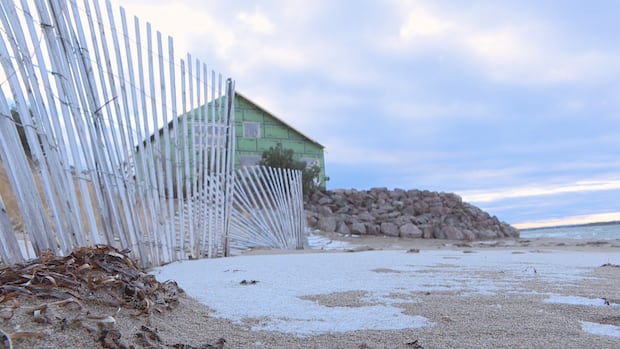
New BrunswickYear-round residents in Pointe-du-Chêne say beachgoers will notice a difference when summer returns.Building on beaches is not a new phenomenon, says environment profVictoria Walton · CBC News · Posted: Dec 05, 2025 5:00 AM EST | Last Updated: 3 hours agoListen to this articleEstimated 5 minutesThe audio version of this article is generated by text-to-speech, a technology based on artificial intelligence.Pointe-du-Chêne residents say a new rock retaining wall on the east end of Parlee Beach interrupts the view. (Victoria Walton/CBC)Year-round residents in Pointe-du-Chêne say beachgoers will notice a difference when summer returns.Parlee Beach Provincial Park is one of the most popular beaches in southeastern New Brunswick, hosting thousands of visitors on busy summer days. But some locals say a new development just past the eastern end of the official parkland threatens to change the landscape of the shoreline.“This is a build up of rocks that don’t belong here,” said Bob Surette, who grew up in and still lives in the area, as he gestured to a new rock wall between a house under construction and the beach.Pointe-du-Chêne resident Bob Surette said when seasonal residents return in the spring, the line of sight down Parlee Beach will be blocked by a new rock wall. (Victoria Walton/CBC)Other residents, like Jean Babin, agree. “This is unbelievable,” said Babin, who is originally from Moncton but has lived in the area since 2020 and says he swims at the beach every day during the summer.”All the rock they put there is too much,” he said. “It kind of blocks the view from the beach and the people coming here to walk.”WATCH | ‘Nature doesn’t care’ how close you build to the beach:Residents question placement of new retaining wall on Parlee BeachThe rock wall is on private property, but locals say it goes against the idea that the beach belongs to everyone.For residents like Surrette and Babin, the beach is more than just a place to spend hot summer days, it’s an important part of New Brunswick’s natural landscape.“Some people say it’s a private beach,” Surrette said. “There’s no such thing as a private beach. The beach is for everybody.”No permit requiredThe property located at 167 Fernwood Ave., sits at the end of a quiet dirt road in what’s known as The Bluff, just past the official end of Parlee Beach.The owners purchased the property in June 2023 for $735,000, according to online property assessment records. The previous cottage was removed, and a new building is being constructed on the property by Shediac-based REMCO Construction Inc.Plan 360, which approves developments for the Southeast Regional Service Commission, said there is an active permit to build a dwelling on the site.Residents claim the rock wall along the beach is closer to the shoreline than the previous one that was on the property. (Victoria Walton/CBC)“A building permit was issued by our team for a dwelling in this development with the approval of the Department of Environment,” said a representative from Plan 360 in an emailed statement to CBC News.But there’s no permit needed for the rock wall at the base of the property, according to the Department of Natural Resources.“In New Brunswick, most land located below the ordinary high-water mark falls under the administration and control of the Department of Natural Resources,” a department spokesperson said in a statement.That’s backed up by the province’s Coastal Land Use policy. The rock wall ends a few feet before the high-tide line, represented by a property line-marker in the sand. (Pierre Fournier/CBC)According to the DNR, a representative from the government went to investigate after it was made aware of the project, and determined that the rock wall does not fall on Crown land.The property owner did not respond to multiple requests for comment.Stronger retaining walls, or stronger coastal protections?Whether any given project or property complies with regulations is one thing, said Mount Allison University environment Prof. Jeff Ollerhead. Whether those regulations are strong enough, is another, he said.“Relative to other parts of North America, we have relatively few regulations that are enforced,” Ollerhead said. “New Brunswick has a coastal policy that’s been in place since the 1990s, but it’s not a law. It’s not legally binding, necessarily.”Ollerhead said that the sea level will continue to rise at an accelerated rate, thanks to climate change, and that a rock retaining wall will only delay the inevitable effects.“The rules allow you to do it, and so you may tick all the boxes and have all the permits and you haven’t broken any laws or done anything that’s against the regulations,” he said.“But nature doesn’t care. When the next big storm comes, the water is still gonna be coming through your front window.”Mount Allison University geography and environment Prof. Jeff Ollerhead said that New Brunswick’s regulations about development along the coast aren’t as strong as they could be. (Victoria Walton/CBC)On top of that, he doesn’t agree that rock walls are necessarily the best way to prevent coastal erosion, especially if they aren’t up to standard.“There really are no regulations about who builds them or whether they have to be properly engineered,” Ollerhead said. “The majority of breakwalls have probably been put in without an engineering study, without a design required, and built out of materials that may or may not be suitable.“So, you know, in New Brunswick, are seawalls well built? In general, not particularly.”Under the province’s current regulations, Surette worries this development won’t be the last along this shore.“I’m really worried about the beach, about everybody doing the same thing,” he said.“This is a canary in the coal mine, and if people are allowed to do this monstrosity on the beach, other people will.”ABOUT THE AUTHORVictoria Walton is a reporter at CBC New Brunswick, and previously worked with CBC P.E.I. She is originally from Nova Scotia, and has a bachelor of journalism from the University of King’s College. You can reach her at victoria.walton@cbc.ca.
Residents worry new retaining wall is canary in the coal mine for Parlee Beach encroachment