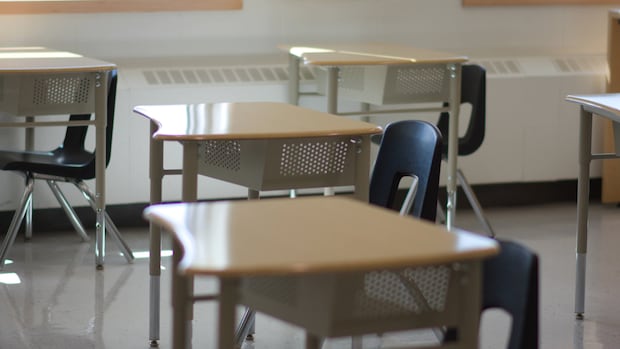
Saskatchewan·NewCBC News compiled the data on school absences across Canada within the last five years. The analysis found that across the country more elementary and secondary students are missing school, including in the Regina and Saskatoon public divisions.Public school attendance in 2024-25 was nearly 4 per cent lower than in 2018-19Aliyah Marko-Omene · CBC News · Posted: Dec 08, 2025 6:00 AM EST | Last Updated: 31 minutes agoListen to this articleEstimated 6 minutesThe audio version of this article is generated by text-to-speech, a technology based on artificial intelligence.Data from across the province shows elementary and secondary students are missing more school than they did five years ago. (Bobby Hristova/CBC)Grade 12 student Kaitlynn Carnie says her day starts with a simple question: Can I handle school today? The Archbishop M.C. O’Neill High School student said she first grabs her phone to check on what she would miss if she stayed home, weighing each period like a set of scales. “If I miss, is it going to be a bad thing? Is there an exam that I should be there for?”The 17-year-old was in Grade 6 when the COVID-19 pandemic started and spent a year and a half learning online from home. After she returned to the physical classroom in Grade 8, she often suffered from panic attacks and missed days of school at a time, she said. Grade 12 student Kaitlynn Carnie says she often debates herself about whether it’s worthwhile or necessary to go to school on a given day. (Submitted by Kaitlynn Carnie)She now considers her mental health when deciding whether or not to attend school, Carnie said.“Being at school a lot can add a lot of strain to you,” she said. “Sometimes you just need to take a day off so you can recalibrate yourself.”Carnie said it’s often deadlines or tests that get her out the door. “If I see that we’re doing notes that day … it makes me want to go less, because I know what’s going to happen and it’s stuff that I can learn on my own at home rather than being at the school itself.”CBC News compiled and analyzed data on school absences across Canada within the last five years and found that across the country, more elementary and secondary students are missing school, including in the Regina and Saskatoon public divisions. Both divisions said several factors are contributing to the increased level of absences. Carnie’s classmate Stacy Dustyhorn, 17, said it’s been harder to be enthusiastic about school since returning to the classroom after the pandemic. Grade 12 student Stacy Dustyhorn says asking for help with schoolwork was easier for her during the pandemic. (Submitted by Stacy Dustyhorn)She struggled with online learning during the pandemic, but could easily ask for help, she said. “My parents could support me, and like my teachers always said, ‘Oh, just send me a text’ and I would,” Dustyhorn said. Asking for help when she struggles doesn’t feel as easy now, and when she falls behind, she wants to stay home. “If I didn’t finish my work and like I knew my teacher would get mad at me, I wouldn’t come in because I’d feel nervous and stressed about it,” she said. Mom says pandemic changed kids’ outlookBecky Peterson, a mother of four, said similar attitudes about school showed up most in her two youngest children, who are now 14 and 17, after the pandemic. She remembers spending months in the kitchen helping them with their weekly worksheets. There was no live instruction or contact with classmates — just packets to complete, she said. “I think learning became a lot more casual for them, as opposed to this really structured thing.”Peterson said she also noticed a change in her own thinking. She used to have hard rules: only fevers and stomach bugs meant the kids would stay home from school. Becky Peterson, a mother of four, says learning was less structured for her kids during the pandemic years. (Germain Wilson/CBC)Peterson said the precautions during the pandemic years reshaped those boundaries.“We try to give them grace if it seems reasonable,” she said. “But we also expect them to be accountable for their choices.”Sometimes she worries about whether she’s being too flexible with her kids, or not flexible enough, but the one thing she keeps coming back to is the importance of balance, she said. “It’s important to recognize when you need space, but also within reason, because you need to show up and do your job and be productive and be part of society.”Saskatoon Public Schools reported a 50 per cent increase in illness-related absences when the 2018-19 school year is compared to the 2024-25 school year. The division attributed the change to several factors, including growth in the student population, more caregivers opting to keep their children home when sick and better reporting and classification of absences. Regina’s public division has seen a smaller increase in student absences. Its overall average attendance rate has dropped by close to four per cent, in line with the provincial average, which has also dropped nearly four per cent. The increase in absences is most pronounced in the earlier grades, especially pre-Kindergarten and Kindergarten, according to the division. “The school division is aware of them and working to reverse the small decrease,” a spokesperson for Regina Public Schools said in an email to CBC News. Pandemic shaped expectations: psychiatrist Dr. Madhav Sarda, a child psychiatrist in Saskatoon, said it’s not surprising to hear that students who were shaped by the pandemic view school differently than previous cohorts. “This is just their environment that they’ve grown up with,” he said. “That’s not necessarily a bad thing.” Sarda said he believes that during the pandemic many students realized they could have more flexibility in their day-to-day lives, but that didn’t mean they stopped caring about school. However, there were students who needed extra intervention and help during the pandemic and didn’t get it, he noted. Those students may be continuing to struggle in school as a result, and there is a risk that they will fall through the cracks of the system, Sarda said.There’s no perfect answer when it comes to bumping up students’ attendance, but people tend to want to go to a place where they feel socially connected, he said.“The more of that social connectedness we have [at school], the more they’re going to come.” Carnie said she would feel more motivated to be in the classroom if she had more opportunities to engage with her teachers and peers at school. “I know I’m in high school, but activities are still fun. And I feel like that motivates more people or makes it more positive.”ABOUT THE AUTHORAliyah Marko-Omene is a reporter for CBC Saskatchewan. She has previously worked for CBC and Toronto Star in Toronto. You can reach her at aliyah.marko@cbc.ca.
Student absence rates at Sask. schools have grown since the pandemic