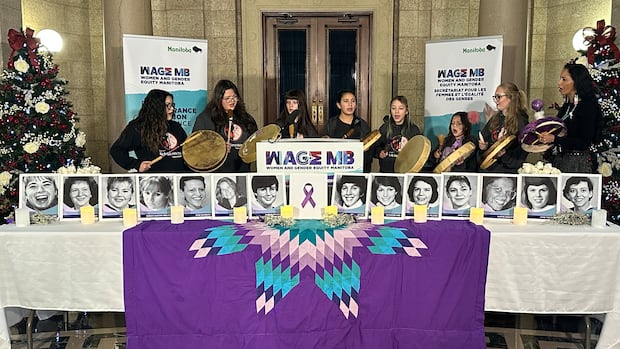
ManitobaThe 14 women killed at École Polytechnique in 1989 were remembered in a solemn memorial held at the Manitoba Legislature on Thursday morning.’1989 was not the end, it was a warning’ of growing male violence: families ministerCBC News · Posted: Dec 04, 2025 1:41 PM EST | Last Updated: 6 hours agoListen to this articleEstimated 4 minutesThe audio version of this article is generated by text-to-speech, a technology based on artificial intelligence.Women drum and sing at a Thursday morning event at the Manitoba Legislature to mark the anniversary of the Montreal Massacre and the National Day of Remembrance and Action on Violence Against Women, which is typically marked on Dec. 6. (Tyson Koschik/CBC)The women killed at École Polytechnique in 1989 were remembered in a solemn memorial held at the Manitoba Legislature on Thursday morning.On Dec. 6, 1989, 14 women, including engineering students, a nursing student and a staff member, were killed in a shooting rampage at Montreal’s École Polytechnique by a gunman who shouted: “I hate feminists.”The event at the Legislature began with a sunrise ceremony, which included drumming and singing, followed by remarks from Families Minister Nahanni Fontaine and Amna Mackin, acting deputy minister for Indigenous reconciliation.At the end of the ceremony, 15 roses were lined up in the rotunda as the names of the victims of the Montreal Massacre were read out — one for each of the women, and another for victims of gender-based violence in the past year.”These women were targeted explicitly because of their gender,” Fontaine said. “This was not random. This was not senseless. This was male violence rooted in misogyny, and it changed this country forever.”Fontaine says Manitoba is not immune to gender-based violence, and has some of the highest rates of missing and murdered Indigenous women, girls and gender-diverse people in the country.Manitoba also carries the “grotesque reality of two serial killers operating in the same generation,” said Fontaine, referring to Shawn Lamb and Jeremy Skibicki.”1989 was not the end, it was a warning … of exactly where male violence was headed in this country,” she said.”We deserve a world where boyhood is not nurtured into entitlement, where manhood does not depend on domination, and where violence is not the cost of simply existing as a woman.”Manitoba Families Minister Nahanni Fontaine says Manitoba is not immune to gender-based violence, and carries the ‘grotesque reality of two serial killers operating in the same generation,’ referring to Shawn Lamb and Jeremy Skibicki. (CBC)Lamb pleaded guilty to two counts of manslaughter in the 2012 slayings of Carolyn Sinclair and Lorna Blacksmith. He was sentenced in 2013 to 20 years in prison — 10 years for each killing — minus time served while awaiting trial. He was granted statutory release last month.Skibicki was convicted of four counts of first-degree murder in July 2024, in a high-profile case that galvanized people across the country to push for the search of a Winnipeg-area landfill for the remains of two of the women Skibicki killed: Morgan Harris and Marcedes Myran.Searchers found the remains of Harris and Myran at the Prairie Green Landfill earlier this year. The province said a search for his first victim, Ashlee Shingoose, began Monday at Winnipeg’s Brady Road landfill.The province previously announced plans to search the same landfill for Tanya Nepinak, who has not been seen or heard from since Sept. 13, 2011. Police did a six-day search for her remains at the Brady Road landfill in 2012 but found nothing.Lamb was previously charged with second-degree murder in Nepinak’s death, but the charge was later dropped.Mackin, who led the landfill search for the remains of Harris and Myran, said she was an engineering student at the University of Manitoba when the Montreal massacre took place.She said the massacre symbolized “a direct attack on equality in education and the right of women to pursue careers in engineering and sciences.””The loss of the women of École Polytechnique 36 years ago exposes ongoing systemic issues,” she said. “We know there are still environments that tolerate hostility and harassment and fail to protect vulnerable individuals.”Mackin said Indigenous women face disproportionate rates of violence in Canada.”In 2022, four vulnerable Indigenous women lost their lives to violence and were believed to have been deposited in landfills: Rebecca Contois, Morgan Harris, Marcedes Myran and Ashlee Shingoose.”She said she was proud to have led the successful search for Harris and Myran: “Our dedicated team brought them home earlier this year, something many thought impossible, yet we were determined to try.”
Sunrise ceremony at Manitoba Legislature remembers victims of 1989 Montreal massacre