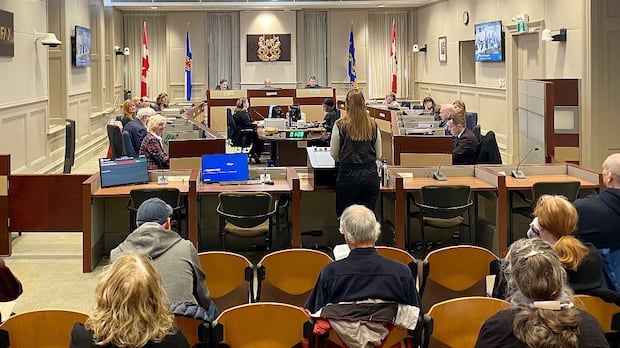
Halifax Regional MunicipalityHalifax council has passed a slew of amendments to planning documents aimed at fast-tracking housing, most of which were required by the province but which also left out what councillors and residents call a key environmental protection. Council officially approves planning rules Nova Scotia government brought in this fallHaley Ryan · CBC News · Posted: Dec 12, 2025 1:40 PM EST | Last Updated: 8 hours agoListen to this articleEstimated 5 minutesThe audio version of this article is generated by AI-based technology. Mispronunciations can occur. We are working with our partners to continually review and improve the results.A Halifax resident speaks to councillors during a public hearing on changes to the regional plan during a public hearing on Dec. 11, 2025. (Haley Ryan/CBC)Halifax council has passed a slew of amendments to planning documents aimed at fast-tracking housing, most of which were required by the province but which also left out what councillors and residents call a key environmental protection.On Thursday, regional council passed some amendments to Halifax’s 2014 regional plan guiding growth in the municipality, and other municipal planning and land-use bylaws, following a public hearing. The changes include fast-tracking new suburban development sites, allowing underutilized buildings in rural areas to be adapted for housing, and enabling short-term rentals in rural areas of the eastern part of the municipality.There are also multiple provincially mandated planning requirements, some of which have been welcomed. But multiple residents and councillors spoke against removing bedroom-mix requirements and reducing ground-floor commercial space in buildings started before April 2028.“The province has the reins on this process and it’s effectively stripped council of any authority that they hold over our municipal affairs,” Jillian Ramsay, sustainable cities co-ordinator with the Ecology Action Centre, told reporters outside the hearing.Jillian Ramsay, sustainable cities co-ordinator with the Ecology Action Centre, speaks with reporters at City Hall on Dec. 11, 2025. (Haley Ryan/CBC)“It kind of renders this process void a little bit. So folks are showing up, trying their best to engage in the democratic process. And unfortunately, it’s going to have to fall on deaf ears because the province is mandating these inclusions, its mandating exclusions.”Ramsay and others echoed councillors’ repeated concerns that those new requirements will actually make housing less affordable by leading to buildings of one-bedroom units.Sue Uteck, executive director of the Spring Garden Area Business Association, said she and the other nine business improvement districts believe reducing ground-floor commercial space will mean less walkable communities.“While the goal of all of us is to lessen our dependence on cars, this amendment will force residents to travel for goods and services,” Uteck said during the hearing.The provincial requirements have actually been in effect since October, when the former municipal affairs minister made Halifax an interim planning area, allowing projects waiting on those rules to continue.The amendments will now go to the municipal affairs minister for final approval, and the interim provincial order can then be lifted.“By saying yes, we do bring this back in our control, and I think that’s what makes saying yes to this the better vote for me,” said Coun. Cathy Deagle Gammon.Mayor Andy Fillmore said while council is in an “atypical situation” that some find uncomfortable, the province is being a strong partner by allowing Halifax to move more quickly to enable housing.“I don’t think this is forever. I know this isn’t forever. The province does not want to be in this business. They would like to get the work done, the fixes made and and get out of it,” Fillmore told reporters.“I expect we will move on and return to a more normal situation soon.”But a point of concern from residents, and multiple councillors during their debate, revolved around a piece of the original plan that was not included in this round of changes.In his rejection of the regional plan this August, then municipal affairs minister John Lohr said he was specifically concerned that requirements for outlets to accommodate electric-vehicle chargers, and increasing setbacks around watercourses and wetlands to 30 metres from 20, would hurt development.Halifax council has passed multiple changes to its regional plan and other planning documents, some of which have been in place through an interim provincial order since October. (Brian MacKay/CBC)Resident Kathleen Hall said Thursday these watercourse buffers help prevent flooding and erosion, and are natural firebreaks which have become especially important in light of Halifax’s 2023 major wildfire.“Removing them to squeeze in one more row of houses is not expediency, it is negligence,” Hall said during the hearing.Stephen Adams of the Urban Development Institute of Nova Scotia, which represents most of the major developers in Halifax, has said he lobbied Lohr to cut those requirements.Adams said during the hearing he knows of at least two developments that would be impacted if the setbacks expanded, and he hasn’t seen enough evidence that an expansion is needed.“If you can’t tell when 20 metres failed, how do you know when 30 metres will work?” Adams said during the hearing.Stephen Adams, executive director of the Urban Development Institute of Nova Scotia, speaks during the public hearing on regional plan changes Dec. 11, 2025 (Haley Ryan/CBC)Coun. Tony Mancini said there is actually “lots of science” showing the effectiveness of increasing buffers, which has been shared with the province.“We’re talking the worst kind of politicking that’s taking place in the industry — listen to a few,” Mancini said.Ramsay of the Ecology Action Centre said the science and evidence on the effectiveness of 30 metre buffer zones is extensive, including federal studies. She cited multiple local cases where development has impacted waterways, like in Eisner Cove and Black Duck Brook.Halifax staff will come back to council next year with a workplan on how to bring in other pieces of the regional plan, including the expanded watercourse buffers.MORE TOP STORIES ABOUT THE AUTHORHaley Ryan is the municipal affairs reporter for CBC covering mainland Nova Scotia. Got a story idea? Send an email to haley.ryan@cbc.ca, or reach out on Twitter @hkryan17.
Take 2: Halifax council passes parts of regional plan following provincial rejection