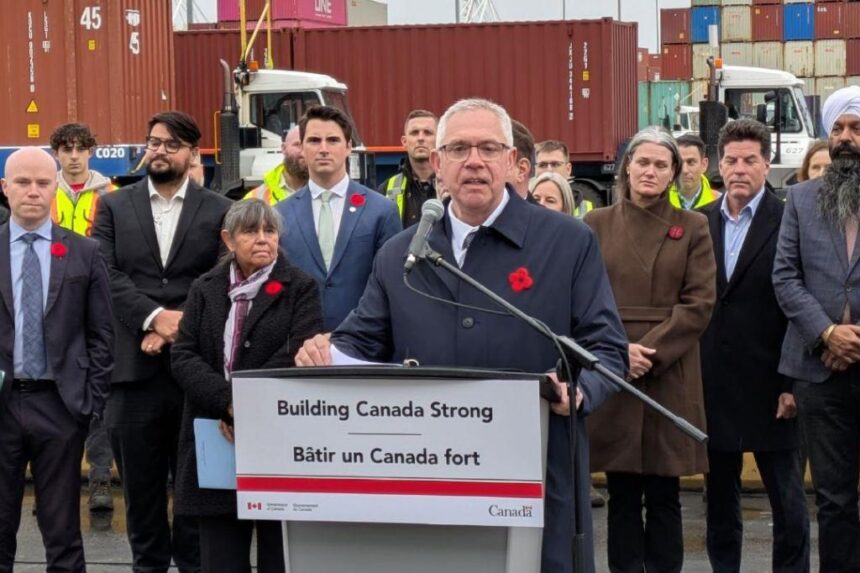
The Government of Canada is officially listing the $5.9-billion Delta container port expansion as a project of “national interest” to help streamline approvals for Roberts Bank Terminal 2 (RBT2). The announcement was made in a special event at the Delta port on Friday, Oct. 30. Minister of Transport Steven MacKinnon was on hand to make the announcement, alongside Delta MP Jill McKnight, B.C. premier-designate Lorne Doerkson, Tsawwassen First Nation Chief Laura Cassidy, Vancouver Fraser Port Authority president and CEO Peter Xotta, and other political and business leaders. “This is an incredibly important day, not just for this community, not just for this province, but this is an incredibly important day for Canada,” MacKinnon said. The minister noted the Port of Vancouver is Canada’s largest port “by a long margin,” connecting Canadian businesses to more than 170 markets around the world and handling approximately one-third of Canada’s trade outside the United States. As such, expanding the port is key to pursuing the government’s ambitious goal of doubling exports to non-U.S. markets by 2035. “But the importance of the Port of Vancouver goes well beyond the volume of goods moving through it. It’s what those goods represent: the hard work of farmers, manufacturers, producers, exporters, small businesses and communities right across Canada,” MacKinnon said. “When we invest in the Port of Vancouver, we’re investing in opportunities for Canadians from coast to coast to coast. And today, we’re taking a very vital step.” The federal government says declaring RBT2 a project of national interest accelerates the project’s commercial operations by up to four years — meaning it will be ready to operate by 2035 rather than 2039. The government is stressing the need to take expedited action on the port expansion to help strengthen Canada’s trade sovereignty. “By listing Roberts Bank Terminal 2 as a project of national interest, we are better connecting our economy with the world and diversifying our trade,” Prime Minister Mark Carney said in a statement. “As the world competes for capital, Canada will not wait. We are building a stronger, more independent and more competitive Canadian economy.” In practical terms, the declaration means the project will be able to bypass the remaining federal permits and authorizations that would be required for the project. Instead, Ottawa’s Major Projects Office (MPO) will “continue to coordinate consultation with Indigenous communities” to create a “conditions document” that will be issued by the minister responsible under the act, currently Minister of Internal Trade Dominic Leblanc. That conditions document can be ready within “a couple of months,” according to senior government officials in a technical briefing with media. Among the conditions that must be met will be environmental protections. Part of the process of becoming a project of national interest includes a consideration of the potential effects on marine ecosystems, including on the Southern resident killer whales (an endangered species) and chinook salmon. The Vancouver Fraser Port Authority has proposed “avoidance, mitigation and offsetting measures” to help address the effects on whales, including measures to mitigate underwater noise. The Port Authority has also committed to 102 hectares of fish habitat offsetting. Speaking at Friday’s announcement, Tsawwassen First Nation Chief Laura Cassidy said environmental protections are key to TFN’s consent to the project, noting their support is not unconditional. “We continue to have concerns about the impacts of the project and the long-term health of the Fraser River estuary and the Salish Sea,” Cassidy said. “At the same time, years of consultation have resulted in a deeper understanding of those impacts and how they can be addressed. The project now includes important accommodations for Tsawwassen harvesters, positive environmental measures and commitments to the ongoing oversight and accountability as the project proceeds.” Cassidy said TFN sought assurances from the federal government that the Building Canada Act would not be used to cut corners or weaken environmental protections, and that Canada committed to upholding project conditions TFN has long fought for and ensuring impacts “will continue to be managed in the spirit of our treaty.” “Looking ahead, one of TFN’s highest priorities is to advance a breach in the Roberts Bank Causeway to improve access to habitat for young salmon. We view this as an important opportunity to support the long-term health of the estuary,” Cassidy said. “More broadly, we believe major projects like this should strive for net environmental gain. It is not enough to simply minimize impacts; we must leave the environment better than we found it. Because I can say with confidence that leaving a healthy planet for our future generations is in the national interest.” MacKinnon, who touted the government’s commitment to protecting endangered whales and local salmon stocks among other environmental measures, did not commit to TFN’s request for a break in the Roberts Bank Causeway, noting he only learned of it earlier that day. “I’ll take that back, obviously, and we’ll be doing a lot of thinking about that.” Construction mobilization and early works were previously expected to occur in 2027, with major land reclamation works expected to begin in 2028. That timeline is unchanged from what it was before Friday’s announcement. How exactly the project will be funded has not yet been announced, but the $5.9-billion capital cost may include some federal funding. A final financial investment decision is expected in 2027. The Government of Canada says that, ultimately, the project is expected to contribute $3 billion annually to Canada’s GDP. More to come…
$5.9B B.C. container port expansion of national interest: Canadian government