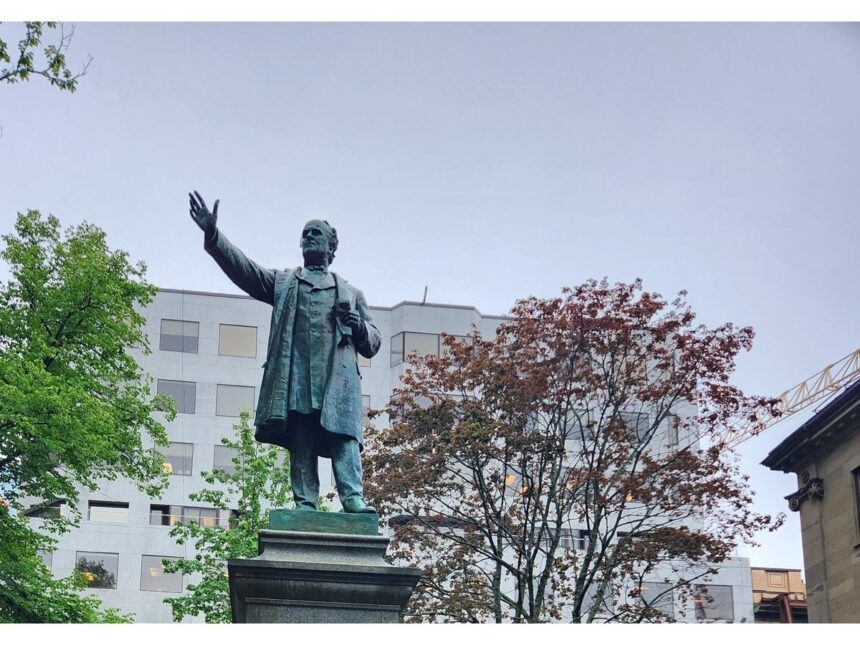
The Canadian province that fought Confederation is best place to lead itAuthor of the article:By Geoffrey V. Hurley, Contributed Published Oct 30, 20266 minute readJoseph Howe, memorialized in a statue outside Province House in Halifax, warned as Nova Scotia joined Confederation in 1867 that a small Atlantic colony would be “neglected in a larger country.” Photo by ContributedArticle contentAs other provinces flirt with separation, the one that almost refused Confederation nearly 160 years ago — and signed a treaty of peace and friendship 300 years ago — has the character, the coastline, and the quiet achievements to lead.THIS CONTENT IS RESERVED FOR SUBSCRIBERS ONLY.Subscribe now to access this story and more:Unlimited access to the website and appExclusive access to premium content, newsletters and podcastsFull access to the e-Edition app, an electronic replica of the print edition that you can share, download and comment onEnjoy insights and behind-the-scenes analysis from our award-winning journalistsSupport local journalists and the next generation of journalistsSUBSCRIBE TO UNLOCK MORE ARTICLES.Subscribe or sign in to your account to continue your reading experience.Unlimited access to the website and appExclusive access to premium content, newsletters and podcastsFull access to the e-Edition app, an electronic replica of the print edition that you can share, download and comment onEnjoy insights and behind-the-scenes analysis from our award-winning journalistsSupport local journalists and the next generation of journalistsRegister to unlock more articles.Create an account or sign in to continue your reading experience.Access additional stories every monthShare your thoughts and join the conversation in our commenting communityGet email updates from your favourite authorsSign In or Create an AccountorArticle contentThis year (2026) has been an anniversary year in Nova Scotia — and it has unfolded just as talk of separation flares in some other provinces, most loudly recently in Alberta.Article contentArticle contentArticle contentThree centuries ago, at Fort Anne in Annapolis Royal, the Mi’kmaq and the British Crown signed the Treaty of Peace and Friendship. It is a living agreement, renewed each Treaty Day — which marks its 40th year in 2026. Before Canada argues again about who belongs, Nova Scotia is remembering a relationship that predates Confederation by 141 years and rests on peace and friendship, not force.Article contentMy answer to the separation talk is the province that never wanted in.Article contentOn July 1, 1867, as bells rang in Ottawa, a Halifax newspaper ran a mock obituary: “Died! Last night at 12 o’clock, the free and enlightened Province of Nova Scotia.” Anti-Confederates took 36 of 38 seats that September. Joseph Howe warned a small Atlantic colony would be “neglected in a larger country.” Nova Scotia joined not from enthusiasm but because Sir Charles Tupper forced it through despite mass protests.Article contentArticle contentThe reluctant partnerArticle contentThat origin matters now. The traits that made Nova Scotia a reluctant partner — fierce independence, suspicion of distant power, deep attachment to its own waters — are exactly what make it uniquely able to restore its reputation as one of Canada’s most indispensable provinces.Article contentArticle contentNova Scotia’s greatest asset has always been its ocean position, facing the sea rather than the interior. Before Confederation, its ports, shipyards, fishing fleets and trade made it a commercial power. Halifax was a gateway for goods and immigrants. The Mi’kmaq fished these waters for millennia before Europeans arrived, and Acadian, Black Loyalist, Scottish, Irish, and German communities built a society that was never a copy of Ontario or Quebec, but distinctly Atlantic.Article contentArticle contentThen came the St. Lawrence Seaway, a wound that never fully healed.Article contentSold as nation-building, it was a bypass for Nova Scotia. Inland routes diverted trade from Halifax and Saint John. By 1964, the Atlantic Development Board reported winter navigation on the St. Lawrence had cost the two ports about $3 million a year, diverting 200,000 tons of general cargo and 3,600 man-months of seasonal employment. Halifax’s container share fell from eight per cent to under five per cent. The seaway did not just redirect ships. It redirected hope.Article contentArticle contentBitterness not an optionArticle contentYet Nova Scotians never surrendered to bitterness. Outsiders miss this: the friendliness here is not a tourist-brochure affectation; it is a survival strategy forged over generations. You cannot build a life on a rocky coast, lose your economic lifeline and still keep your door open to strangers unless your resilience runs bone deep. That warm, stubborn, generous, unbreakable character is the province’s most underrated resource — and it is critical to future success.Article contentArticle content The Mi’kmaw Interpretive Centre at the Fortress of Louisbourg National Historic Site (Parks Canada) is one of the national historic sites in Nova Scotia that will benefit from the new Toqi’maliaptmu’k Arrangement, which means “we will look after it together.”Article contentArticle contentConsider the Acadians. Expelled in Le Grand Dérangement, scattered across the Atlantic world, they still returned.Article content“These sufferings made the Acadians stronger, united and determined to move forward,” Nova Scotia’s lieutenant-governor wrote in 2018. A people who could have chosen resentment chose to rebuild.Article contentConsider the Mi’kmaq, who never stopped protecting land and water. In 2025, the Mi’kmaq and Parks Canada signed the Toqi’maliaptmu’k Arrangement — “we will look after it together” — rooted in Netukulimk, leaving the Earth healthy for future generations.Article contentArticle contentNova Scotia is not merely surviving; it is quietly becoming indispensable.Article contentArticle contentHomegrown leadershipArticle contentIn renewable energy and environmental innovation, Nova Scotia built North America’s first tidal power plant at Annapolis Royal in 1984 — a pioneering facility that has since been retired, but which helped establish the province as a proving ground for tidal energy. Offshore wind potential exceeds 60 gigawatts — more than 25 per cent of Canada’s current energy consumption — and renewable electricity rose from nine per cent in 2007 to 40 per cent in 2020.Article contentIn health, the Canadian Centre for Vaccinology at Dalhousie has shaped national immunization strategy, and QEII clinicians pioneer radiation-free 3D ultrasound. In marine science, Dalhousie researchers are advancing ocean-based carbon removal and monitoring right whales and white sharks.Article contentAnd Nova Scotia has never lacked political leadership of consequence. Joseph Howe did more than any other man to establish responsible government — the first British colony governed by it, in 1848 — and defended freedom of the press when it was still radical. Robert Stanfield rebuilt a party with no seats into a government, then led the federal Progressive Conservatives with such integrity that he is still called “the greatest prime minister Canada never had.”Article contentArticle contentSir Charles Tupper and Sir John Thompson both became prime minister; Angus L. Macdonald reshaped the province’s roads and schools and served as minister of naval defence; Alexa McDonough led a federal party from this small province. This is not a province that sits on the sidelines.Article contentNova Scotia’s cultural contributions run far deeper than its size suggests. Anne Murray, the Springhill girl who became the first Canadian woman to hit No. 1 in America and sold 54 million records, carried Atlantic Canada into the global pop mainstream. Rita MacNeil turned Cape Breton’s mines and kitchens into songs that became part of the national soundtrack. The Cape Breton fiddle tradition — carried worldwide by Natalie MacMaster and Ashley MacIsaac — turned a small island’s music into an international export. And Rita Joe’s poetry gave Mi’kmaq experience a permanent place in Canadian literature. A province that produces such contributions is not a backwater. It is a wellspring.Article contentArticle contentThe obituary was wrongArticle contentAs warming makes other regions less hospitable, Nova Scotia’s deep harbours, temperate maritime climate and fresh water become strategic assets. Tourism spending reached $3.7 billion in 2025, supporting over 55,000 jobs. This province can be a refuge for a harried world.Article contentI speak as an “Upper Canadian” who married a Haligonian, raised a family with four children here, and has lived in this province nearly 50 years. Nova Scotia took me in, taught me resilience up close, and never made me feel a stranger. For that, I am grateful.Article contentThe case I make for Nova Scotia status to be considered as Canada’s greatest province does not rest on size or swagger. It rests on being forced to be smarter, more adaptive, and more ocean-literate than the rest.Article contentConfederation was supposed to make it a junior partner. Instead, it made it a laboratory for what Canada must become: a country that looks to the sea for its future, not just its past; that learns from the Acadian who returned, the Mi’kmaq who kept watch, and the Nova Scotian who still holds the door open with a smile.Article contentArticle contentNova Scotia embraces the technologies of the next century — tidal, offshore wind, marine biotech, digital health — not as novelties but as the natural extension of a people who have always had to innovate to survive, and increasingly to do so within environmental limits.Article contentThe province that once mourned its own birth has spent 150 years proving the obituary wrong. It is time to say so.Article contentArticle contentGeoffrey Hurley is a retired fisheries biologist and environmental consultant living in Dartmouth, N.S. He can be reached at hurleyenvironment@gmail.com.Article content
COMMENTARY: Nova Scotia’s saltwater spine