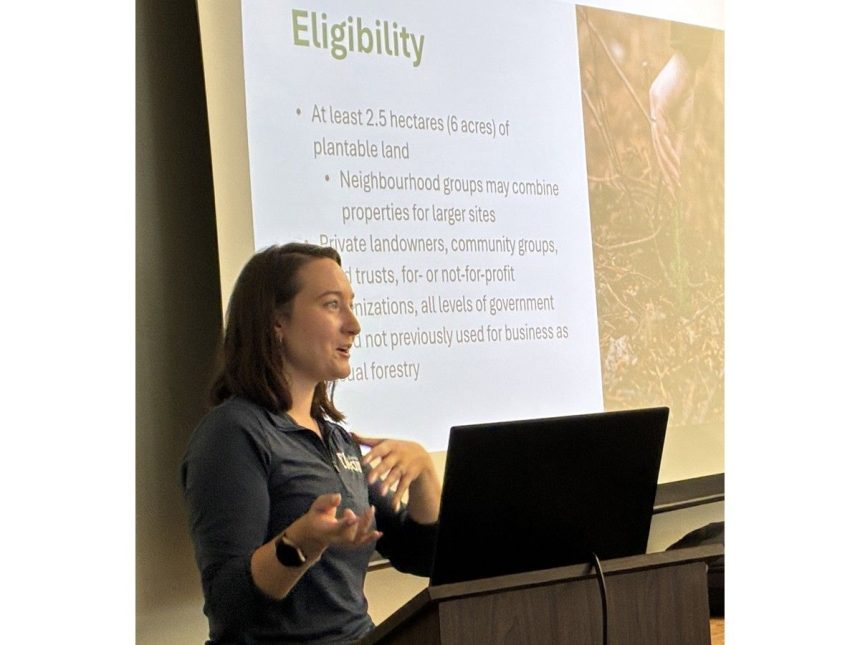
Article contentThe program is not able to fund streetscaping or landscaping projects as the price would increase from $2 trees to $2,200 trees.Article content“So unfortunately, those areas, we aren’t able to cover. There’s a few other programs that are sort of starting to get out and running that will help support that, the municipal community side of it,” said Lloyd.Article contentShe said they don’t plant on non-forested wetlands or areas where there are major species that aren’t forested species.Article contentArticle contentPROCESSArticle contentArticle content“It’s quite quick, it only takes about five minutes to fill out. It’s a little bit of information on sort of what your land looks like, your name, your contact info, where you’re located, super easy to fill out, and then one of our project team will reach out and set up a quick meeting to chat a little bit more about your goals, what kind of trees you want planted, what’s been done on your land,” Lloyd said.Article content“And we accept these applications all throughout the year. So anytime it comes in, you can expect to hear from us within a couple weeks, usually sooner, and sort of start getting the ball rolling, and then once the expression of interest is in and we’ve spoken to you a little bit, we usually expect it to take about a year, sometimes a little bit more, depending on the cycle of the season, just because of how involved it is to create a planting plan, do the site visits, and then we have to order the trees from the nursery, about a year to a year and a half, in advance, at the numbers that we’re planting at.”Article contentArticle content Madison Lloyd, project lead for the Thriving Forests program, outlines program details such as eligibility and the application process during an information session at the McKay Memorial Library in Shelburne on July 21. Photo by Kathy Johnson /Tri-County VanguardArticle contentThen project specialists visit the sites to assess details like the size, density, conditions, and soil.Article content“We also have a couple of drones. If people are interested in having, or OK with having their land, covered by the drone, it’s able to give us a better idea of the trees that are there, and what the land looks like,” Lloyd said. “If the site is deemed eligible, we’ll work together to create a planting plan and a goal for the project, share it with the proponent. And then we have a brief participation waiver that we ask people to sign, and that basically just says that you are ready to be the steward of the trees and take care of them.”Article contentThe Clean Foundation works with local nursery providers in Nova Scotia, Lloyd added.Article content“We’re currently planning for spring of 2027 for new projects coming in.”Article contentQualified projects will be fully funded to receive trees and planting. Nova Scotia’s Thriving Forests plants a mix of tree species native to the province’s Wabanaki-Acadian and boreal forests.Article contentArticle contentArticle contentPLANTINGArticle contentWhen it comes to the actual tree planting, Laura Schmidt, co-owner of Bushwhackers Forestry, said planters can plant several thousand trees a day.Article content“Once the planters reach the replanting site they have tree bags and a little spade. They basically go around and grab a tree, put the tree in the ground,” Schmidt explained. “And down here, in certain areas, too, it’s important to make sure they’re nice and tight. So, we try to get those roots fully in the ground.”Article content Laura and Trevor Schmidt, owners of Bushwhackers Forestry, talk about the tree replanting they have done so far in Shelburne County as part of the Thriving Forests program during an information session at the McKay Memorial Library in Shelburne on July 21. Photo by Kathy Johnson /Tri-County VanguardArticle contentThe company uses two ATVs to move the seedlings. It is currently cutting access trails.Article content“So just basically just clearing the path so an ATV can get through with the trees. It’s a little bit of work when you have a big site, quite a bit of work.”Article contentIn the area they are working now, there’s a lot of blown down burnt trees going every which way.Article content“So that’s what we’re kind of working with for now to be into those sites,” said Schmidt. “The big one is getting, I think, the trees into the sites, and that’s tricky as you guys know.”
Reforestation begins in Shelburne Countyfollowing 2023 wildfire