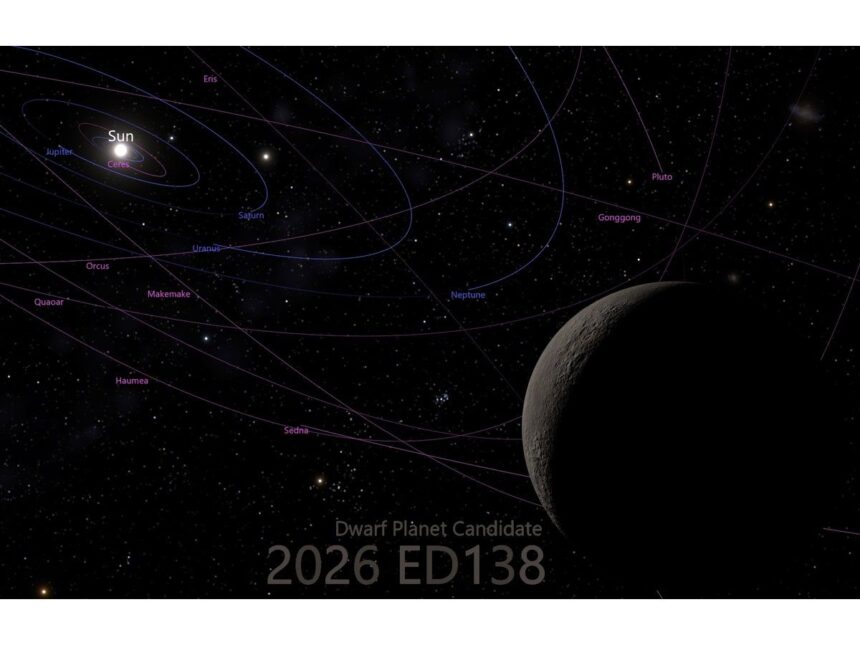
Scientists have recently discovered a large, bright object orbiting the sun beyond PlutoPublished Nov 05, 2026Last updated 14 minutes ago7 minute readAn artist’s impression of the newly discovered dwarf planet candidate 2026 ED138, with other space objects labeled. Anonymsiy (Screenshot and editinArticle contentScientists have just recently discovered a large, bright object orbiting our sun beyond Pluto.THIS CONTENT IS RESERVED FOR SUBSCRIBERS ONLY.Subscribe now to access this story and more:Unlimited access to the website and appExclusive access to premium content, newsletters and podcastsFull access to the e-Edition app, an electronic replica of the print edition that you can share, download and comment onEnjoy insights and behind-the-scenes analysis from our award-winning journalistsSupport local journalists and the next generation of journalistsSUBSCRIBE TO UNLOCK MORE ARTICLES.Subscribe or sign in to your account to continue your reading experience.Unlimited access to the website and appExclusive access to premium content, newsletters and podcastsFull access to the e-Edition app, an electronic replica of the print edition that you can share, download and comment onEnjoy insights and behind-the-scenes analysis from our award-winning journalistsSupport local journalists and the next generation of journalistsRegister to unlock more articles.Create an account or sign in to continue your reading experience.Access additional stories every monthShare your thoughts and join the conversation in our commenting communityGet email updates from your favourite authorsSign In or Create an AccountorArticle contentAlthough it’s not the long-sought Planet X (aka Planet 9) that’s believed to be orbiting beyond the orbit of Neptune, it could be our solar system’s eighth planet, following the 2016 demotion of Pluto from its status as a planet to a dwarf planet.Article contentArticle contentThe object, currently labelled ED138, was discovered on Oct. 13, 2026 by Matthew Holman, using the Simonyi Survey Telescope at the Vera C. Rubin Observatory (Rubin) in Chile.Article contentArticle contentDuring its 10-year Legacy Survey of Space and Time, Rubin will scan the southern sky hundreds of times each night, repeatedly photographing the night sky. One of its primary goals will be to complete an inventory of the solar system, while, at the same time, studying the Milky Way Galaxy and investigating dark matter and dark energy.Article content A mosaic of images captured by NSF–DOE Vera C. Rubin Observatory of the newly discovered dwarf planet candidate 2026 ED138 (ED138). ED138 was discovered in observational data from Rubin spanning 4 March–11 July 2026. It was found by Rubin Operations team member and in-Kind contributor Matthew Holman (Center for Astrophysics | Harvard & Smithsonian), who contributes to improving Rubin’s algorithms that search for distant moving objects in our solar system. Its distance from the sun places it beyond the orbit of Pluto, and initial analysis indicates that it may be among the largest and brightest bodies scientists have discovered in this region of the solar system. NSF–DOE Vera C. Rubin ObservatArticle contentHow was it found?Article contentHolman, a member of Rubin’s optical team, contributes to the improvement of the algorithms that assist the Observatory’s search for moving objects in the solar system.Article contentWhile using a search code designed to find and compare billions of detections of moving celestial objects, Holman analyzed data from Rubin’s earlier observations in 2026. While doing so, he noticed a large, bright object in the outer region of the solar system — an object, the analysis showed, that could be among the largest and brightest bodies found in this region.Article contentA detailed follow-up search through Rubin’s earlier data sets to identify other possible observations of ED138 found 20 additional observations of the object going back as far as March 4, 2025, and a total of 30 observations over a period of 20 nights between March 4 and July 11, 2025.Article contentArticle contentArchived images from the US Deptartment of Energy’s fabricated Dark Energy Camera, mounted on the Victor M. Blanco Telescope at the Cerro Tololo Inter-American Observatory in Chile, provided data from as far back as 2016, thereby providing scientists with 10 years’ worth of orbital data for the object.Article contentArticle contentIs it a planet?Article contentAlthough a provisional candidate for designation as a dwarf planet by the International Astronomical Union’s Minor Planet Center, additional observations will be needed to confirm ED138’s actual size and shape.Article contentShould the dwarf planet designation be confirmed, ED138 will join the ranks of the other five known dwarf planets in the solar system: Ceres, Pluto, Haumea, Makemake, and Eris.Article contentIf and when it is designated a dwarf planet, ED138 will likely be given a formal name by the Minor Planet Center. Traditionally, such objects are given a name representing a mythical being associated with creation or death in various cultures around the world. Although no formal name has yet been chosen, the name ‘Donn’ — the Irish god of the dead — has already been proposed.Article content A view of the solar system showing the orbital pathway of newly discovered dwarf planet candidate 2026 ED138. NOIRLab, CC BY 4.0, via WikimediArticle contentWhere is it located?Article contentED138 currently orbits the sun at a distance of approximately 46 AU (1 AU, or one astronomical unit, is equal to the average distance between the sun and Earth, approximately 148,800,000 km), about six AU beyond Pluto, and 46 times further from the sun than Earth.Article contentAt that distance, ED138 qualifies as a trans-Neptunian object (TNO). Its extreme distance and the fact that it appears among a crowded region of the sky near the plane of the Milky Way Galaxy, where the density of stars makes it extremely difficult to identify moving objects, may help explain why ED138 has remained hidden for so long.Article contentED138’s tilted orbit suggests that it may have formed between Jupiter and Saturn before being ejected outwards by the gravitational influence of one or more of the gas giants.Article contentWhat else has the Rubin found?Article contentED138 is not the only new object found by the Rubin Observatory. Thousands of other objects have been discovered by Rubin throughout the solar system, including 11,000 new, previously unknown, asteroids.Article contentArticle contentIncidentally, these asteroids were all discovered during Rubin’s earlier testing and optimization work, before the observatory’s main 10-year LSST survey commenced on June 30, 2026. In addition to regularly observing more than 80,000 known solar system objects, Rubin also discovered 33 previously unknown near-Earth objects (NEOs) and hundreds of objects beyond the orbit of Neptune.Article contentHow big is it?Article contentBased on its distance, brightness and albedo (how much light it reflects), it is estimated that ED138 is between 600 and 1,500 km across.Article contentAt such a large size, it should be spherical in shape as a result of its own gravity. The spherical shape is an important factor by the IAU in its determination of whether or not an object qualifies as a dwarf planet.Article contentWhile Planet X/9 has not yet been found, the discovery of ED138 and numerous other objects beyond the orbit of Neptune and Pluto strongly suggests that it may only be a matter of time, along with a great deal of perseverance and an equal amount of luck, that the elusive planet, if it indeed exists, will one day be found.Article contentArticle contentThis week’s skyArticle contentMercury (magnitude +5.9, in Libra – the Scales) is not readily observable this coming week, as it is very close to the sun at only seven degrees separation. Mercury will reach perihelion, its closest point to the sun, at 4:17 a.m. AST on Nov. 10, at a distance of 46,128,000 km or 0.31 AU.Article contentVenus (mag. -4.3 in Virgo), visible in the dawn sky this week, rises around 5:10 a.m. AST, reaching 13 degrees above the southeast horizon before fading from view by about 6:40 a.m. AST as dawn breaks.Article contentMars (mag. +0.9, in Leo – the Lion), visible in the dawn sky, rises around 11:30 p.m. AST, reaching 59 degrees above the southern horizon before fading from view by about 6:20 a.m. AST. On Nov. 14, Mars will be in conjunction (share the same right ascension) with Jupiter at 10:42 p.m. AST, with Mars passing just over one degree north of Jupiter. On the 15th, the two planets will make a close approach (an appulse) to each other at 10:04 p.m. AST.Article contentJupiter (mag. -2.1, in Leo), also visible in the dawn sky, rises around 11:45 p.m. AST, reaching 57 degrees above the southern horizon before fading from view around 6:40 a.m. AST.Article contentSaturn (mag. +0.4, in Cetus – the Sea Monster), having recently passed opposition, becomes accessible 19 degrees above the eastern horizon by about 5:25 p.m. AST, before reaching its highest point in the sky at 44 degrees above the southern horizon by about 9:35 p.m. AST, and remaining observable until around 2:35 a.m. AST, when it sinks below 10 degrees above the western horizon.Article contentUranus (mag. +5.6, in Taurus – the Bull), currently approaching opposition, becomes accessible 21 degrees above the eastern horizon around 7:50 p.m. AST, reaching its highest point in the sky 64 degrees above the southern horizon around 1:10 a.m. AST, before becoming lost in the dawn twilight 29 degrees above the western horizon by about 5:45 a.m. AST.Article contentNeptune (mag. +7.8, in Pisces – the Fish), visible in the evening sky, becomes accessible when it reaches 27 degrees above the southeast horizon around 6 p.m. AST, reaching its highest point in the sky 43 degrees above the southern horizon shortly after 9 p.m. AST, and remaining observable until around 12:55 a.m. AST, when it sinks below 21 degrees above the southwest horizon.Article contentArticle contentMeteor shower comingArticle contentOn Nov. 12, the North Taurid meteor shower will peak.Article contentActive between Oct. 20 and Dec. 10, the North Taurids are debris from asteroid 2004 TG10.Article contentThe shower’s radiant (the apparent point of origin in the sky as seen from Earth) lies in the constellation of Taurus – the Lion, which will be above the horizon all night.Article contentThe shower is best observed around 1 a.m. AST, when the radiant will be highest (typically the best time for the most meteors), 65 degrees above the southern horizon.Article contentInterference from the four-day-old, waning crescent moon (15 per cent lit) will be minimal.Article contentFrom a dark site under clear skies, expect to see between five and 10 bright meteors per hour.Article contentUntil next week, clear skies.Article contentEvents: Nov. 9 – New Moon; 3:03 a.m. AST Nov. 10 – Mercury at perihelion Nov. 11 – Moon at perihelion at 4:06 p.m. AST (146,969,760 km or 0.9877 AU) Nov. 12 – Comet 69P/Taylor passes perihelion (337,776,000 km or 2.27 AU); North Taurids meteor shower peak Nov. 13 – Moon at apogee at 1:50 p.m. AST (406,700 km) Nov. 14 – conjunction of Mars and Jupiter Nov. 15 – close approach (appulse) of mars and JupiterArticle content
ATLANTIC SKIES: Is there a new new dwarf planet beyond the orbit of Pluto?