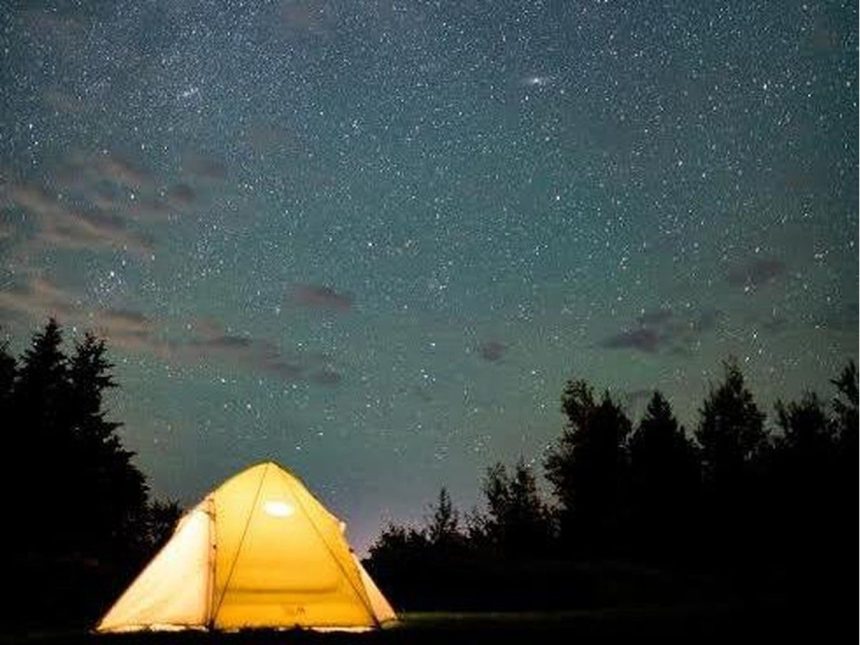
Published Aug 05, 20267 minute readThe night sky is viewed at Kouchibouguac National Park in New Brunswick, which is a dark sky preserve. Astronomy enthusiast Glenn K. Roberts fears views like this will one day be hampered by daisy chains of space mirrors like those proposed by U.S. company Reflect Orbital. Photo by ContributedArticle contentI shall do my best not to make this week’s article a rant against modern technology, but I can’t promise that my prejudices against the negative impacts of technology on peoples’ rights to enjoy a dark sky won’t seep in.THIS CONTENT IS RESERVED FOR SUBSCRIBERS ONLY.Subscribe now to access this story and more:Unlimited access to the website and appExclusive access to premium content, newsletters and podcastsFull access to the e-Edition app, an electronic replica of the print edition that you can share, download and comment onEnjoy insights and behind-the-scenes analysis from our award-winning journalistsSupport local journalists and the next generation of journalistsSUBSCRIBE TO UNLOCK MORE ARTICLES.Subscribe or sign in to your account to continue your reading experience.Unlimited access to the website and appExclusive access to premium content, newsletters and podcastsFull access to the e-Edition app, an electronic replica of the print edition that you can share, download and comment onEnjoy insights and behind-the-scenes analysis from our award-winning journalistsSupport local journalists and the next generation of journalistsRegister to unlock more articles.Create an account or sign in to continue your reading experience.Access additional stories every monthShare your thoughts and join the conversation in our commenting communityGet email updates from your favourite authorsSign In or Create an AccountorArticle contentI have previously written about the growing loss of our dark skies, and the enjoyment thereof by those who observe it, both professional and amateur, due to the planned launch of tens of thousands or, in one case, a million, of low-orbit telecommunication satellites by companies such as SpaceX, Amazon, Microsoft, Google, Verizon, AT&T, China Mobile, to name but a few. The destruction of the night sky by these satellite daisy-chains is already having a negative impact on the enjoyment of the night sky by the casual observer, to say nothing of their significant detrimental impact on professional astronomical research.Article contentArticle contentArticle contentUnfortunately, the sad saga of our deteriorating night sky is about to get even worse.Article contentArticle contentProject would reflect Sun’s raysArticle contentThe latest inane project involves launching huge mirrors into low orbit around our planet. The USA’s Federal Communications Commission (FCC) has recently approved a licence for the U.S. company Reflect Orbital to place a 142 kg satellite, named Earendil-1, into orbit 650 km above Earth. Once in orbit, the satellite will unfurl a huge square mirror, designed to reflect the Sun’s light back to Earth, illuminating a three-mile-wide stretch of our planet’s surface.Article contentWhile the FCC’s approval was for a demonstration space mirror, the company has stated that, if successful, it plans to place 50,000 such space mirrors into low-orbit by the year 2035. Each space mirror would appear as a dot of light in the night sky about as bright as a full moon. One can only surmise that this could quite conceivably only be the beginning of similar ventures, with tens of thousands (millions?) additional space mirrors being launched in the future.Article contentArticle contentThe stated purpose of these space mirrors is, according to Reflect Orbital, to make “clean energy available on demand” (i.e., for those who could pay for it). The company suggests that the extra light could be potentially used to light up emergency scenes, construction sites, farms, or any other type of development which might require or make use of 24-hour sunlight, such as solar farms.Article contentArticle contentThe deployment of each space mirror would, accordingly to Reflect Orbital specs, illuminate the night sky for several hours by 36,000 lux (the unit of measurement for light) — an amount comparable to daylight. However, a constellation (a daisy-chain array of satellites) of space mirrors would illuminate our planet’s surface below by 100 lux all the time, effectively destroying our view of the night sky.Article contentArticle contentNegative impacts to scienceArticle contentOf course, such technology would be very expensive, currently estimated by Reflect Orbital to be approximately $5,000 an hour for those who sign up for a one-year contract. As with all tech contracts, that price could, and likely would, increase over time, after the one-year contract has expired. The company even admits on its website that the hourly cost of the reflected sunlight for one-time events or for emergencies would be much higher than the contract hourly price.Article contentBeyond the monetary costs associated with such a venture, there are significant negative impacts to the scientific community, and even to our planet’s natural ecosystems. Unfortunately, in its licence approval process, the FCC does not take into consideration environmental concerns. It only considers such factors as whether a satellite’s radio communications would interfere with aircraft, and whether or not the satellite, at the end of its life, will be safely disposed of; to the FCC, astronomical and environmental concerns are not applicable in space.Article contentThe additional negative impacts to astronomical observational research by space mirrors, particularly tens of thousands (or more) of them, speaks for itself. Already, the growing plague of telecommunication satellites in the night sky, and the ever-increasing intrusion of urban-caused light pollution is negatively impacting professional astronomical research, as photos of the night sky are routinely polluted with streaks of light.Article contentArticle contentIt can only be imagined how the addition of countless space mirrors in low orbit in the night sky would contaminate valuable data for astronomical research, let alone the enjoyment of the night sky by amateur astronomers or casual observers. This plague has already been given a title by the global astronomical community — orbital light pollution.Article contentArticle contentAltered circadian rhythmArticle contentWildlife experts around the globe decry the potential negative impact that an altered circadian rhythm caused by the space mirrors would inflict on the natural world. The European Southern Observatory, a multinational, intergovernmental research organization, estimates that each space mirror in the satellite fleet would shine four times brighter than the full moon or the planet Venus. Such an altered light regime would disrupt peoples’ diurnal sleep patterns, when birds and animals migrate, and when plants bloom.Article contentSadly, despite objections by astronomical organizations, including the prestigious American Astronomical Society, and wildlife experts from around the globe, the FCC approved the Reflect Orbital licence application, albeit on a trial basis. It can only be hoped that Reflect Orbital’s attempt to launch its Earendil-1 satellite, with its space mirror, fails spectacularly enough that the FCC does not grant them additional licences.Article contentArticle contentHowever, given the substantial financial returns such high-tech ventures stand to generate, it is probably only a matter of time before there are tens of thousands of space mirrors orbiting our planet. If you have young children or grandchildren, now might be a good time to take them out under the night sky on a clear, moonless night and let them see for themselves the majestic beauty of the night sky; their generation, unfortunately, could well be the last to experience its splendour.Article contentArticle content NASA Solar Terrestrial Relations Observatory satellites captured this image of the Sun. A U.S. company, Reflect Orbital, has been granted a licence to send a satellite with a huge square mirror into space to reflect the Sun’s light back to Earth. NASAArticle contentArticle contentHappenings in the summer skiesArticle contentMercury (mag. -0.3, in Gemini – the Twins), now moving closer to the Sun, rises around 4:30 a.m. ADT, reaching 9 degrees above the eastern horizon before fading from view around 5:40 a.m. ADT. Mercury reaches its closest point to the Sun (perihelion) at 6:31 a.m. ADT on the morning of Aug. 14, at a distance of 0.31 AU or 46,128,000 km.Article contentVenus (mag. -4.2, in Virgo – the Maiden) becomes visible around 8:50 p.m. ADT, 11 degrees above the western horizon as dusk gives way to darkness, before sinking towards the horizon and setting about 10 p.m. ADT. Venus reaches its dichotomy or half-illuminated phase on Aug. 12 at 4:44 p.m. ADT. On Aug. 14, at 6:59 p.m. Venus reaches its greatest elongation (the apparent angular separation between two celestial bodies as seen from Earth) west of the Sun. Venus and the 4-day old Moon will make a close approach (appulse) to one another at 3:56 a.m. ADT on Aug, 16, passing within roughly 1.5 degrees of each other. A couple of hours later, at 5:47 a.m. ADT, Venus and the Moon will reach conjunction (sharing the same right ascension in the sky as seen from Earth) with each other, with Venus north of the Moon.Article contentMars (mag. +1.3, in Taurus – the Bull) rises in the eastern, predawn sky around 2 a.m. ADT, reaching 30 degrees above the eastern horizon before fading from view by about 5:10 a.m. ADT.Article contentJupiter (mag. -1.8, in Cancer – the Crab) is not observable this week, as it is no higher than 3 degrees above the eastern horizon at dawn.Article contentSaturn (mag. +0.4, in Pisces – the Fish) becomes accessible in the eastern pre-dawn sky 10 degrees above the eastern horizon around 11:45 p/m. ADT, reaching 46 degrees above the southern horizon shortly before 5 a.m. ADT, where it will fade from view around 5:25 a.m. ADT.Article contentUranus (mag. +5.8, in Taurus) rises around 12:30 a.m. ADT, reaching 40 degrees above the eastern horizon before fading from view by about 4:40 a.m. ADT.Article contentNeptune (mag. +7.8 in Pisces), becomes visible in the eastern pre-dawn sky 21 degrees above the southeast horizon by about 12:25 a.m. ADT, reaching 43 degrees above the southern horizon around 4:15 a.m. ADT, where it is lost to the dawn twilight around 4:40 a.m. ADT.Article contentArticle contentThe annual Perseid meteor shower (radiant in Perseus – the Prince), visible until Aug. 24, peaks during the overnight period of Aug. 12-13, with the best performance likely to come just before dawn on the 13th. Debris from Comet 109 P/Swift Tuttle, the Perseids are known for producing very bright and fast meteors. Under a clear sky away from city lights, expect to see about 140-150 meteors per hour during the peak, pre-dawn hours; the Moon, at its New Moon phase on Aug.12, will not interfere with this year’s shower.Article contentErrata: In paragraph 8 of last week’s article, I inadvertently wrote “The Earth rotates around the Sun…”, when I should have written ” The Earth orbits around the Sun…” My apologies for the error.Article contentUntil next week, clear skies.Article contentArticle contentArticle contentUpcoming events:Article contentAug. 10 – Moon at perigee (closest point to Earth); 8:17 a.m. ADT; approx. 356,500 kmAug. 12 – New Moon; 2:37 p.m. ADTAug. 12 – Venus at dichotomy; 4:44 p.m. ADTAug. 13 – Perseid meteor shower peak; pre-dawn western skyAug. 14 – Moon at perihelion (closest point to the Sun); 6:01 a.m. ADT; 1.0107 AU or 150,392,160 kmAug. 14 – Mercury at perihelion; 6:31 a.m. ADTAug. 14 – Venus at greatest elongation west of the Sun; 6:59 p.m. ADTAug. 16 – close approach of Moon and Venus; 3:56 a.m. ADTAug. 16 – conjunction of Moon and Venus; 5:54 a.m. ADTArticle contentArticle contentArticle contentArticle contentGlenn K. Roberts lives in Stratford, P.E.I., and has been an avid amateur astronomer since he was a small child. He welcomes comments from readers at glennkroberts@gmail.com.Article content
ATLANTIC SKIES: Space mirrors: more ‘orbital light pollution’