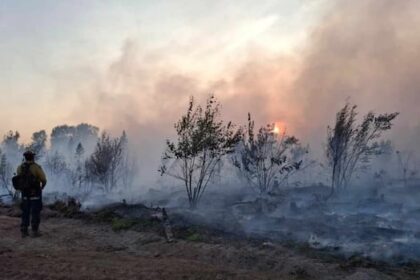
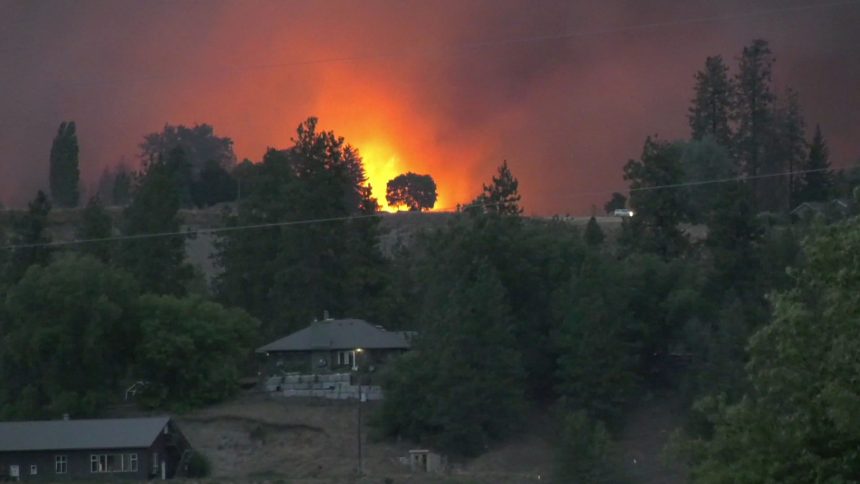
The destruction left behind by the Bradley Creek wildfire in British Columbia cannot be measured only in burned buildings and lost acreage, according to Okanagan Indian Band Chief Dan Wilson. “I know some people measure it in hectares and structures lost, but our people… we measure it in memories lost,” Wilson told APTN News. The wildfire tore through the Okanagan Indian Band reserve near Vernon, B.C., destroying more than 200 homes and forcing hundreds of residents to flee. More than 30 homes belonging to band members were lost, along with more than 200 additional homes on certificate of possession lands occupied by non-members, according to Wilson. For many families, the losses include belongings that cannot be replaced. “Our members are really shaken up,” Wilson said. “We’ve had Elders that lost their homes that have got old family pictures, old Syilx baskets, you know, just things that are irreplaceable. And they lived in these houses, you know, for generations.” The Bradley Creek wildfire remains active as crews continue battling hotspots and assessing damage. The blaze ignited late July 31, on rangeland near the band’s powwow grounds, school and daycare, and quickly spread under extreme wind conditions. Wilson said many residents had only minutes to escape. “This fire happened so fast that a lot of our members didn’t have much time to get out,” he said. “A lot of them had to get out without clothes, even they couldn’t grab their purses or wallets.” The fire’s rapid spread also damaged critical infrastructure, cutting power and internet service after flames crossed Westside Rd. “When it spread across West Side Road at Bradley Creek, it took out an 11 kilometres stretch of power lines and our internet was cut off,” Wilson said. The disruption created major challenges for the band’s emergency operations centre, which was also dealing with damaged cell service and road closures. “It was really a logistics nightmare right at the start,” Wilson said. Wilson said the community’s emergency preparedness plan had been updated just weeks before the wildfire, but the speed and intensity of the blaze overwhelmed response efforts. “But this time around, it happened so fast that we do have an emergency preparedness plan that was just updated this past June 2026,” he said. “But when things like this happen, especially when that wind picks up, there’s really not much you can do, no matter how experienced firefighters you got.” A screenshot of the wildfire threatening the Okanagan Indian Band. Source: BC Wildfire Service. Extreme fire weather is making wildfires harder to suppress The conditions that drove the rapid spread of the Bradley Creek wildfire come during another intense wildfire season across Canada, as scientists warn that climate change is increasing the likelihood of extreme fire weather. A rapid assessment from World Weather Attribution found that human-caused climate change has made severe fire weather conditions more likely in parts of Canada this year. Researchers examined factors including temperature, dryness, wind and conditions that determine how difficult wildfires are to suppress. The study did not examine the cause of individual fires, including the Bradley Creek wildfire, but looked at the weather conditions that allow fires to spread quickly and become more difficult to control. In a media briefing on Aug. 5, Jonathan Boucher, a wildland fire research scientist with Natural Resources Canada, said Canada’s forests have always been adapted to wildfire, but climate change is increasing the severity of the conditions firefighters are facing. “The conditions that we just demonstrated with this study and with previous studies are being heightened with climate change,” Boucher said during the briefing. Researchers also highlighted that Indigenous communities can face additional challenges during wildfire events, including evacuation barriers, displacement and impacts to cultural practices and traditional lands. For Wilson, the wildfire has reinforced the need for stronger wildfire preparedness and Indigenous-led approaches to managing the land. Protecting what remains Despite the devastation, Wilson credited aerial crews with protecting important community spaces. “I like to give credit to the water bombers because they saved our new cultural diversion school, our powwow grounds, and our daycare,” he said. The community is now focused on safety, damage assessments and recovery. Wilson said recovery will require cooperation between the band and government partners, including support for replacing homes and restoring services. He also pointed to what he described as the Crown’s responsibility to support Indigenous communities after disasters. “My elders always tell me, because we’re non-treaty, to always remind the Crown that they created this fiduciary duty when they placed us on reserves in the 1890s,” Wilson said. “That’s why the elders say never let anybody say we’re taking handouts, because it’s out of the proceeds of our traditional territory that we’re providing these services on reserve.” Click here for the latest on the wildfires: BC Wildfire Service Looking ahead, Wilson said, the wildfire has reinforced the need for more resources, including a second fire hall, additional equipment, more training and a dedicated wildland firefighting truck. He also called for a greater role for Indigenous-led fire stewardship practices. “We need to get back to our traditional burns,” Wilson said. “That’s how we managed our territory in the past.” As firefighters continue working to contain the Bradley Creek wildfire, Wilson said the community is focused on rebuilding, not just homes, but a sense of security after a devastating loss. Continue Reading
We measure it in memories lost: Bradley Creek wildfire leaves Okanagan Indian Band community facing long road to recovery



Leave a Comment