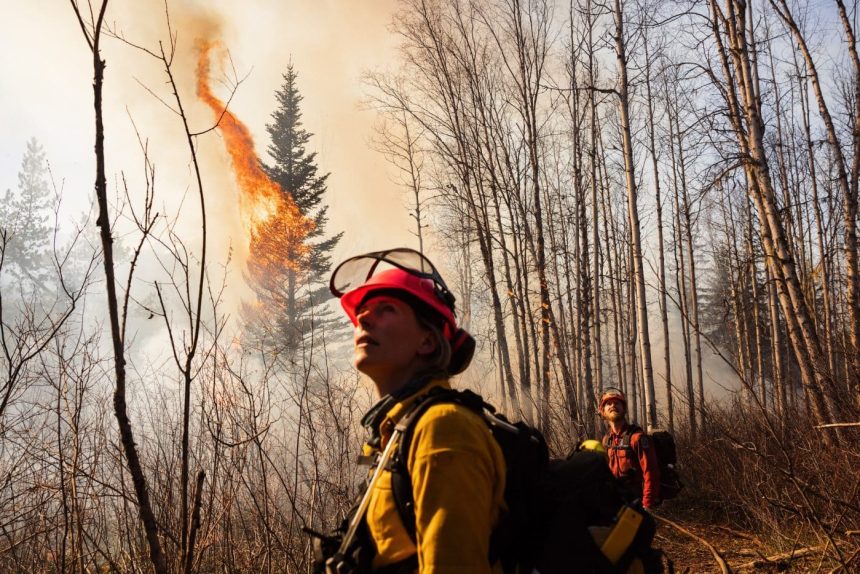
“What are you going to do about wildland firefighter mental health?” The question came to Jim Johansson — a former wildland firefighter and assistant professor in the faculty of nursing at the University of Alberta — from a student in December 2023. Canada had just experienced its deadliest wildfire season on record. Eight wildland firefighting personnel died in 2023 in Western Canada and the Northwest Territories, prompting scrutiny of the profession’s hidden costs: chronic fatigue, physical and mental burnout and post-traumatic stress disorder (PTSD). Now, the 2026 fire season has made one thing unmistakingly clear: the psychological toll of wildland firefighting in North America has reached new levels. In June, two wildland firefighters and a bush pilot died in a plane crash near Fort Simpson, N.W.T. Several days later, three firefighters were fatally burnt while working on a wildfire along the Utah-Colorado border, while a fourth died on July 24 from injuries he sustained. Kylie Foisy, the nursing student who sent the email about mental health to Johansson back in 2023, had just wrapped up her rookie season as an initial attack crew member in northwestern Alberta. Initial attack crews are the first on the scene of new blazes, tasked with quickly extinguishing them. On her second day on the job in May 2023, Foisy’s crew was dispatched to a 5,000-hectare wildfire. “It was so crazy,” she says. “But so fun.” Kylie Foisy, a former wildland firefighter based in Edmonton, felt her mental well-being was being impacted while on the job, despite her love of the work. Along with fellow former wildland firefighter and current assistant professor of nursing at the University of Alberta, Jim Johansson, she created the first wildland firefighter peer-support network in Canada. Photos: Supplied by Kylie Foisy She loved the intensity of the work and the strong bonds she developed with her crew, but the summer unfolded with more sobering events, including a fatal helicopter crash in her district. For Foisy’s crew it was “business as usual” the next day, she says. For the duration of the season she felt the impacts wearing on her mental well-being, and could see others were also struggling. For Johansson, Foisy’s email was a call to action. And it was the very start of what is now Canada’s first wildland firefighter peer-support network. Johansson has assembled a team of veteran wildland firefighters, occupational health therapists, psychologists and climate specialists to co-create and launch a new peer-support network in Alberta “by wildland firefighters, for wildland firefighters” — the first of its kind in Canada. Johansson hopes to apply what he’s learned over the past decade as a mental health nurse to bolster support for those on the frontlines of wildfire. A year after Foisy’s email landed in his inbox, he hired her as a research assistant. Together, they’re undertaking a qualitative research project to examine the mental health challenges related to wildland firefighting and climate change in Alberta.Already, they’ve heard stories from those who have experienced or witnessed crew members escape near-death scenarios, including close calls with fallen trees or vehicle collisions. Others were impacted by fatal tragedies, like in August 2024, when 24-year-old firefighter Morgan Kitchen was killed by a fallen tree while working on the Jasper wildfire. Last week, as the two-year anniversary of Kitchen’s death approached, six workplace safety charges were laid against Alberta’s Ministry of Forestry and Parks in relation to it, for failing to take measures to assess and control hazards related to dangerous trees — along with failing to adequately train firefighters to identify hazardous trees. The first court appearance is scheduled for this September, in Jasper. Wildfire fighters lack the supports of municipal firefighters Despite working on the frontlines of some of Canada’s most intense climate-related disasters, most wildland firefighters are classified as forestry workers — not first responders — under Canada’s national occupational classification system. They also often lack the wages, pensions and benefits afforded to municipal firefighters. Johansson was all too familiar with the working conditions on the frontlines of wildfires. He had worked as an initial attack firefighter in Alberta from 2001 to 2009, then taught up-and-coming crew members and leaders at the Hinton Training Centre until 2013. Johansson led an initial attack crew from 2005 to 2009, working 12- to 16-hour days over three-week shifts, hauling hose through muskeg and pumping water from swamps to extinguish wildfires. Wildland firefighters in Canada are classified as forestry workers, not first responders. They lack the benefits, wages and pensions afforded to municipal firefighters, and the mental health impacts of their frontline jobs are often not accounted for. Photo: Marty Clemens / The Narwhal Despite the low pay, the camaraderie and joy of spending days in the bush “got into his blood,” Johansson says. “There’s a culture of wildland firefighting that I felt so happy in, and that didn’t really exist anywhere else,” he says. Yet, there were psychological hazards, too. In 2007, a helicopter carrying an initial attack crew crashed near Fort McMurray, killing 22-year-old Patrick Dominic Watters-Michaud. After the news arrived, Johansson had to “jump in a helicopter and go day-base that day,” he says. Day-basing involves relocating crews to high-risk wildfire areas to increase their chances of extinguishing the fires when they’re still small. The next day, wildland firefighters informally banded together, lowering the flags at bases across the province, “mourning the loss of one of our people,” Johansson recalls. Alberta Wildfire managers raised the flags, citing that the firefighter did not meet the criteria of their flag-lowering policy. The policy changed in 2008 after crew leaders filed formal complaints. Alberta Wildfire did not respond to questions from The Narwhal about this incident or any other questions. The incident opened Johansson’s eyes to the “legitimate danger” of wildland firefighting, and he became increasingly anxious to fly on helicopter patrols — a routine part of firefighting work where crew members survey the landscape for new ignitions. But it also shone a light on what he says is the government’s ongoing failure to provide safe, culturally relevant mental health support to wildland firefighters. Jim Johansson is a former wildland firefighter with Alberta Wildfire and now an assistant professor of nursing at the University of Alberta. He is spearheading a qualitative study on mental health, climate change and wildland firefighters in Alberta. Photo: Todd Korol / The Narwhal Johansson became increasingly vocal as a leader, advocating for the safety and well-being of his crew. He would eventually be “DNRed” by the Edson district — a term referring to Alberta Wildfire’s “Do Not Rehire” policy. Alberta Wildfire does not grant seasonal firefighters automatic recall rights from one season to the next, unlike other Canadian provinces like B.C. Alberta Wildfire did not respond to questions about whether this policy exists or how it’s applied. After leaving wildfire, it felt like Johansson was “starting all over again,” he says. He decided to pursue higher education in nursing, specializing in mental health. Johansson doesn’t want his research limited to publishing papers. “When I put my nursing lens on firefighting, I’m always looking for strengths and how we can mobilize those to help people. In wildfire, that strength is the people,” Johansson says. “That’s what keeps firefighters coming back every season.” Climate change and gaps in mental health support put Alberta’s wildland firefighters at risk For his research, Johansson interviewed 17 former and current wildland firefighters in Alberta. He shared preliminary results with The Narwhal. Early data from Johansson’s qualitative research has raised some red flags. The majority of wildland firefighters Johansson spoke to agreed the 2023 fire season was a “turning point” in their careers. Crews spent a higher number of days actively fighting fires in increasingly risky and volatile environments. It’s “non-stop all season long,” and there’s fatigue and additional safety issues that come with that, researchers found. BC Wildfire Service firefighters in northern B.C. The Alberta wildland firefighters Johansson interviewed said they are facing increasingly risky and volatile environments, and have been exposed to stresses such as colleagues facing near-death experiences. Photos: Marty Clemens / The Narwhal Initial attack and unit crew leaders also spoke to Johansson about mental health challenges related to high turnover of crew members. “In the past, most crews would only have a small number of rookies each year,” Johansson says. An Alberta Wildfire document, leaked to The Narwhal, analyzes the results of a wildfire crew exit survey in 2023, and indicates that “60 per cent of all firefighters were either brand new, or entering their second year.” Alberta Wildfire did not respond to any questions about the findings of Johannson’s research. Johansson’s research found leaders were worried about dividing their attention between managing large-scale wildfires, and simultaneously supervising a higher number of rookies less familiar with volatile fire behaviour and danger trees, whose unstable roots and surrounding soil could result in suddenly toppling over. In addition, some reported that third-year firefighters were being pushed prematurely into leadership roles, he says. There are broader labour issues in Alberta too, including that wildland firefighters lack paid sick days and health benefits. There are some limited mental health services available — including a counselling hotline — but interviewees expressed hesitation, or lack of trust about confidentiality when using the services for fear they might not be hired back the following spring, Johansson says. Wildland firefighters are left to fend for themselves in the off-season — when they often need supports the most Johansson often compares the dynamics of wildland firefighting to that of soldiers returning from combat. “[Wildland firefighters] exist in these really high-intensity situations. They have a tight-knit peer support network that keeps them safe mentally,” he says. But when the wildfire season ends in the fall and seasonal firefighters’ contracts are terminated, they suddenly lose that support network. For Jessica Broder, a former wildland firefighter with the BC Wildfire Service, when she left her crew to spend the winters in other communities she lost her “sounding board for processing.” She also points to the reality of wildland firefighters relying on substances to cope through the off-season. A study of U.S. wildland firefighters found that nearly four in five respondents reported binge drinking before and after the fire season. Broder worked on a unit crew in Revelstoke, B.C., in 2023, the summer her colleague Devyn Gale was killed by a fallen tree. The accident felt all too relatable, Broder says. She herself had narrowly avoided falling trees and knew others had experienced similar close calls. After Gale’s accident, she and her crew participated in critical incident stress management debriefs, and had access to a clinical counsellor with a history in wildland firefighting. Jessica Broder, a former wildland firefighter for the BC Wildfire Service, says during the off-season she lost her sounding board for processing the difficult realities of the work. Photo: Kari Medig / The Narwhal Broder and her crew accrued approximately 100 fireline days in the 2023 season (a unit crew would be happy if they got 60 days, according to Broder). While initial attack crews respond to wildfires with the goal of quickly extinguishing them, unit crews are 20-person crews that specialize in “sustained action,” or longer-term firefighting efforts on mega-fires. In September, her crew was deployed to northern B.C. to work on the Big Creek fire, which she described as her “breaking point.” The Big Creek fire grew to more than 175,000 hectares in 2023 and triggered evacuation orders in the Takla Lake First Nation. Broder led a night shift, working from 5 p.m. until 9 a.m. the next morning, and had to evacuate camp when the wildfire threatened to burn it. Broder worries that increasingly destructive wildfire seasons are exposing firefighters to greater psychological strain. While BC Wildfire Service has some mental health training, including a course offered through the Canadian Mental Health Association, adapted specifically for wildfire, called Resilient Minds, Broder would like to see more preparatory training for all wildland firefighters. “We’re not giving people the tools to tell someone at 4 a.m. that their house is not ‘an achievable objective,’ or to go into a rural or Indigenous community [to engage with community members],” she points out, referring to how wildland firefighters have to knock on doors and tell community members to leave their homes — and sometimes warn them they are unlikely to have a home to return to. Recently, Johansson recruited Broder — today a student at Thompson Rivers University in Kamloops, B.C. — onto his team to research existing mental health support programs for wildland firefighters in North America. “It’s something that really lacks across Canada,” she says. “I think [a peer-support network] could be transformational.” ‘It’s not a hopeless endeavour’: veteran wildland firefighter Over a 30-year career, Michelle Wigmore fought wildfires across Canada and North America, led a 20-person unit crew and developed national training courses. Today, she’s teaming up with Johansson to help launch the peer-support network. Over the years, Wigmore has seen wildland firefighters struggle with mental health, but says “it’s often not in the way people think.” Busy seasons and long hours can be challenging, but they’re also “why people join fire and stay in it,” she says. “It’s the excitement, adrenaline, you’re working as a team — it’s the greatest thing ever.” But it comes with immense pressure. Wigmore has lost colleagues to helicopter accidents, health conditions and suicide. One year, a crew member died by suicide on his day off. A recent survey in the U.S. found 22 per cent of wildland firefighters have attempted suicide, while 37 per cent reported suicidal ideation. Rainy seasons can be just as psychologically hazardous, Wigmore says. When wildfire activity is low, crews may spend extended periods away from home without the opportunity to earn overtime. “That’s when I’ve seen the most issues come up,” she says. Michelle Wigmore spent 30 years working as a wildland firefighter across Canada. She says that solutions to mental health challenges are well within reach, and often most effective when they come from the ground up. “Crew morale is at the heart of it,” she says. “It’s not a hopeless endeavour.” She is helping Johansson with the wildland firefighter peer-support network. Photos: Amber Bracken / The Narwhal The solutions don’t always need to be complicated, Wigmore says, and they’re most effective when they come from the ground up. Crew morale is at the heart of it, she says. “It’s not a hopeless endeavour.” What helped her crew the most when they lost a colleague to suicide, was the show of solidarity from other wildland firefighters on base. They collectively decided to construct a bench in honour of their colleague and flew it to a nearby mountaintop. In 2023, Wigmore wasn’t hired back on — she was “DNRed.” The “do not rehire” policy in Alberta is “barbaric,” Wigmore says. Wildland firefighters deserve job security and automatic recall rights, so they’re not afraid of advocating for their well-being, or safety, says the veteran firefighter But she’s quick to credit recent progress. The Alberta government and union signed a new agreement in 2025 that will increase wages for crew members with the most years of service by more than 19 per cent by 2027. Wages for longest-serving crew leaders and supervisors will rise by more than 27 per cent and 31 per cent, respectively. “This is career-changing for people,” Wigmore says. “[Firefighters] that were planning their exit strategy … are now planning to stay.” Other major wildfire agencies in Canada, including B.C. and Ontario should take note, Wigmore says. BC Wildfire leads cultural shift in mental health awareness The devastating losses of six firefighters in B.C.’s wildland firefighting community in 2023 “struck a chord” for the BC Wildfire Service, Olivia Goldney, a safety specialist with the organization, says. “We need to have a strengthened culture of care for our staff and develop trauma-informed systems that can allow our staff to do this job long-term,” she adds. Aside from chronic fatigue and burnout, wildland firefighters are grappling with a profound sense of “ecological grief,” as their communities and landscapes are burnt over by wildfires. Goldney experienced post-traumatic stress disorder (PTSD) from her experiences as an initial attack crew leader in 2021, witnessing the devastating events of the Lytton fire, which tore through the community in 15 minutes, destroying homes and businesses, and killing two people. Today, she’s leading the development of a new psychological health and safety strategy within the BC Wildfire Service. “We want to align psychological injuries closer to how we approach physical injuries,” Goldney says. Many wildland firefighters experience PTSD from the job, which Johansson compares to the dynamics of soldiers returning from combat. Ecological grief is another issue, as workers sometimes witness their own communities burned to the ground. Photo: Marty Clemens / The Narwhal All wildland firefighters in B.C. have automatic recall rights and benefits, including sick days and partially paid short-term disability leave, according to Goldney. Once they have worked over a certain number of hours, they also receive a $1,000 annual health and wellness allowance that can be used for services such as massage therapy and counselling. A counselling hotline is available to all firefighters, while First Nations firefighters can also access a crisis line to access culturally informed support. A 2021 survey found more than 50 per cent of Indigenous wildland firefighters in Canada had experienced additional risks related to cultural discrimination on the frontlines. After the 2023 season, BC Wildfire Service also launched a recovery program, a four-day intensive retreat that provides firefighters with therapeutic tools for their long-term recovery from work-related traumatic stress. While wildland firefighting has long been dominated by a culture of stoicism — “a kind of buck up and do the job,” Goldney says — she’s seeing a cultural shift within BC Wildfire Service’s leadership to acknowledge and address the psychological toll of the work. “From the bottom to the top, there’s this ‘shake’ that’s happening culturally,” Goldney says. “People are understanding the work we do has profound impacts on a person.” She points to systemic changes that are underway in B.C.: wildland firefighters are becoming increasingly recognized by their first responder peers in the province. Recently, BC Wildfire Service was invited to join the BC First Responders Mental Health committee, Goldney says. In addition, B.C. wildland firefighters will soon have the most comprehensive cancer coverage in all of Canada. She’s hopeful that federal legislation will change to recognize wildland firefighters as first responders. “I think only good things are to come,” Goldney says. Wildland firefighting peer-support network sets sights on launching in early 2027 If you had asked Johansson at 25 whether he was struggling with his mental health, he would have shrugged and replied, “Job’s fine. I’m fine.” Twenty years later, he’s no longer sure that was really the case. That realization is part of why Johansson sees value in long-term support. His team plans to build a year-round support network for both active and retired wildland firefighters, offering a space where those still processing their experiences can find an informed, listening ear. “You could be two, three, five, 10 years out and still access [support],” he says. Jim Johansson once struggled with his own mental health as a wildland firefighter. It’s part of the reason he wants to build a year-round support network for both active and retired firefighters. Photo: Todd Korol / The Narwhal Come September, after the fire season, Johansson’s team will brainstorm what the network could look like. There are already ideas of starting an online platform, a peer-support counselling line, group fitness challenges or even integrating supports into video games. They plan to launch the pilot peer-support network in Alberta in the spring of 2027 with the broader goal of eventually expanding across Canada. Already he’s receiving overwhelmingly enthusiastic reception and support for the project, he says. “[People] are like, ‘Thank you for doing this’, or ‘How can I help?’ It’s obviously filling a need.” It’s been a full-circle moment for the former wildland firefighter, although Johansson admits that, emotionally, a part of him has never really left. Gardening in his backyard in Calgary often evokes the memory of “digging in the dirt, looking for hot spots,” he says. Even the faintest trace of wildfire smoke has a way of transporting him back to the frontlines. “It’s total nostalgia,” Johansson says. “For a minute, I’m back in it.”
Falling trees and helicopter crashes: Alberta wildfire fighters create their own support system