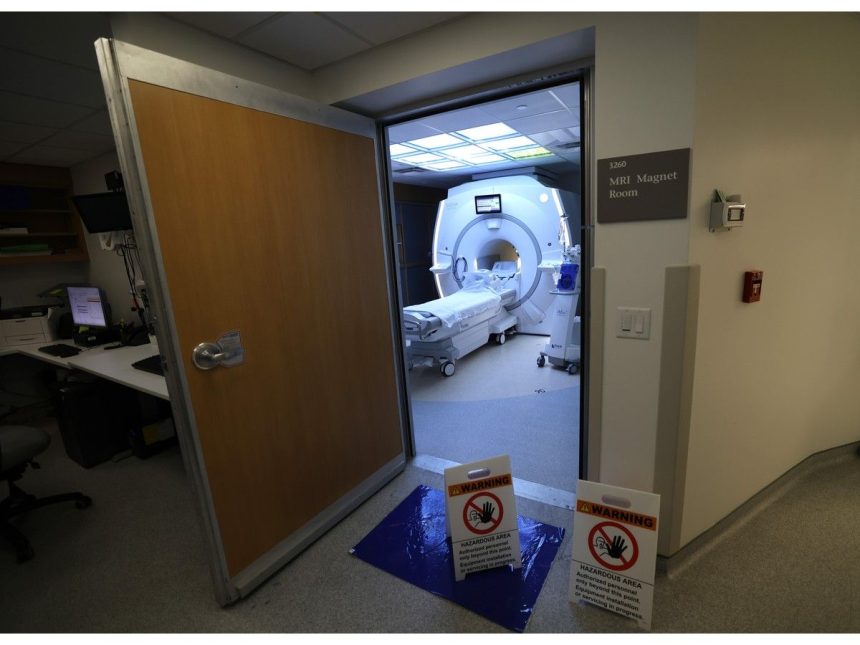
Article content The MRI magnet room at the Victoria General Hospital in Halifax on Thursday. Photo by Tim Krochak /Chronicle HeraldArticle contentBoth Clarke and Mailman say shortening wait times is far from a finished project, but the improvements over the past few years are undeniable. Data provided by Nova Scotia Health showed a 39 per cent increase in annual CT scans performed since the pre-pandemic era (169,410 in 2019-20 versus 236,275 in 2025-26), plus a 47 per cent bump in MRIs (40,055 in 2019-20 versus 58,815 in 2025-26).Article contentThere were 1,240,000 diagnostic imaging exams completed in 2024-25, which represents an increase of 109,000 from the year before. The total jumped to 1,260,000 in 2025-26.Article content“There are a lot of different types of MRIs, but let’s look at routine joints, for example,” Clarke said.Article content“Say you have an injury to your shoulder and your family doc wants to have a look at it and make sure that you haven’t torn a rotator cuff, or to see if you’ve got something going on with your tendons or your ligaments. Those are the ones that we’re getting to within six to eight weeks.Article content“Or if you’ve got lower back pain that’s been grumbling for a while and they need to get your spine checked out, those are examinations where we don’t administer heavy contrast (media). So, previously, you might be waiting nine to 12 months for one of those studies on a routine inpatient basis, and we’ve gotten it down to six to eight weeks. I don’t want to oversell it because there are still some studies where you might wait a year or more, but we have gotten a lot of our wait lists down significantly.”Article contentArticle contentBut as is the case with any improvement to the provincial health-care system, reducing wait times doesn’t come cheap. Under Premier Tim Houston’s leadership, public spending in the sector increased by 36 per cent ($1.9 billion) from 2022 to 2025. Included in that is $44.5 million for new diagnostic imaging projects.Article content“Nova Scotians are telling us they are worried about getting the health care they need when they need it,” Rod Wilson, Nova Scotia NDP health critic, said. “People believed the Houston government would move the needle, but after five years, Nova Scotians are waiting longer for CTs and other vital scans they need while staff burn out trying to help.Article content“If this government is serious about making a difference, they need to focus on retaining and training more staff so that Nova Scotians don’t have to wait in pain for answers about their health.”Article contentFor those like Mailman and Clarke at the ground level who see it as a work in progress, the commitment feels like a step in the right direction.Article contentArticle content An MRI technician places a new sheet for an upcoming patient on the scanner bed in the MRI magnet room at the Victoria General Hospital in Halifax on Thursday. Photo by Tim Krochak /Chronicle HeraldArticle content“The analogy that I sometimes use for wait lists in diagnostic imaging is it’s like you’ve got a really long bus, and there are thousands of people on that bus,” Clarke said.Article content“There are always people getting off the bus at the back door because they’re getting their scans done. But there are always people arriving in the front door of the bus, so there’s a different few thousand people that are waiting. People do get their scans done and they do move through, but unless you can (improve) something meaningfully to get a whole bunch of people out of the bus, you’re always going to have these wait times.Article content“We were falling behind and it was getting worse, so I think the commitments the government made, and the efforts to refresh the equipment, are making a difference. A (new) MRI scanner can scan 30 per cent more people than one of our older scanners. The technology has improved that much. And that’s with the same number of technologists. Now we have more people, too.”Article contentAdded Mailman: “2026 is going to be a big year in health care in Nova Scotia, particularly for diagnostic imaging. . . . By the end of this year, we’re hoping to really have very accurate prospective wait time data. Our wait time data up until this point has been retrospective. What that means is we can tell you how long someone waited for an MRI before he got it, but that doesn’t tell you how long you’re going to wait. That’s what people care about.”Article content In the MRI magnet room at the Victoria General Hospital in Halifax on Thursday. Photo by Tim Krochak /Chronicle HeraldArticle content
Are wait times for CT scans, MRI exams and other diagnostic imaging getting any better in Nova Scotia?