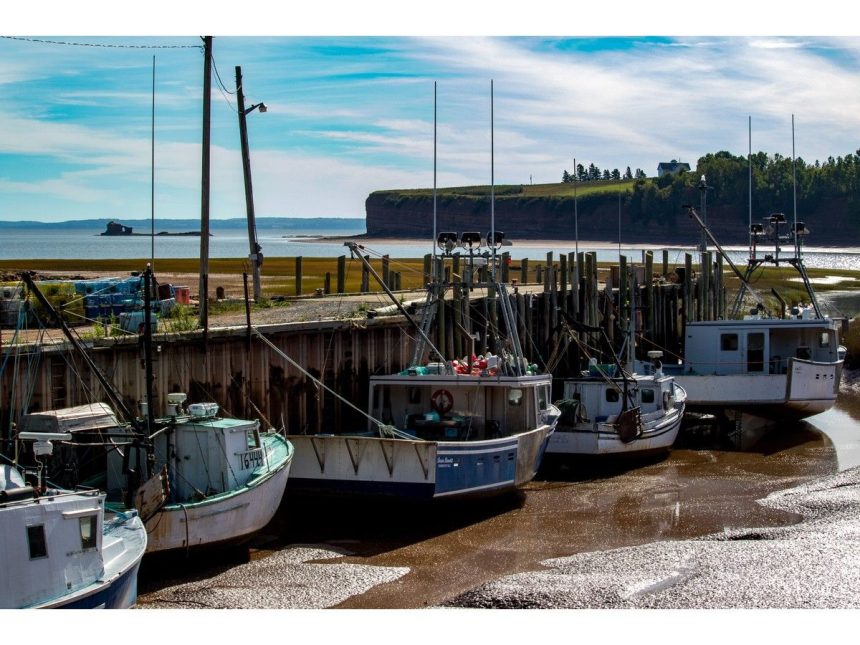
Published Aug 14, 2026Last updated 18 minutes ago5 minute readLow tide in the Minas Basin at Parrsboro, N.S. Twice each day, about 14 billion tonnes of water moving at speeds of more than five metres per second is funnelled through the Minas Passage, a narrow channel in the eastern part of the Bay of Fundy. Photo by Mike Drew /PostmediaArticle contentUsing a different approach to developing tidal energy in the Bay of Fundy, the Nova Scotia government is opening the door to small-scale demonstration projects that could test emerging technologies while feeding electricity into the provincial grid.THIS CONTENT IS RESERVED FOR SUBSCRIBERS ONLY.Subscribe now to access this story and more:Unlimited access to the website and appExclusive access to premium content, newsletters and podcastsFull access to the e-Edition app, an electronic replica of the print edition that you can share, download and comment onEnjoy insights and behind-the-scenes analysis from our award-winning journalistsSupport local journalists and the next generation of journalistsSUBSCRIBE TO UNLOCK MORE ARTICLES.Subscribe or sign in to your account to continue your reading experience.Unlimited access to the website and appExclusive access to premium content, newsletters and podcastsFull access to the e-Edition app, an electronic replica of the print edition that you can share, download and comment onEnjoy insights and behind-the-scenes analysis from our award-winning journalistsSupport local journalists and the next generation of journalistsRegister to unlock more articles.Create an account or sign in to continue your reading experience.Access additional stories every monthShare your thoughts and join the conversation in our commenting communityGet email updates from your favourite authorsSign In or Create an AccountorArticle contentThe province is accepting proposals for tidal power projects capable of generating up to two megawatts each. Projects must be connected to the local power grid, with up to 7.7 megawatts of total capacity available through the program.Article contentArticle contentArticle contentApplications are open until the end of September.Article content“We are opening up a unique chance to explore new energy technologies in the Bay of Fundy,” Nova Scotia Energy Minister Marco MacLeod said in a news release. “As we work to make Nova Scotia a clean energy superpower, this program will help us learn more about the potential for marine renewable energy.”Article content Equipment is transported to the FORCE site in the Minas Passage off the shore of Parrsboro, N.S. Photo by Fundy Ocean Research Centre for EnergyArticle contentSuccessful applicants will receive demonstration permits lasting up to five years, with opportunities for renewal.Article contentThe program is intended to create a pathway for smaller projects to be deployed in the Bay of Fundy and connected to the grid, giving companies an opportunity to evaluate emerging tidal technologies in real-world conditions while collecting technical, operational and environmental data, a Province of Nova Scotia news release said.Article contentLindsay Bennett is executive director of the Fundy Ocean Research Centre for Energy (FORCE), a not-for-profit research and testing facility for tidal stream energy located near Parrsboro, N.S., which is 186 kilometres northwest of Halifax. She said the opportunity could help diversify the province’s tidal energy sector.Article contentArticle content“A diverse tidal sector helps everyone,” Bennett said in an email.Article contentArticle content“A big part of any new commercial technology is supply chain expertise, and the more we get Canadian companies working on more than one project – with different turbines, deployment approaches, moorings – the stronger our industry gets.Article content“It also makes sense to have a number of paths into the water; a chance to prove newer technologies with smaller projects. Community-scale projects can have real community benefit, a chance for local vessels, technicians and other businesses to take part, and with lower financial risks to navigate.”Article contentHighest tides, highest potentialArticle contentThe Bay of Fundy is home to the world’s highest tides and is viewed as a potentially significant source of clean, predictable electricity.Article contentTwice each day, about 14 billion tonnes of water moving at speeds of more than five metres per second is funnelled through the Minas Passage, a narrow channel in the eastern part of the Bay of Fundy.Article contentThe powerful currents are among the strongest tidal flows in the world. Industry estimates suggest the Minas Passage could eventually generate as much as 2,500 megawatts of renewable electricity.Article contentNova Scotia has long viewed tidal energy as an opportunity to produce clean electricity while stimulating manufacturing and marine engineering activity. Developing that resource commercially has proven to be difficult.Article contentThe extreme conditions that make the Bay of Fundy attractive for renewable energy also create significant engineering challenges. Several tidal projects have struggled with the passage’s powerful currents, underscoring the technical, financial and regulatory hurdles that accompany development in such an extreme environment.Article content A view of the Minas Passage from the Fundy Ocean Research Centre for Energy site near Parrsboro, N.S. Photo by FORCEArticle content“The question isn’t whether a tidal turbine can generate electricity anymore: We know it can,” Bennett said. “The work now is figuring out how you move safely, responsibly and economically from one device to several, and eventually to commercial arrays. That’s the stage the industry is in.Article contentArticle content“There are lots of challenges. The Bay of Fundy is an incredible energy resource precisely because the conditions are so extreme. This enormous energy resource is also a complex ecosystem and a sacred Mi’kmaw watershed. The bar is high: To address the engineering and operational challenges, to respect and meaningfully include rights holders and other partners, to secure the financing, to meet the regulatory requirements and answer the environmental questions.”Article contentBennett added that tidal power also offers a potential advantage as the province looks to increase its reliance on renewable electricity. Wind and solar generation can fluctuate depending on weather conditions and daylight. Tidal currents, by contrast, are highly predictable.Article content“There are also challenges this sector is designed to respond to, the same challenge every grid with a growing share of renewables faces: variability,” Bennett said.Article content“Wind and solar generation can fluctuate from hour to hour, depending on weather and daylight. Tidal currents, on the other hand, are steady and predictable, delivering energy four times a day guaranteed.”Article contentArticle contentFORCE test siteArticle contentFORCE was established in 2009 and provides specialized infrastructure for connecting tidal energy devices to the provincial power grid. The organization operates what it describes as North America’s leading test site for tidal stream energy technologies.Article contentThe facility is located about 10 kilometres west of Parrsboro and includes offshore and onshore electrical infrastructure capable of connecting tidal devices to the grid.Article contentFORCE’s infrastructure is designed for 30 megawatts of capacity, about half of one per cent of the estimated total tidal resource in the Bay of Fundy.Article contentBennett said the sector still has room for new technologies and business models.Article content“This offering from Nova Scotia could help open doors to more projects like that across Canada,” she said.Article content“We have plenty of opportunities for small-scale devices across the country, in remote communities that rely on diesel or fuel oil for electricity, and where solar and onshore wind can be intermittent.”Article contentIndustry progressArticle contentBennett noted that in Haida Gwaii, off the northern coast of British Columbia, a project is using a 500-kilowatt turbine to displace diesel generation.Article contentThe commercialization of tidal power has been making progress internationally, Bennett said, with projects increasingly moving beyond the demonstration phase.Article content“Tidal energy is starting to move from demonstration to deployment,” she said.Article content“Scotland has a multi-device array in operation in Pentland Firth. And Orbital Marine Power . . . have had their O2 – the world’s most powerful turbine (anchored off the Orkney Islands in Scotland) – in operation since 2021.Article content“France is directly funding a grid-connected tidal farm. The Faroe Islands, Ireland, (South) Korea and Japan are all supporting tidal testing and innovation. We also have a new regulatory approach in Canada that enables deployments of multiple devices.Article contentArticle content The Fundy Ocean Research Centre for Energy visitor centre near Parrsboro, N.S. Photo by FORCEArticle content“The questions are evolving from ‘Will it work?’ to ‘How many can we build, sustainably?’ and ‘Who will lead the scale-up?’”Article contentThe province says applications will be assessed on project readiness, technical capability, environmental considerations, innovation and the applicant’s experience.Article contentFor companies considering a project, Bennett said getting a tidal device into the water requires substantial commitment.Article content“Meeting the technical, regulatory and financial demands to put a project together takes commitment,” she said.Article content“There are some very experienced tidal companies out there. If they can deliver a technology solution here, responsibly, if they have the staying power to get something in the water, keep it operating, pay their bills and monitor fish interactions, I think it’s in Nova Scotia’s interest to add a seat at the table for them.Article content“We look forward to seeing who will apply. There are many companies out there.”Article content
Nova Scotia opens door to small-scale tidal power projects in Bay of Fundy