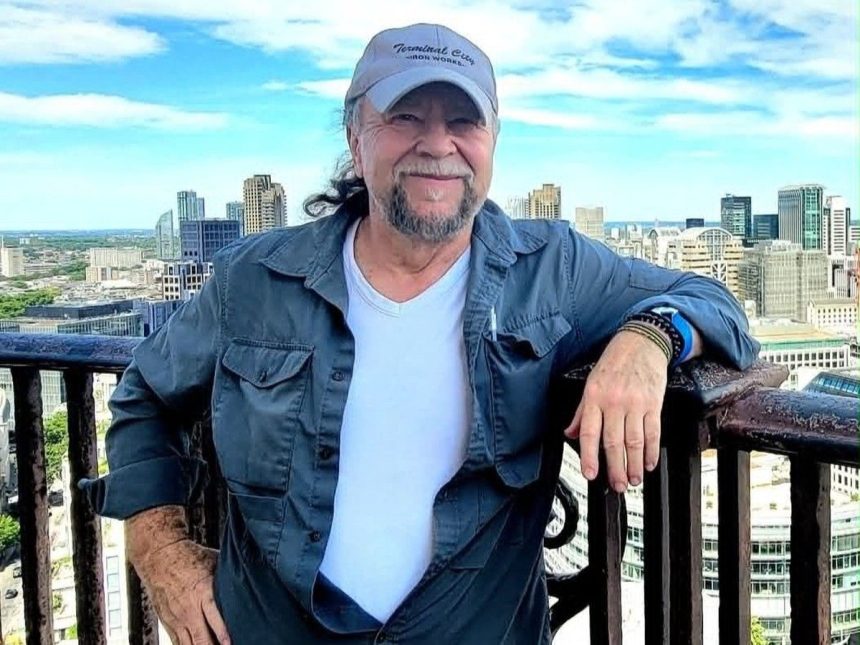
Gerard Curtis spent from April to July with the last group students to attend the UK campusPublished Aug 20, 2026Last updated 21 minutes ago9 minute readGerard Curtis believes that MUN’s Harlow Campus in the UK still has a future despite the university’s plan to sell it. Curtis has brought over 400 visual arts students from Grenfell Campus in Corner Brook to study at Harlow over the course of 17 years. CONTRIBUTEDArticle contentGerard Curtis has been teaching visual arts at Memorial University’s Grenfell Campus in Corner Brook for 34 years.THIS CONTENT IS RESERVED FOR SUBSCRIBERS ONLY.Subscribe now to access this story and more:Unlimited access to the website and appExclusive access to premium content, newsletters and podcastsFull access to the e-Edition app, an electronic replica of the print edition that you can share, download and comment onEnjoy insights and behind-the-scenes analysis from our award-winning journalistsSupport local journalists and the next generation of journalistsSUBSCRIBE TO UNLOCK MORE ARTICLES.Subscribe or sign in to your account to continue your reading experience.Unlimited access to the website and appExclusive access to premium content, newsletters and podcastsFull access to the e-Edition app, an electronic replica of the print edition that you can share, download and comment onEnjoy insights and behind-the-scenes analysis from our award-winning journalistsSupport local journalists and the next generation of journalistsRegister to unlock more articles.Create an account or sign in to continue your reading experience.Access additional stories every monthShare your thoughts and join the conversation in our commenting communityGet email updates from your favourite authorsSign In or Create an AccountorArticle contentDuring that time there have been 17 years when the professor of visual culture and art history has taken groups of students to study abroad for a semester at the university’s Harlow Campus in the United Kingdom.Article contentArticle content Grenfell Campus professor Gerard Curtis lectures to the last group of students to study at MUN’s Harlow Campus outside the Natural History Museum in London. CONTRIBUTEDArticle contentWith Memorial University (MUN) planning to close and sell the campus, that opportunity will be no more, but Curtis said it doesn’t have to be that way, and that Harlow still has a future.Article contentArticle contentMUN has operated the Harlow Campus, located in the town of Old Harlow in the county of Essex, since 1969.Article contentMUN President Janet Morrison has said the decision to close and sell the campus is a financial one. The cost of operating the campus is around $1 million a year, and it is in need of about $2 million in maintenance.Article contentCurtis thinks MUN’s decision to close the campus is shortsighted.Article content“They’re going after low hanging fruit in a way to make them look good to the government and to the auditor general,” he told The Telegram on Wednesday, Aug. 19, 2026.Article contentHe said the campus has had a series of problematic directors.Article content“There were a series of issues that I think they were trying to cover up and just didn’t want to deal with,” said Curtis.Article contentHe said things have changed under the new director who has come in and made more money for the campus in six months than others have in the previous 16 years.Article content“So, we’re seeing sort of what the difference between really good directorship of the campus is and what poor directorship was in some ways,” said Curtis.Article contentArticle content“I got the feeling that it was an attempt to really cover up past sins rather than deal with them and try to make the campus really work in the way it’s meant to work.”Article contentCAMPUS HAS BEEN WELL ATTENDEDArticle contentCurtis has brought over 400 visual arts students to Harlow.Article contentBesides those students, Harlow has also accommodated hundreds more students in a wide range of programs including communication studies, theatre, biology, business, kinesiology, social cultural studies and English literature.Article contentThe campus has an enrolment capacity of 153 students per year, but in an article that she wrote for The Gazette, Morrison said occupancy rates have been well below that over the last decade.Article contentCurtis takes issue with the data MUN uses on usage of the campus. He calls it “false data.”Article contentHe said the new director pumped up the real data on usage on social media and was told to take it down.Article content“They were saying it was only 36 students using the campus at any one time. In fact, there’s been 108 to 120 students at times using the campus.”Article content Gerard Curtis is a professor of visual culture and art history at Grenfell Campus in Corner Brook. CONTRIBUTEDArticle contentBENEFITS FOR STUDENTSArticle contentFor his students, Curtis said they get to go to “probably one of the hottest art markets in the world.”Article contentThey get to see and experience the largest contemporary art museum in the world and visit loads of galleries. They get to talk a lot about architecture and urban planning, and a lot about that background and the history architecture.Article contentFor Indigenous students Curtis said, “it’s sort of going to the heart of colonialism,” and they’re getting to see that from a very different perspective.Article contentThe students spend three months at the campus and study six days a week.Article contentThey get a nine-day break partway through, and Curtis said family members and partners of the students will often visit for that time.Article contentHe brought the last group to ever use the campus over in April.Article contentThere were 27 in the group and Curtis said he doesn’t normally take that many but decided to open this final trip to anyone who wanted to go.Article contentThe group finished up in mid-July and shortly after that a group of 21 alumni joined him at the campus.Article contentArticle content“Getting to see the alumni from all over the years come out and celebrate all the accomplishments they’ve achieved because of Harlow was a fantastic experience as well.Article content“And they closed out the campus effectively,” said Curtis.Article content“It was the same experience; it’s just a different experience.”Article contentSCALED DOWNArticle contentOperations have already been scaled down at the campus, and the staffing level has been reduced, but Curtis said they still went above and beyond for the students and other visitors.Article content“And you know they were facing the fact that they were facing redundancies, that the campus was going to close Aug. 31. They could have left, just walked away and gotten other jobs, and they stayed on to make sure the students had a great time.Article content“Kudos to them, they did an outstanding job,” said Curtis.Article content‘DOESN’T NEED TO HAPPEN’Article contentCurtis said being at the campus for the last time was a bittersweet feeling for him.Article content“But it’s also like this doesn’t need to happen.”Article contentHe said this is something that with creativity and imagination could be changed. The new director, he said, has been making money for the campus and had $30,000 pounds worth of bookings going into October and November that he was told to cancel.Article contentArticle contentHe alleged the university wants to portray it as losing money to justify the sale.Article contentCurtis said others see the value in the campus and noted that Tom Cooper, an associate professor in Memorial’s Faculty of Business, has put forward a plan for the campus.Article contentCurtis said supporters of the campus are advocating that at this point in time when the federal government is turning away from the U.S., that trying to create greater links with the European Union, and particularly England, should be pursued more.Article content“This is the perfect time and opportunity to actually use the campus for social political connections,” said Curtis, adding that it sits on a really strongly developing interchange between London and Cambridge, which is considered the Silicon Valley of Europe.Article content“So, it’s in a prime location to develop links with the sciences and business in the UK,” he said.Article content“But again, imaginative and creative ways of thinking about the campus are really important. Not simply the sort of grey people model of accountants cutting things, which is really how the university is being run at the moment, versus you could look at this campus in a way to make it financially viable.”Article contentSomething he reiterated that the new director is doing.Article content“So, it’s obvious you know that it’s not a financial burden. It can be made successful, but it just needs the support and creative vision and insight to foster that along, and that’s not happening at the university at the moment,” said Curtis.Article contentSo, while the end of August and the campus closure is approaching, Curtis said it’s not the end.Article contentHe said the university has to get federal approval for the sale. Once that comes, it has to offer the campus to another educational institution for six to nine months before putting it on the market.Article contentHe also said the facility may also require expensive asbestos abatement.Article content“So, there’s ongoing issues that I tend to think we have another year or so that we can rescue the facility and turn it into what it should be,” said Curtis.Article content Keziah Turney got to see a lot of famous architecture during her time studying at MUN’s Harlow Campus in the UK. Visiting Buckingham Palace was definitely on the Grenfell Campus student’s list of must sees. CONTRIBUTEDArticle contentA STUDENT’S PERSPECTIVEArticle contentKeziah Turney was one of the last visual arts students from Grenfell to go to Harlow with Curtis.Article contentTurney, 21, is from St. John’s and about to enter her fourth and final year of study in the visual arts program.Article contentArticle content“Growing up I always had a love for art,” Turney told The Telegram.Article contentIt’s a love she eventually wants to share with others as a teacher.Article content“I just love art and everything that it comes with and the way you can express yourself with it,” she said.Article contentWhen she finished high school, Turney had been planning to attend university in New Brunswick. About a month and a half before she was supposed to leave, she applied to Grenfell.Article content“It was closer to home and I thought it would be a good experience for me to be able to stay somewhat close to home but also be able to adventure beyond home and live by myself and kind of get that experience,” she said.Article contentTurney didn’t know about the option to study at Harlow until after she arrived at Grenfell.Article content“I had no idea that it was something that existed. I thought it was an amazing opportunity. It’s not something that you see very often. It’s usually not part of the school programme and I thought it was something that was really, really cool and a great experience for people to be able to go and do that.”Article contentArticle contentTurney can now say that’s exactly what the experience was for her after studying art history at Harlow.Article content“You have an appreciation for art history for when you’re learning it in class and when you’re seeing it, but being able to go over there and see certain things in person and experience it is a whole different level of appreciation,” she said.Article content“And, I think, that experience has made me want to do more with art history in my career.Article content“I loved all the museums that we got to go into and experience all the different artworks of all different genres. I thought that was really, really cool.”Article contentTurney said it was especially cool to see the paintings of really popular high artists in person.Article content“It’s a way different level. There’s just so much in the UK to be able to see and experience, and it’s truly amazing,” said Turney.Article content Keziah Turney of St. John’s was one of the last students to study at MUN’s Harlow Campus in the UK. CONTRIBUTEDArticle contentPART OF THE LAST CLASSArticle content“Knowing we were the last group to go over there was just sad, because what we did experience was amazing. And I think it’s an experience of a lifetime, and you kind of can’t get that experience back or anywhere else because what we learnt over there we wouldn’t be able to learn the same in Corner Brook sitting in a classroom.Article content“Going and seeing certain buildings and the architecture on them and paintings in museums, you can’t do that from a classroom. So, the experience just completely adds to it, being able to go and do those things,” said Turney.Article content“It is quite sad that no one else will be able to enjoy that and have that same experience.”Article contentTurney thinks the Harlow closure could have an effect on students choosing to study at Grenfell.Article content“I heard people that I even went with saying ‘I wasn’t going to go to Grenfell without this experience,’ because they had known about it beforehand.Article content“So, I think it may be a drawback for people wanting to go over there.”Article contentMEMORIAL UNIVERSITY RESPONSEArticle contentIn July, Memorial University told The Telegram that it was completing due diligence with the sale of the campus and associated components.Article content“A property valuation has been completed, and we’re now focused on asset management and preparations for decommissioning,” said the university in an email.Article contentAt the time there were three full-time and two part-time staff members at the campus.Article contentArticle content“Memorial recognizes the special attachment people have to Harlow, and we’re glad these experiences have been part of our legacy. However, Memorial can offer students an equally rich international learning experience, without owning and operating a building in the UK that can accommodate, at most, 153 students annually.Article content“We have partnerships in place with more than 180 universities in over 50 countries. Also, net proceeds from the sale of the Harlow Campus property will be reinvested to ensure global learning opportunities are more accessible and equitable for a broader array of students from Newfoundland and Labrador,” said the university.Article contentThe email also noted the cost of operating the campus and the maintenance required.Article content“Efforts to capitalize on alternate revenue generation opportunities have had very limited success. It is also important to note that UK immigration laws have changed since Memorial acquired Harlow Campus, and these restrictions prevent Canadian faculty from teaching full semesters at Harlow,” said the university.Article content
Grenfell professor believes MUN’s Harlow Campus still has a future